
Furry Book Reviews

The Furry Book Review - LiveJournal.com
Updated: 8 hours 40 min ago
Beautiful World: Fast, Fun, Evocative Read
Beautiful World by Kristina Tracer is a near-future sci-fi erotic suspense novel.
Here, a company has created Irokai, a virtual-reality world that's a cross between the Matrix and Second Life. It's very reminiscent of Snow Crash's metaverse, except that Irokai is self-contained system; if you want to access it, you have to go to one of the company's buildings and hook up. While in the real world everyone is a human, for some reason in Irokai everyone is an anthropomorphic animal. Also inside Irokai, there are AI programs who self-develop - they aren't programmed so much as grown, so they operate on an independent level, unaware of their code.
The story follows Johnathan, an artist who is in love with one of the AI programs inside Irokai. He has gotten a job with the company to design a new area in-world. There is a process that allows Johnathan to actually be permanently uploaded into the Irokai database - his body dies but his personality, memories, etc are uploaded into Irokai, making him a permanent resident. This way John can live with his love.
Yet all is not well in the land of Irokai. Because this is a private company running the show, everything costs money. Want to teleport instead of walk? That's a charge. Want to design a mod for your avatar? That's a charge. Want to eat something? That's a charge. Included in the charges are things like the Residents of Irokai (those AI programs and the people who have uploaded themselves) have to pay rent in order to be kept online. If they don't, they are just backed up and turned off. This is causing some issues of civil rights, of being taxed to live, and there's a revolution afoot.
Once the big events get underway, the story takes off. When the other shoe drops, it's like a hole blown in an airplane, sucking you out under its power. I felt a real "Uh oh" when we see what's really going on, and the final stretch had a solid urgency that left me turning the pages as quickly as I could.
One thing about the novel is that like many other books in the Fandom (Out of Position, Shadow of the Father, Thousand Leaves), each chapter is from the perspective of one of our cast of characters. We see from the perspective of every relevant character to our plot.
As far as the writing is concerned, the author does a good job with her prose. I never had a problem, I saw no real errors, and everything that is described is evocative and visible without too much detail spent on it. The author's demonstration of the world is nice. It feels like another world, and there is continual consistency throughout. Furthermore, the manner that Irokai's parent company milks customers for every dime feels very realistic.
A pleasant surprise to me was that actual transsexual issues came up. This is one of the first novels that I've seen that even bothers to acknowledge TG, much less have a compelling character with those issues.
Initially I had thought that Beautiful World was a straight novel, but I was surprised when there was an M/M/F scene later in the book.
Most of the faults with the novel are minor. We spend four chapters (out of a 200 book) dedicated to the subplot of John uploading himself into the world. That's a lot of book real estate for a subplot that doesn't feel that tense. The sex scenes are brief but unnecessary - the novel would have lost nothing had the author just chosen to fade to black instead. Certain scenes (the two between John and Adam) come off as... is there a literary version of "overacting"? They come off as chewing the scenery. But these are the only scenes that seem this way. Finally, the issue comes with the final scene of the novel, where we learn the Villain's true motivation for what occurs, and when we learn his motivation, reflecting back on his past actions seem to show a lack of consistency. Or rather a, "If that's what the villain wanted, then why did he do x in this scene, not Y?" Also the reaction to this revelation is somewhat out of left field - there were no warning signs for it.
The real disappointment of the novel is its brevity. I wanted to know more about the world. For instance, John uploads himself into Irokai, leaving his body behind. What happens to the body? What about John's parents - what do they think of this decision? Also in Irokai, even the programs/AI desire food and sleep. Why? A novel has much more space to explore the world of the story, a little more time to get into the lives of those involved, and I wish the author had taken advantage of that space.
The book's brevity also hampers its plot structure. The first half of the book is really devoted to introducing us to the characters, the world, as well as getting us familiar with the plot's underlying situation. Once all the pieces are out on the board, events get underway and then escalate a little too fast. Had there been more of a lead-up, with increased intensity, the big events and the crunch time of the novel would have had a bigger payoff.
Thus the book feels a tad underfed and bony.
The Kindle version is $5. It's well worth that price - I liked the book, it's a nice read and the flaws don't outweigh the overall positive weight.
Here, a company has created Irokai, a virtual-reality world that's a cross between the Matrix and Second Life. It's very reminiscent of Snow Crash's metaverse, except that Irokai is self-contained system; if you want to access it, you have to go to one of the company's buildings and hook up. While in the real world everyone is a human, for some reason in Irokai everyone is an anthropomorphic animal. Also inside Irokai, there are AI programs who self-develop - they aren't programmed so much as grown, so they operate on an independent level, unaware of their code.
The story follows Johnathan, an artist who is in love with one of the AI programs inside Irokai. He has gotten a job with the company to design a new area in-world. There is a process that allows Johnathan to actually be permanently uploaded into the Irokai database - his body dies but his personality, memories, etc are uploaded into Irokai, making him a permanent resident. This way John can live with his love.
Yet all is not well in the land of Irokai. Because this is a private company running the show, everything costs money. Want to teleport instead of walk? That's a charge. Want to design a mod for your avatar? That's a charge. Want to eat something? That's a charge. Included in the charges are things like the Residents of Irokai (those AI programs and the people who have uploaded themselves) have to pay rent in order to be kept online. If they don't, they are just backed up and turned off. This is causing some issues of civil rights, of being taxed to live, and there's a revolution afoot.
Once the big events get underway, the story takes off. When the other shoe drops, it's like a hole blown in an airplane, sucking you out under its power. I felt a real "Uh oh" when we see what's really going on, and the final stretch had a solid urgency that left me turning the pages as quickly as I could.
One thing about the novel is that like many other books in the Fandom (Out of Position, Shadow of the Father, Thousand Leaves), each chapter is from the perspective of one of our cast of characters. We see from the perspective of every relevant character to our plot.
As far as the writing is concerned, the author does a good job with her prose. I never had a problem, I saw no real errors, and everything that is described is evocative and visible without too much detail spent on it. The author's demonstration of the world is nice. It feels like another world, and there is continual consistency throughout. Furthermore, the manner that Irokai's parent company milks customers for every dime feels very realistic.
A pleasant surprise to me was that actual transsexual issues came up. This is one of the first novels that I've seen that even bothers to acknowledge TG, much less have a compelling character with those issues.
Initially I had thought that Beautiful World was a straight novel, but I was surprised when there was an M/M/F scene later in the book.
Most of the faults with the novel are minor. We spend four chapters (out of a 200 book) dedicated to the subplot of John uploading himself into the world. That's a lot of book real estate for a subplot that doesn't feel that tense. The sex scenes are brief but unnecessary - the novel would have lost nothing had the author just chosen to fade to black instead. Certain scenes (the two between John and Adam) come off as... is there a literary version of "overacting"? They come off as chewing the scenery. But these are the only scenes that seem this way. Finally, the issue comes with the final scene of the novel, where we learn the Villain's true motivation for what occurs, and when we learn his motivation, reflecting back on his past actions seem to show a lack of consistency. Or rather a, "If that's what the villain wanted, then why did he do x in this scene, not Y?" Also the reaction to this revelation is somewhat out of left field - there were no warning signs for it.
The real disappointment of the novel is its brevity. I wanted to know more about the world. For instance, John uploads himself into Irokai, leaving his body behind. What happens to the body? What about John's parents - what do they think of this decision? Also in Irokai, even the programs/AI desire food and sleep. Why? A novel has much more space to explore the world of the story, a little more time to get into the lives of those involved, and I wish the author had taken advantage of that space.
The book's brevity also hampers its plot structure. The first half of the book is really devoted to introducing us to the characters, the world, as well as getting us familiar with the plot's underlying situation. Once all the pieces are out on the board, events get underway and then escalate a little too fast. Had there been more of a lead-up, with increased intensity, the big events and the crunch time of the novel would have had a bigger payoff.
Thus the book feels a tad underfed and bony.
The Kindle version is $5. It's well worth that price - I liked the book, it's a nice read and the flaws don't outweigh the overall positive weight.
Beautiful World: Fast, Fun, Evocative Read
Beautiful World by Kristina Tracer is a near-future sci-fi erotic suspense novel.
Here, a company has created Irokai, a virtual-reality world that's a cross between the Matrix and Second Life. It's very reminiscent of Snow Crash's metaverse, except that Irokai is self-contained system; if you want to access it, you have to go to one of the company's buildings and hook up. While in the real world everyone is a human, for some reason in Irokai everyone is an anthropomorphic animal. Also inside Irokai, there are AI programs who self-develop - they aren't programmed so much as grown, so they operate on an independent level, unaware of their code.
The story follows Johnathan, an artist who is in love with one of the AI programs inside Irokai. He has gotten a job with the company to design a new area in-world. There is a process that allows Johnathan to actually be permanently uploaded into the Irokai database - his body dies but his personality, memories, etc are uploaded into Irokai, making him a permanent resident. This way John can live with his love.
Yet all is not well in the land of Irokai. Because this is a private company running the show, everything costs money. Want to teleport instead of walk? That's a charge. Want to design a mod for your avatar? That's a charge. Want to eat something? That's a charge. Included in the charges are things like the Residents of Irokai (those AI programs and the people who have uploaded themselves) have to pay rent in order to be kept online. If they don't, they are just backed up and turned off. This is causing some issues of civil rights, of being taxed to live, and there's a revolution afoot.
Once the big events get underway, the story takes off. When the other shoe drops, it's like a hole blown in an airplane, sucking you out under its power. I felt a real "Uh oh" when we see what's really going on, and the final stretch had a solid urgency that left me turning the pages as quickly as I could.
One thing about the novel is that like many other books in the Fandom (Out of Position, Shadow of the Father, Thousand Leaves), each chapter is from the perspective of one of our cast of characters. We see from the perspective of every relevant character to our plot.
As far as the writing is concerned, the author does a good job with her prose. I never had a problem, I saw no real errors, and everything that is described is evocative and visible without too much detail spent on it. The author's demonstration of the world is nice. It feels like another world, and there is continual consistency throughout. Furthermore, the manner that Irokai's parent company milks customers for every dime feels very realistic.
A pleasant surprise to me was that actual transsexual issues came up. This is one of the first novels that I've seen that even bothers to acknowledge TG, much less have a compelling character with those issues.
Initially I had thought that Beautiful World was a straight novel, but I was surprised when there was an M/M/F scene later in the book.
Most of the faults with the novel are minor. We spend four chapters (out of a 200 book) dedicated to the subplot of John uploading himself into the world. That's a lot of book real estate for a subplot that doesn't feel that tense. The sex scenes are brief but unnecessary - the novel would have lost nothing had the author just chosen to fade to black instead. Certain scenes (the two between John and Adam) come off as... is there a literary version of "overacting"? They come off as chewing the scenery. But these are the only scenes that seem this way. Finally, the issue comes with the final scene of the novel, where we learn the Villain's true motivation for what occurs, and when we learn his motivation, reflecting back on his past actions seem to show a lack of consistency. Or rather a, "If that's what the villain wanted, then why did he do x in this scene, not Y?" Also the reaction to this revelation is somewhat out of left field - there were no warning signs for it.
The real disappointment of the novel is its brevity. I wanted to know more about the world. For instance, John uploads himself into Irokai, leaving his body behind. What happens to the body? What about John's parents - what do they think of this decision? Also in Irokai, even the programs/AI desire food and sleep. Why? A novel has much more space to explore the world of the story, a little more time to get into the lives of those involved, and I wish the author had taken advantage of that space.
The book's brevity also hampers its plot structure. The first half of the book is really devoted to introducing us to the characters, the world, as well as getting us familiar with the plot's underlying situation. Once all the pieces are out on the board, events get underway and then escalate a little too fast. Had there been more of a lead-up, with increased intensity, the big events and the crunch time of the novel would have had a bigger payoff.
Thus the book feels a tad underfed and bony.
The Kindle version is $5. It's well worth that price - I liked the book, it's a nice read and the flaws don't outweigh the overall positive weight.
Here, a company has created Irokai, a virtual-reality world that's a cross between the Matrix and Second Life. It's very reminiscent of Snow Crash's metaverse, except that Irokai is self-contained system; if you want to access it, you have to go to one of the company's buildings and hook up. While in the real world everyone is a human, for some reason in Irokai everyone is an anthropomorphic animal. Also inside Irokai, there are AI programs who self-develop - they aren't programmed so much as grown, so they operate on an independent level, unaware of their code.
The story follows Johnathan, an artist who is in love with one of the AI programs inside Irokai. He has gotten a job with the company to design a new area in-world. There is a process that allows Johnathan to actually be permanently uploaded into the Irokai database - his body dies but his personality, memories, etc are uploaded into Irokai, making him a permanent resident. This way John can live with his love.
Yet all is not well in the land of Irokai. Because this is a private company running the show, everything costs money. Want to teleport instead of walk? That's a charge. Want to design a mod for your avatar? That's a charge. Want to eat something? That's a charge. Included in the charges are things like the Residents of Irokai (those AI programs and the people who have uploaded themselves) have to pay rent in order to be kept online. If they don't, they are just backed up and turned off. This is causing some issues of civil rights, of being taxed to live, and there's a revolution afoot.
Once the big events get underway, the story takes off. When the other shoe drops, it's like a hole blown in an airplane, sucking you out under its power. I felt a real "Uh oh" when we see what's really going on, and the final stretch had a solid urgency that left me turning the pages as quickly as I could.
One thing about the novel is that like many other books in the Fandom (Out of Position, Shadow of the Father, Thousand Leaves), each chapter is from the perspective of one of our cast of characters. We see from the perspective of every relevant character to our plot.
As far as the writing is concerned, the author does a good job with her prose. I never had a problem, I saw no real errors, and everything that is described is evocative and visible without too much detail spent on it. The author's demonstration of the world is nice. It feels like another world, and there is continual consistency throughout. Furthermore, the manner that Irokai's parent company milks customers for every dime feels very realistic.
A pleasant surprise to me was that actual transsexual issues came up. This is one of the first novels that I've seen that even bothers to acknowledge TG, much less have a compelling character with those issues.
Initially I had thought that Beautiful World was a straight novel, but I was surprised when there was an M/M/F scene later in the book.
Most of the faults with the novel are minor. We spend four chapters (out of a 200 book) dedicated to the subplot of John uploading himself into the world. That's a lot of book real estate for a subplot that doesn't feel that tense. The sex scenes are brief but unnecessary - the novel would have lost nothing had the author just chosen to fade to black instead. Certain scenes (the two between John and Adam) come off as... is there a literary version of "overacting"? They come off as chewing the scenery. But these are the only scenes that seem this way. Finally, the issue comes with the final scene of the novel, where we learn the Villain's true motivation for what occurs, and when we learn his motivation, reflecting back on his past actions seem to show a lack of consistency. Or rather a, "If that's what the villain wanted, then why did he do x in this scene, not Y?" Also the reaction to this revelation is somewhat out of left field - there were no warning signs for it.
The real disappointment of the novel is its brevity. I wanted to know more about the world. For instance, John uploads himself into Irokai, leaving his body behind. What happens to the body? What about John's parents - what do they think of this decision? Also in Irokai, even the programs/AI desire food and sleep. Why? A novel has much more space to explore the world of the story, a little more time to get into the lives of those involved, and I wish the author had taken advantage of that space.
The book's brevity also hampers its plot structure. The first half of the book is really devoted to introducing us to the characters, the world, as well as getting us familiar with the plot's underlying situation. Once all the pieces are out on the board, events get underway and then escalate a little too fast. Had there been more of a lead-up, with increased intensity, the big events and the crunch time of the novel would have had a bigger payoff.
Thus the book feels a tad underfed and bony.
The Kindle version is $5. It's well worth that price - I liked the book, it's a nice read and the flaws don't outweigh the overall positive weight.
Animorphs
here's a series that i'm surprised nobody has reviewed.
Animorphs
author: k.a. applegate (and ghostwriters)
rating: 5 stars out of 5
the animorphs series is about a group of kids who are dragged into the middle of an intergalactic war, taking place right here on earth. they cut through a construction site one night, only to be the unsuspecting witness to the death of an alien warrior. before he died, he gave these children the power to morph into any animal that they can touch. spanning more than 60 novels, this series follows the adventures of these children as they fight against the alien invasion, and how the decisions they make while fighting this war affect them. watch as these characters confront issues of morality versus expediency, and how the death of both friend and enemy will change how they see the world. this series is extremely well written, showing how different people from different backgrounds deal with stresses in different ways. the reluctant leader, the warrior, the caring heart, the comedian, and the loner face the world together, grow together, and grow apart, all in a believable background. this was one of my favorite series as a kid, and is probably most directly responsible for me finding the fandom in the first place. see kids just like you used to be face their own dark side, and learn that the world is full of shades of grey. will they even survive?
Animorphs
author: k.a. applegate (and ghostwriters)
rating: 5 stars out of 5
the animorphs series is about a group of kids who are dragged into the middle of an intergalactic war, taking place right here on earth. they cut through a construction site one night, only to be the unsuspecting witness to the death of an alien warrior. before he died, he gave these children the power to morph into any animal that they can touch. spanning more than 60 novels, this series follows the adventures of these children as they fight against the alien invasion, and how the decisions they make while fighting this war affect them. watch as these characters confront issues of morality versus expediency, and how the death of both friend and enemy will change how they see the world. this series is extremely well written, showing how different people from different backgrounds deal with stresses in different ways. the reluctant leader, the warrior, the caring heart, the comedian, and the loner face the world together, grow together, and grow apart, all in a believable background. this was one of my favorite series as a kid, and is probably most directly responsible for me finding the fandom in the first place. see kids just like you used to be face their own dark side, and learn that the world is full of shades of grey. will they even survive?
Animorphs
here's a series that i'm surprised nobody has reviewed.
Animorphs
author: k.a. applegate (and ghostwriters)
rating: 5 stars out of 5
the animorphs series is about a group of kids who are dragged into the middle of an intergalactic war, taking place right here on earth. they cut through a construction site one night, only to be the unsuspecting witness to the death of an alien warrior. before he died, he gave these children the power to morph into any animal that they can touch. spanning more than 60 novels, this series follows the adventures of these children as they fight against the alien invasion, and how the decisions they make while fighting this war affect them. watch as these characters confront issues of morality versus expediency, and how the death of both friend and enemy will change how they see the world. this series is extremely well written, showing how different people from different backgrounds deal with stresses in different ways. the reluctant leader, the warrior, the caring heart, the comedian, and the loner face the world together, grow together, and grow apart, all in a believable background. this was one of my favorite series as a kid, and is probably most directly responsible for me finding the fandom in the first place. see kids just like you used to be face their own dark side, and learn that the world is full of shades of grey. will they even survive?
Animorphs
author: k.a. applegate (and ghostwriters)
rating: 5 stars out of 5
the animorphs series is about a group of kids who are dragged into the middle of an intergalactic war, taking place right here on earth. they cut through a construction site one night, only to be the unsuspecting witness to the death of an alien warrior. before he died, he gave these children the power to morph into any animal that they can touch. spanning more than 60 novels, this series follows the adventures of these children as they fight against the alien invasion, and how the decisions they make while fighting this war affect them. watch as these characters confront issues of morality versus expediency, and how the death of both friend and enemy will change how they see the world. this series is extremely well written, showing how different people from different backgrounds deal with stresses in different ways. the reluctant leader, the warrior, the caring heart, the comedian, and the loner face the world together, grow together, and grow apart, all in a believable background. this was one of my favorite series as a kid, and is probably most directly responsible for me finding the fandom in the first place. see kids just like you used to be face their own dark side, and learn that the world is full of shades of grey. will they even survive?
Basecraft Cirrostratus
Basecraft Cirrostratus
Justin Lamar
FurPlanet
Even by themselves, the terms “amateur,” “adult,” and “furry” can all give one pause when it comes to fiction; when all three apply to the same work, there can be even more reason for hesitation. Still, when it's only a mere ten bucks to see whether someone's debut novella is any good, it can be worth it to gamble from time to time, and in this case, for the most part, that gamble has paid off.
Basecraft Cirrostratus tells the story of Elor Kaya, an esteemed professor who is wanted for sedition and indoctrination against a totalitarian regime. Fleeing the country with the secret police hot on his tail, he escapes into self-imposed exile aboard the titular Basecraft Cirrostratus, a massive flying machine that operates in international airspace. Once there, he seeks out the only connection he has left: Vinz, his ex-lover from a decade prior.
Problem is, Vinz doesn't want anything to do with Elor anymore, having moved on both personally as well as romantically. Instead, Elor is forced to turn to the organized crime syndicate that acts as the true power within the decks of the Basecraft Cirrostratus, which, as it turns out, is home to many a political refugee aside from Elor.
The plot itself is actually quite solid and very breezy. The pacing is good, with events never dragging and the story never going off the rails. Lamar clearly has a good handle on the setting, and the political backdrop and behind-the-scenes machinations play very well into the events of the book as they unfold. Things get a little heavy-handed at some points, but only very occasionally, and it's never bad enough to induce eye-rolling. The ending lacks some emotional punch simply because the emotional framework didn't have time to develop thoroughly enough during the course of the plot, but the plot itself does have an arc (as do the characters, to be fair). On two notable instances, dumb luck sees things through where it would have been preferable to have direct action on the characters' part, but for the most part, the plot itself stays together fairly well.
When it comes to amateur writers, one of the biggest pitfalls one usually comes across is the author belaboring points too much, or taking too long to say what needs to be said. Here, though, I had the opposite problem: much of the time, I wanted the author to slow down and take some more time to build on things, especially as they related to the characters and their relationships. For example, there's a love triangle that serves as an emotional focus for much of the story; I definitely bought into one of the relationships, but not the other—we're told that they're in love, but it never really comes across on the page. A bit of a textbook example for the caution of “show, don't tell,” which might have been avoided if more time were taken to develop things.
This is also an adult story, with the erotic aspects being entirely male/male. Sex, though, happens on page as something that's important between the characters, and (with one marked exception near the very end) it's never gratuitous, and it serves itself as part of the story and not a goal of it. Most of the sex scenes are actually pretty tasteful, and, like much of the rest of the book, never slow things down at the expense of the plot.
The best thing I can say about the book is that it's very cinematic. With the right special effects (and maybe a little less on-screen sex), this would actually make a fairly decent action thriller flick, the kind you watch with a big tub of popcorn without needing the story to shatter and rewrite your world.
In the end, Basecraft Cirrostratus bears some hallmarks of amateur writing, but when taken as a whole, it does more things right than it does wrong. It's good—not great, but certainly not bad, and Lamar certainly shows promise for future offerings. If it were maybe half again as long, with some more time spent making some of the character relationships a little more believable, and if the point of view were a bit tighter (it gets kind of loose in some points), Basecraft Cirrostratus could have been better. Still, as-is, if you're the kind of person looking for a dieselpunk action thriller and don't mind some gay sex and relationship drama thrown in along the way, you could do worse than check this book out.
Justin Lamar
FurPlanet
Even by themselves, the terms “amateur,” “adult,” and “furry” can all give one pause when it comes to fiction; when all three apply to the same work, there can be even more reason for hesitation. Still, when it's only a mere ten bucks to see whether someone's debut novella is any good, it can be worth it to gamble from time to time, and in this case, for the most part, that gamble has paid off.
Basecraft Cirrostratus tells the story of Elor Kaya, an esteemed professor who is wanted for sedition and indoctrination against a totalitarian regime. Fleeing the country with the secret police hot on his tail, he escapes into self-imposed exile aboard the titular Basecraft Cirrostratus, a massive flying machine that operates in international airspace. Once there, he seeks out the only connection he has left: Vinz, his ex-lover from a decade prior.
Problem is, Vinz doesn't want anything to do with Elor anymore, having moved on both personally as well as romantically. Instead, Elor is forced to turn to the organized crime syndicate that acts as the true power within the decks of the Basecraft Cirrostratus, which, as it turns out, is home to many a political refugee aside from Elor.
The plot itself is actually quite solid and very breezy. The pacing is good, with events never dragging and the story never going off the rails. Lamar clearly has a good handle on the setting, and the political backdrop and behind-the-scenes machinations play very well into the events of the book as they unfold. Things get a little heavy-handed at some points, but only very occasionally, and it's never bad enough to induce eye-rolling. The ending lacks some emotional punch simply because the emotional framework didn't have time to develop thoroughly enough during the course of the plot, but the plot itself does have an arc (as do the characters, to be fair). On two notable instances, dumb luck sees things through where it would have been preferable to have direct action on the characters' part, but for the most part, the plot itself stays together fairly well.
When it comes to amateur writers, one of the biggest pitfalls one usually comes across is the author belaboring points too much, or taking too long to say what needs to be said. Here, though, I had the opposite problem: much of the time, I wanted the author to slow down and take some more time to build on things, especially as they related to the characters and their relationships. For example, there's a love triangle that serves as an emotional focus for much of the story; I definitely bought into one of the relationships, but not the other—we're told that they're in love, but it never really comes across on the page. A bit of a textbook example for the caution of “show, don't tell,” which might have been avoided if more time were taken to develop things.
This is also an adult story, with the erotic aspects being entirely male/male. Sex, though, happens on page as something that's important between the characters, and (with one marked exception near the very end) it's never gratuitous, and it serves itself as part of the story and not a goal of it. Most of the sex scenes are actually pretty tasteful, and, like much of the rest of the book, never slow things down at the expense of the plot.
The best thing I can say about the book is that it's very cinematic. With the right special effects (and maybe a little less on-screen sex), this would actually make a fairly decent action thriller flick, the kind you watch with a big tub of popcorn without needing the story to shatter and rewrite your world.
In the end, Basecraft Cirrostratus bears some hallmarks of amateur writing, but when taken as a whole, it does more things right than it does wrong. It's good—not great, but certainly not bad, and Lamar certainly shows promise for future offerings. If it were maybe half again as long, with some more time spent making some of the character relationships a little more believable, and if the point of view were a bit tighter (it gets kind of loose in some points), Basecraft Cirrostratus could have been better. Still, as-is, if you're the kind of person looking for a dieselpunk action thriller and don't mind some gay sex and relationship drama thrown in along the way, you could do worse than check this book out.
Basecraft Cirrostratus
Basecraft Cirrostratus
Justin Lamar
FurPlanet
Even by themselves, the terms “amateur,” “adult,” and “furry” can all give one pause when it comes to fiction; when all three apply to the same work, there can be even more reason for hesitation. Still, when it's only a mere ten bucks to see whether someone's debut novella is any good, it can be worth it to gamble from time to time, and in this case, for the most part, that gamble has paid off.
Basecraft Cirrostratus tells the story of Elor Kaya, an esteemed professor who is wanted for sedition and indoctrination against a totalitarian regime. Fleeing the country with the secret police hot on his tail, he escapes into self-imposed exile aboard the titular Basecraft Cirrostratus, a massive flying machine that operates in international airspace. Once there, he seeks out the only connection he has left: Vinz, his ex-lover from a decade prior.
Problem is, Vinz doesn't want anything to do with Elor anymore, having moved on both personally as well as romantically. Instead, Elor is forced to turn to the organized crime syndicate that acts as the true power within the decks of the Basecraft Cirrostratus, which, as it turns out, is home to many a political refugee aside from Elor.
The plot itself is actually quite solid and very breezy. The pacing is good, with events never dragging and the story never going off the rails. Lamar clearly has a good handle on the setting, and the political backdrop and behind-the-scenes machinations play very well into the events of the book as they unfold. Things get a little heavy-handed at some points, but only very occasionally, and it's never bad enough to induce eye-rolling. The ending lacks some emotional punch simply because the emotional framework didn't have time to develop thoroughly enough during the course of the plot, but the plot itself does have an arc (as do the characters, to be fair). On two notable instances, dumb luck sees things through where it would have been preferable to have direct action on the characters' part, but for the most part, the plot itself stays together fairly well.
When it comes to amateur writers, one of the biggest pitfalls one usually comes across is the author belaboring points too much, or taking too long to say what needs to be said. Here, though, I had the opposite problem: much of the time, I wanted the author to slow down and take some more time to build on things, especially as they related to the characters and their relationships. For example, there's a love triangle that serves as an emotional focus for much of the story; I definitely bought into one of the relationships, but not the other—we're told that they're in love, but it never really comes across on the page. A bit of a textbook example for the caution of “show, don't tell,” which might have been avoided if more time were taken to develop things.
This is also an adult story, with the erotic aspects being entirely male/male. Sex, though, happens on page as something that's important between the characters, and (with one marked exception near the very end) it's never gratuitous, and it serves itself as part of the story and not a goal of it. Most of the sex scenes are actually pretty tasteful, and, like much of the rest of the book, never slow things down at the expense of the plot.
The best thing I can say about the book is that it's very cinematic. With the right special effects (and maybe a little less on-screen sex), this would actually make a fairly decent action thriller flick, the kind you watch with a big tub of popcorn without needing the story to shatter and rewrite your world.
In the end, Basecraft Cirrostratus bears some hallmarks of amateur writing, but when taken as a whole, it does more things right than it does wrong. It's good—not great, but certainly not bad, and Lamar certainly shows promise for future offerings. If it were maybe half again as long, with some more time spent making some of the character relationships a little more believable, and if the point of view were a bit tighter (it gets kind of loose in some points), Basecraft Cirrostratus could have been better. Still, as-is, if you're the kind of person looking for a dieselpunk action thriller and don't mind some gay sex and relationship drama thrown in along the way, you could do worse than check this book out.
Justin Lamar
FurPlanet
Even by themselves, the terms “amateur,” “adult,” and “furry” can all give one pause when it comes to fiction; when all three apply to the same work, there can be even more reason for hesitation. Still, when it's only a mere ten bucks to see whether someone's debut novella is any good, it can be worth it to gamble from time to time, and in this case, for the most part, that gamble has paid off.
Basecraft Cirrostratus tells the story of Elor Kaya, an esteemed professor who is wanted for sedition and indoctrination against a totalitarian regime. Fleeing the country with the secret police hot on his tail, he escapes into self-imposed exile aboard the titular Basecraft Cirrostratus, a massive flying machine that operates in international airspace. Once there, he seeks out the only connection he has left: Vinz, his ex-lover from a decade prior.
Problem is, Vinz doesn't want anything to do with Elor anymore, having moved on both personally as well as romantically. Instead, Elor is forced to turn to the organized crime syndicate that acts as the true power within the decks of the Basecraft Cirrostratus, which, as it turns out, is home to many a political refugee aside from Elor.
The plot itself is actually quite solid and very breezy. The pacing is good, with events never dragging and the story never going off the rails. Lamar clearly has a good handle on the setting, and the political backdrop and behind-the-scenes machinations play very well into the events of the book as they unfold. Things get a little heavy-handed at some points, but only very occasionally, and it's never bad enough to induce eye-rolling. The ending lacks some emotional punch simply because the emotional framework didn't have time to develop thoroughly enough during the course of the plot, but the plot itself does have an arc (as do the characters, to be fair). On two notable instances, dumb luck sees things through where it would have been preferable to have direct action on the characters' part, but for the most part, the plot itself stays together fairly well.
When it comes to amateur writers, one of the biggest pitfalls one usually comes across is the author belaboring points too much, or taking too long to say what needs to be said. Here, though, I had the opposite problem: much of the time, I wanted the author to slow down and take some more time to build on things, especially as they related to the characters and their relationships. For example, there's a love triangle that serves as an emotional focus for much of the story; I definitely bought into one of the relationships, but not the other—we're told that they're in love, but it never really comes across on the page. A bit of a textbook example for the caution of “show, don't tell,” which might have been avoided if more time were taken to develop things.
This is also an adult story, with the erotic aspects being entirely male/male. Sex, though, happens on page as something that's important between the characters, and (with one marked exception near the very end) it's never gratuitous, and it serves itself as part of the story and not a goal of it. Most of the sex scenes are actually pretty tasteful, and, like much of the rest of the book, never slow things down at the expense of the plot.
The best thing I can say about the book is that it's very cinematic. With the right special effects (and maybe a little less on-screen sex), this would actually make a fairly decent action thriller flick, the kind you watch with a big tub of popcorn without needing the story to shatter and rewrite your world.
In the end, Basecraft Cirrostratus bears some hallmarks of amateur writing, but when taken as a whole, it does more things right than it does wrong. It's good—not great, but certainly not bad, and Lamar certainly shows promise for future offerings. If it were maybe half again as long, with some more time spent making some of the character relationships a little more believable, and if the point of view were a bit tighter (it gets kind of loose in some points), Basecraft Cirrostratus could have been better. Still, as-is, if you're the kind of person looking for a dieselpunk action thriller and don't mind some gay sex and relationship drama thrown in along the way, you could do worse than check this book out.
Save the Day Review
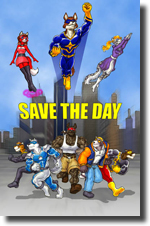
Save the Day Review
Back Text: Jay Carson loves his boyfriend Ted Rodriguez. They’ve been together through the difficult times and the great times, and they’ve grown closer together through it all. They finally have a home together. So why does it seem that Ted is keeping secrets from him? Why does the house always feel so empty?
In a world of superheroes and supervillains, where the incredible can happen every day, the triumphs and tragedies of life can be epic. For Jay and Ted, friendship, love, and home are the most important things in the world, but they must find a way to balance them against the truth of Ted’s life. In the end, will they be able to Save the Day?
Review:
First of all, this is a gay story. Not only is it a gay story, but one about coming to terms with the opinions of those around you, and the repercussions of coming out of the closet. However, it is not a run-of-the-mill “coming out” story. Ted and Jay are already in a long-term, domestic relationship. However, Ted's a bit of a closet case, due to demons in his past and his paranoia about the opinions of his coworkers. Even in a world where superheroes, villains, and mad science is common, prejudice still runs rampant.
This world of superheroes reads like an open love letter/marriage proposal to the Golden and Silver Age of DC Comics. Super-strong heroes, insane, over-the-top villains abound, and every now and then someone beats up a Nazi. Analogs to Superman, Wonder Woman, and the Flash are all present, but done in just the right way to stick on the right side of the barrier between homage and ripoff. The powers of the main and secondary characters remain fresh, breathing new life into the genre. This is not a “Watchmen” world, where everyone with the exception of Dr. Manhattan is just a supercop. This is the Extraordinaries, and they can freeze, blind, or confuse you into submission.
Emotions remain consistently high, strong, and believable throughout the story. Ted and Jay's relationship feels organic, and their bickering or arguments do not feel forced. There is remarkably little melodrama for the subject matter, with most of the angst coming from Ted's internal fears. As for the secondary characters, almost all are quite believable characters (with the exception of a certain straight friend, who may be the most understanding straight man ever).
D.J. Fahl, most of all, understands that there is a certain level of ridiculousness present in superhero fiction. Along with neo-Nazis and villains that make you relive your most painful memories (two of the most powerful scenes, by the way), there are the downright goofy villains that prance around in fluorescent capes with death rays and lightning gloves, spouting monologues and then cackle with unrestrained glee. Jokes about tights and buns of steel appear throughout, giving it a light tone between crises.
However, the novel is not without its flaws. Since the story is written in first person, when the perspective switches between chapters or sections it can be jarring. Some of the stream-of-consciousness sections read somewhat clunky. English mistakes pepper the project; for example, D.J. Fahl reverses “than” and “then”, which makes the English-teacher part of my brain scream in agony, but the mistake is at least consistent. There are never enough mistakes to take away from the story, however.
Bottom Line: “Save the Day” is one of the best pieces of gay fiction I've read, and one of the best books in the furry fandom, despite its flaws. Pick it up at http://furplanet.com/shop/item.aspx?itemid=437
"Clan Ground" by Clare Bell
I had the good fortune to meet Clare Bell at Further Confusion. I'd read "Ratha's Creature" a long time ago and so I knew her by reputation only, but she proved to be a delightful person and a very savvy author. We did a panel on making worlds furry and had a great time doing it. And she wanted to read one of my books! *swoon* So it seemed only fair that I return the favor.
"Clan Ground" is the second in the "Named" series about a tribe of intelligent jungle cats (fully feline, not anthropomorphic in any way other than speech and thought). Ratha, having brought fire back to her tribe and, by her mastery of it, assumed leadership of the tribe, is now faced with the problem of how to integrate this new power into the life of her clan. Certain clan-members are designated Fire-Keepers, set to tend the fire and guard the perimeter of the clan ground. Others are herders, keeping the tribe's domesticated food supply in line. This division seems to be working pretty well until an outsider comes into the tribe, seeking shelter. The clan takes him in, and soon he is working with the Fire-Keepers, seeming to have a good feel for how to work with fire.
Meanwhile, Thakur, one of the herders Ratha is close to has taken to exploring, and has befriended a small tree-climber, which seems to be a lemur-type critter. He brings it back to the clan and discovers that its hands are very useful for tending fire. The idea of letting a tree-creature near the fire is uncomfortable for many, so he trains it in secret.
Things heat up--ha ha--as the new clan member begins to be more aggressive. The division between the Fire-Keepers and the herders becomes more pronounced. And Ratha needs to take the next step, from simply leading her clan to becoming a true leader.
The book is told alternately between Ratha's viewpoint and Thakur's, a narrative style I've become fond of recently. It serves in this case to highlight the changes the clan is going through, from the incorporation of fire to the acceptance of this outsider to the introduction of the tree-creatures. You get a very good sense from the story of a clan in turmoil, set loose from many of their traditions, and the struggle many of the cats go through in trying to deal with it. When you have no learning to guide you, you have to make your own path, and that is what Ratha turns out to be good at. (Though it wouldn't be as exciting a novel if she didn't make a few mistakes along the way.)
Bell builds personal stories into these philosophical ones as well: Ratha's uncertainty about her leadership, Thakur's search for companionship, the difficulty the clan has in maintaining the line between the Named and the outsiders, who have no intelligent thought. The main characters are all well-defined, and even the side characters are rendered well. I found myself quite engaged in the story, and even a couple weeks after finishing, I can remember the uncertain young Fire-Keeper Bira, the headstrong Fessran, the lonely and quick-witted Thakur.
The thing I found most admirable about the book, though, is the way Bell avoids the trap of absolute rights and wrongs. The outsider, Orange-Eyes, is neither good nor evil. Ratha herself makes mistakes. The book allows the characters to grow and learn, and the difference in the end is who can make the best decisions for the whole clan. That makes the whole thing feel more real, and like the best furry stories, it's a relevant, human story, even though the protagonists are jungle cats.
It was some fifteen years between reading the first and second books of the "Named" series. It won't be that long between the second and third, I can promise that.
"Clan Ground" is the second in the "Named" series about a tribe of intelligent jungle cats (fully feline, not anthropomorphic in any way other than speech and thought). Ratha, having brought fire back to her tribe and, by her mastery of it, assumed leadership of the tribe, is now faced with the problem of how to integrate this new power into the life of her clan. Certain clan-members are designated Fire-Keepers, set to tend the fire and guard the perimeter of the clan ground. Others are herders, keeping the tribe's domesticated food supply in line. This division seems to be working pretty well until an outsider comes into the tribe, seeking shelter. The clan takes him in, and soon he is working with the Fire-Keepers, seeming to have a good feel for how to work with fire.
Meanwhile, Thakur, one of the herders Ratha is close to has taken to exploring, and has befriended a small tree-climber, which seems to be a lemur-type critter. He brings it back to the clan and discovers that its hands are very useful for tending fire. The idea of letting a tree-creature near the fire is uncomfortable for many, so he trains it in secret.
Things heat up--ha ha--as the new clan member begins to be more aggressive. The division between the Fire-Keepers and the herders becomes more pronounced. And Ratha needs to take the next step, from simply leading her clan to becoming a true leader.
The book is told alternately between Ratha's viewpoint and Thakur's, a narrative style I've become fond of recently. It serves in this case to highlight the changes the clan is going through, from the incorporation of fire to the acceptance of this outsider to the introduction of the tree-creatures. You get a very good sense from the story of a clan in turmoil, set loose from many of their traditions, and the struggle many of the cats go through in trying to deal with it. When you have no learning to guide you, you have to make your own path, and that is what Ratha turns out to be good at. (Though it wouldn't be as exciting a novel if she didn't make a few mistakes along the way.)
Bell builds personal stories into these philosophical ones as well: Ratha's uncertainty about her leadership, Thakur's search for companionship, the difficulty the clan has in maintaining the line between the Named and the outsiders, who have no intelligent thought. The main characters are all well-defined, and even the side characters are rendered well. I found myself quite engaged in the story, and even a couple weeks after finishing, I can remember the uncertain young Fire-Keeper Bira, the headstrong Fessran, the lonely and quick-witted Thakur.
The thing I found most admirable about the book, though, is the way Bell avoids the trap of absolute rights and wrongs. The outsider, Orange-Eyes, is neither good nor evil. Ratha herself makes mistakes. The book allows the characters to grow and learn, and the difference in the end is who can make the best decisions for the whole clan. That makes the whole thing feel more real, and like the best furry stories, it's a relevant, human story, even though the protagonists are jungle cats.
It was some fifteen years between reading the first and second books of the "Named" series. It won't be that long between the second and third, I can promise that.
"Clan Ground" by Clare Bell
I had the good fortune to meet Clare Bell at Further Confusion. I'd read "Ratha's Creature" a long time ago and so I knew her by reputation only, but she proved to be a delightful person and a very savvy author. We did a panel on making worlds furry and had a great time doing it. And she wanted to read one of my books! *swoon* So it seemed only fair that I return the favor.
"Clan Ground" is the second in the "Named" series about a tribe of intelligent jungle cats (fully feline, not anthropomorphic in any way other than speech and thought). Ratha, having brought fire back to her tribe and, by her mastery of it, assumed leadership of the tribe, is now faced with the problem of how to integrate this new power into the life of her clan. Certain clan-members are designated Fire-Keepers, set to tend the fire and guard the perimeter of the clan ground. Others are herders, keeping the tribe's domesticated food supply in line. This division seems to be working pretty well until an outsider comes into the tribe, seeking shelter. The clan takes him in, and soon he is working with the Fire-Keepers, seeming to have a good feel for how to work with fire.
Meanwhile, Thakur, one of the herders Ratha is close to has taken to exploring, and has befriended a small tree-climber, which seems to be a lemur-type critter. He brings it back to the clan and discovers that its hands are very useful for tending fire. The idea of letting a tree-creature near the fire is uncomfortable for many, so he trains it in secret.
Things heat up--ha ha--as the new clan member begins to be more aggressive. The division between the Fire-Keepers and the herders becomes more pronounced. And Ratha needs to take the next step, from simply leading her clan to becoming a true leader.
The book is told alternately between Ratha's viewpoint and Thakur's, a narrative style I've become fond of recently. It serves in this case to highlight the changes the clan is going through, from the incorporation of fire to the acceptance of this outsider to the introduction of the tree-creatures. You get a very good sense from the story of a clan in turmoil, set loose from many of their traditions, and the struggle many of the cats go through in trying to deal with it. When you have no learning to guide you, you have to make your own path, and that is what Ratha turns out to be good at. (Though it wouldn't be as exciting a novel if she didn't make a few mistakes along the way.)
Bell builds personal stories into these philosophical ones as well: Ratha's uncertainty about her leadership, Thakur's search for companionship, the difficulty the clan has in maintaining the line between the Named and the outsiders, who have no intelligent thought. The main characters are all well-defined, and even the side characters are rendered well. I found myself quite engaged in the story, and even a couple weeks after finishing, I can remember the uncertain young Fire-Keeper Bira, the headstrong Fessran, the lonely and quick-witted Thakur.
The thing I found most admirable about the book, though, is the way Bell avoids the trap of absolute rights and wrongs. The outsider, Orange-Eyes, is neither good nor evil. Ratha herself makes mistakes. The book allows the characters to grow and learn, and the difference in the end is who can make the best decisions for the whole clan. That makes the whole thing feel more real, and like the best furry stories, it's a relevant, human story, even though the protagonists are jungle cats.
It was some fifteen years between reading the first and second books of the "Named" series. It won't be that long between the second and third, I can promise that.
"Clan Ground" is the second in the "Named" series about a tribe of intelligent jungle cats (fully feline, not anthropomorphic in any way other than speech and thought). Ratha, having brought fire back to her tribe and, by her mastery of it, assumed leadership of the tribe, is now faced with the problem of how to integrate this new power into the life of her clan. Certain clan-members are designated Fire-Keepers, set to tend the fire and guard the perimeter of the clan ground. Others are herders, keeping the tribe's domesticated food supply in line. This division seems to be working pretty well until an outsider comes into the tribe, seeking shelter. The clan takes him in, and soon he is working with the Fire-Keepers, seeming to have a good feel for how to work with fire.
Meanwhile, Thakur, one of the herders Ratha is close to has taken to exploring, and has befriended a small tree-climber, which seems to be a lemur-type critter. He brings it back to the clan and discovers that its hands are very useful for tending fire. The idea of letting a tree-creature near the fire is uncomfortable for many, so he trains it in secret.
Things heat up--ha ha--as the new clan member begins to be more aggressive. The division between the Fire-Keepers and the herders becomes more pronounced. And Ratha needs to take the next step, from simply leading her clan to becoming a true leader.
The book is told alternately between Ratha's viewpoint and Thakur's, a narrative style I've become fond of recently. It serves in this case to highlight the changes the clan is going through, from the incorporation of fire to the acceptance of this outsider to the introduction of the tree-creatures. You get a very good sense from the story of a clan in turmoil, set loose from many of their traditions, and the struggle many of the cats go through in trying to deal with it. When you have no learning to guide you, you have to make your own path, and that is what Ratha turns out to be good at. (Though it wouldn't be as exciting a novel if she didn't make a few mistakes along the way.)
Bell builds personal stories into these philosophical ones as well: Ratha's uncertainty about her leadership, Thakur's search for companionship, the difficulty the clan has in maintaining the line between the Named and the outsiders, who have no intelligent thought. The main characters are all well-defined, and even the side characters are rendered well. I found myself quite engaged in the story, and even a couple weeks after finishing, I can remember the uncertain young Fire-Keeper Bira, the headstrong Fessran, the lonely and quick-witted Thakur.
The thing I found most admirable about the book, though, is the way Bell avoids the trap of absolute rights and wrongs. The outsider, Orange-Eyes, is neither good nor evil. Ratha herself makes mistakes. The book allows the characters to grow and learn, and the difference in the end is who can make the best decisions for the whole clan. That makes the whole thing feel more real, and like the best furry stories, it's a relevant, human story, even though the protagonists are jungle cats.
It was some fifteen years between reading the first and second books of the "Named" series. It won't be that long between the second and third, I can promise that.
Shadow of the Father Review
Well, it's later than I really hoped, but it's still the first review up on  furrybookreview.
Kyell's new book, Shadow of the Father, released this January at Further Confusion. Fans of Kyell have been following production for quite some time, starting with daily updated word counts on kyellgold's livejournal during initial writing phases, and some bonus content in the form of journal entries written from the perspective of yilon, the main character. There's also been a pre-release review posted on Weasel Wordsmith by jakebe.
At this point, there's quite a bit of back story established in modern Argaea, to say nothing of the historical events alluded to in the various novels and short stories. Jakabe felt in his review that Shadow is still a good entry point even if you aren't familiar with the history of Argaea, told in the novels Volle, Pendant of Fortune, Prisoner's Release and Other Stories as well as a few other short stories scattered here and there. I somewhat disagree. While you wouldn't by any means be lost in the book if you haven't read any previous work, the characters would make less sense. At minimum, I would recommend at least reading Pendant of Fortune and Yilon's journal before picking up this book.
Shadow starts up right away with Yilon, second son of Volle being named as successor to lordship of the country of Dewanne, and establishing Yilon's intimate relationship with Sinchon, a mouse, which sets up a wide range of conflict over the course of the book. As an aside, although the two characters are technically 'of age', that equates to roughly 16, which makes the few sex scenes ever so slightly uncomfortable to this aging reader. I hope no one calls the pedobear on me. In all fairness, the sex scenes are not written for the titillation of the reader, but to illustrate the relationship between the two characters.
The various tensions caused by Yilon's relationship with Sinch are mostly underplayed, subservient to the main plot of the book, something which could be described as a rip-roaring adventure yarn--At least those would be the word's you'd use to write a cliche back cover blurb for young-adult novels. While a tad too explicit to truly qualify for the young-adult stamp, in plot and structure, this really is a classic bildungsroman, a coming of age story wrapped around an adventure in a foreign land. The basic outline is that Yilon makes a few mistakes in the beginning due to inexperience, rashness, and impetuousness, i.e. youth, and spends the rest of the book learning why what he did was a mistake and trying to fix it.
The book is quite a departure from Kyell's other novels in that it has a much more active plot, and between Yilon's story arc and Sinch's story arc there is much less room for the characters to examine their motivations, to develop and grow organically over the course of the book as in previous books. The time frame of the narrative is so compressed that this sort of slow build and change is just not possible. I think that's part of why having the background from the previous Argaea novels and short stories is that much more vital to this book. Yilon is very much his father's son, and it holds up better if the reader knows it.
Overall, it's a very excellent book. The return to Argaea with a new generation revitalizes the setting for me, even as Volle's brief appearance cements in my mind that his narrative arc is coming to a close. I've read the book twice already, and I'll likely read it again in the coming months.
That said however, as a reviewer, I do feel I need to bring up a few points I had issue with. While this book has action and adventure, it feels a little bit like the rough edges have been trimmed up, the points filed off, the sharp corners sanded down. It's a bit like a roller coaster, which may have a thrilling design, but never puts you in genuine peril. The language of danger in this book is somewhat toned down. For those familiar with film terminology, the Foley effects are missing. Missing is the dull twock of an arrow hitting a body, the almost inaudible drip of blood from a wound falling into a puddle. It's almost PG-13. This comes from a couple different places, partially from the tropes of the coming of age novel, partially from the balance Kyell struck between plot advancement and character development, but it is also put into sharp relief by the contrast between Shadow of the Father and Seventh Chakra, which I reviewed earlier.
Both books are good in their own way, but they have a number of similar plot points, which invite rather direct comparison. Reading the two back to back (literally, as I sat on airplanes and in airports on the way home from FC) one can't help but make comparisons between the two. It was after I started re-reading Shadow that I was able to articulate why Chakra resonated with me more. This part has little to do with the quality of the book itself, but rather my own reactions as a reader. I pointed out a couple times already that Shadow is very much about young characters, as well as using some tropes common in fiction for young-adults, and I have premature old-man syndrome--I'm crotchety, cynical, and want you to get off my lawn. That makes it only natural that I wind up gravitating more toward the gritty and hard-boiled adventure.
In truth, none of the issues I had with the book can honestly be called faults of the book so much as a difference between myself and the intended audience. It certainly didn't detract from my enjoyment of the story as the pages flew beneath my fingers. This is definitely another solid piece from Kyell, the superhero. I seriously don't know how he manages to get all of this done and still have time for half the stuff he does in the fandom, much less having an actual job, too. If you weren't able to be at FC to pick it up in person, I highly recommend ordering it, or picking it up at first available opportunity.
furrybookreview.Kyell's new book, Shadow of the Father, released this January at Further Confusion. Fans of Kyell have been following production for quite some time, starting with daily updated word counts on
kyellgold's livejournal during initial writing phases, and some bonus content in the form of journal entries written from the perspective of yilon, the main character. There's also been a pre-release review posted on Weasel Wordsmith by jakebe. At this point, there's quite a bit of back story established in modern Argaea, to say nothing of the historical events alluded to in the various novels and short stories. Jakabe felt in his review that Shadow is still a good entry point even if you aren't familiar with the history of Argaea, told in the novels Volle, Pendant of Fortune, Prisoner's Release and Other Stories as well as a few other short stories scattered here and there. I somewhat disagree. While you wouldn't by any means be lost in the book if you haven't read any previous work, the characters would make less sense. At minimum, I would recommend at least reading Pendant of Fortune and Yilon's journal before picking up this book.
Shadow starts up right away with Yilon, second son of Volle being named as successor to lordship of the country of Dewanne, and establishing Yilon's intimate relationship with Sinchon, a mouse, which sets up a wide range of conflict over the course of the book. As an aside, although the two characters are technically 'of age', that equates to roughly 16, which makes the few sex scenes ever so slightly uncomfortable to this aging reader. I hope no one calls the pedobear on me. In all fairness, the sex scenes are not written for the titillation of the reader, but to illustrate the relationship between the two characters.
The various tensions caused by Yilon's relationship with Sinch are mostly underplayed, subservient to the main plot of the book, something which could be described as a rip-roaring adventure yarn--At least those would be the word's you'd use to write a cliche back cover blurb for young-adult novels. While a tad too explicit to truly qualify for the young-adult stamp, in plot and structure, this really is a classic bildungsroman, a coming of age story wrapped around an adventure in a foreign land. The basic outline is that Yilon makes a few mistakes in the beginning due to inexperience, rashness, and impetuousness, i.e. youth, and spends the rest of the book learning why what he did was a mistake and trying to fix it.
The book is quite a departure from Kyell's other novels in that it has a much more active plot, and between Yilon's story arc and Sinch's story arc there is much less room for the characters to examine their motivations, to develop and grow organically over the course of the book as in previous books. The time frame of the narrative is so compressed that this sort of slow build and change is just not possible. I think that's part of why having the background from the previous Argaea novels and short stories is that much more vital to this book. Yilon is very much his father's son, and it holds up better if the reader knows it.
Overall, it's a very excellent book. The return to Argaea with a new generation revitalizes the setting for me, even as Volle's brief appearance cements in my mind that his narrative arc is coming to a close. I've read the book twice already, and I'll likely read it again in the coming months.
That said however, as a reviewer, I do feel I need to bring up a few points I had issue with. While this book has action and adventure, it feels a little bit like the rough edges have been trimmed up, the points filed off, the sharp corners sanded down. It's a bit like a roller coaster, which may have a thrilling design, but never puts you in genuine peril. The language of danger in this book is somewhat toned down. For those familiar with film terminology, the Foley effects are missing. Missing is the dull twock of an arrow hitting a body, the almost inaudible drip of blood from a wound falling into a puddle. It's almost PG-13. This comes from a couple different places, partially from the tropes of the coming of age novel, partially from the balance Kyell struck between plot advancement and character development, but it is also put into sharp relief by the contrast between Shadow of the Father and Seventh Chakra, which I reviewed earlier.
Both books are good in their own way, but they have a number of similar plot points, which invite rather direct comparison. Reading the two back to back (literally, as I sat on airplanes and in airports on the way home from FC) one can't help but make comparisons between the two. It was after I started re-reading Shadow that I was able to articulate why Chakra resonated with me more. This part has little to do with the quality of the book itself, but rather my own reactions as a reader. I pointed out a couple times already that Shadow is very much about young characters, as well as using some tropes common in fiction for young-adults, and I have premature old-man syndrome--I'm crotchety, cynical, and want you to get off my lawn. That makes it only natural that I wind up gravitating more toward the gritty and hard-boiled adventure.
In truth, none of the issues I had with the book can honestly be called faults of the book so much as a difference between myself and the intended audience. It certainly didn't detract from my enjoyment of the story as the pages flew beneath my fingers. This is definitely another solid piece from Kyell, the superhero. I seriously don't know how he manages to get all of this done and still have time for half the stuff he does in the fandom, much less having an actual job, too. If you weren't able to be at FC to pick it up in person, I highly recommend ordering it, or picking it up at first available opportunity.
Shadow of the Father Review
Well, it's later than I really hoped, but it's still the first review up on  furrybookreview.
Kyell's new book, Shadow of the Father, released this January at Further Confusion. Fans of Kyell have been following production for quite some time, starting with daily updated word counts on kyellgold's livejournal during initial writing phases, and some bonus content in the form of journal entries written from the perspective of yilon, the main character. There's also been a pre-release review posted on Weasel Wordsmith by jakebe.
At this point, there's quite a bit of back story established in modern Argaea, to say nothing of the historical events alluded to in the various novels and short stories. Jakabe felt in his review that Shadow is still a good entry point even if you aren't familiar with the history of Argaea, told in the novels Volle, Pendant of Fortune, Prisoner's Release and Other Stories as well as a few other short stories scattered here and there. I somewhat disagree. While you wouldn't by any means be lost in the book if you haven't read any previous work, the characters would make less sense. At minimum, I would recommend at least reading Pendant of Fortune and Yilon's journal before picking up this book.
Shadow starts up right away with Yilon, second son of Volle being named as successor to lordship of the country of Dewanne, and establishing Yilon's intimate relationship with Sinchon, a mouse, which sets up a wide range of conflict over the course of the book. As an aside, although the two characters are technically 'of age', that equates to roughly 16, which makes the few sex scenes ever so slightly uncomfortable to this aging reader. I hope no one calls the pedobear on me. In all fairness, the sex scenes are not written for the titillation of the reader, but to illustrate the relationship between the two characters.
The various tensions caused by Yilon's relationship with Sinch are mostly underplayed, subservient to the main plot of the book, something which could be described as a rip-roaring adventure yarn--At least those would be the word's you'd use to write a cliche back cover blurb for young-adult novels. While a tad too explicit to truly qualify for the young-adult stamp, in plot and structure, this really is a classic bildungsroman, a coming of age story wrapped around an adventure in a foreign land. The basic outline is that Yilon makes a few mistakes in the beginning due to inexperience, rashness, and impetuousness, i.e. youth, and spends the rest of the book learning why what he did was a mistake and trying to fix it.
The book is quite a departure from Kyell's other novels in that it has a much more active plot, and between Yilon's story arc and Sinch's story arc there is much less room for the characters to examine their motivations, to develop and grow organically over the course of the book as in previous books. The time frame of the narrative is so compressed that this sort of slow build and change is just not possible. I think that's part of why having the background from the previous Argaea novels and short stories is that much more vital to this book. Yilon is very much his father's son, and it holds up better if the reader knows it.
Overall, it's a very excellent book. The return to Argaea with a new generation revitalizes the setting for me, even as Volle's brief appearance cements in my mind that his narrative arc is coming to a close. I've read the book twice already, and I'll likely read it again in the coming months.
That said however, as a reviewer, I do feel I need to bring up a few points I had issue with. While this book has action and adventure, it feels a little bit like the rough edges have been trimmed up, the points filed off, the sharp corners sanded down. It's a bit like a roller coaster, which may have a thrilling design, but never puts you in genuine peril. The language of danger in this book is somewhat toned down. For those familiar with film terminology, the Foley effects are missing. Missing is the dull twock of an arrow hitting a body, the almost inaudible drip of blood from a wound falling into a puddle. It's almost PG-13. This comes from a couple different places, partially from the tropes of the coming of age novel, partially from the balance Kyell struck between plot advancement and character development, but it is also put into sharp relief by the contrast between Shadow of the Father and Seventh Chakra, which I reviewed earlier.
Both books are good in their own way, but they have a number of similar plot points, which invite rather direct comparison. Reading the two back to back (literally, as I sat on airplanes and in airports on the way home from FC) one can't help but make comparisons between the two. It was after I started re-reading Shadow that I was able to articulate why Chakra resonated with me more. This part has little to do with the quality of the book itself, but rather my own reactions as a reader. I pointed out a couple times already that Shadow is very much about young characters, as well as using some tropes common in fiction for young-adults, and I have premature old-man syndrome--I'm crotchety, cynical, and want you to get off my lawn. That makes it only natural that I wind up gravitating more toward the gritty and hard-boiled adventure.
In truth, none of the issues I had with the book can honestly be called faults of the book so much as a difference between myself and the intended audience. It certainly didn't detract from my enjoyment of the story as the pages flew beneath my fingers. This is definitely another solid piece from Kyell, the superhero. I seriously don't know how he manages to get all of this done and still have time for half the stuff he does in the fandom, much less having an actual job, too. If you weren't able to be at FC to pick it up in person, I highly recommend ordering it, or picking it up at first available opportunity.
furrybookreview.Kyell's new book, Shadow of the Father, released this January at Further Confusion. Fans of Kyell have been following production for quite some time, starting with daily updated word counts on
kyellgold's livejournal during initial writing phases, and some bonus content in the form of journal entries written from the perspective of yilon, the main character. There's also been a pre-release review posted on Weasel Wordsmith by jakebe. At this point, there's quite a bit of back story established in modern Argaea, to say nothing of the historical events alluded to in the various novels and short stories. Jakabe felt in his review that Shadow is still a good entry point even if you aren't familiar with the history of Argaea, told in the novels Volle, Pendant of Fortune, Prisoner's Release and Other Stories as well as a few other short stories scattered here and there. I somewhat disagree. While you wouldn't by any means be lost in the book if you haven't read any previous work, the characters would make less sense. At minimum, I would recommend at least reading Pendant of Fortune and Yilon's journal before picking up this book.
Shadow starts up right away with Yilon, second son of Volle being named as successor to lordship of the country of Dewanne, and establishing Yilon's intimate relationship with Sinchon, a mouse, which sets up a wide range of conflict over the course of the book. As an aside, although the two characters are technically 'of age', that equates to roughly 16, which makes the few sex scenes ever so slightly uncomfortable to this aging reader. I hope no one calls the pedobear on me. In all fairness, the sex scenes are not written for the titillation of the reader, but to illustrate the relationship between the two characters.
The various tensions caused by Yilon's relationship with Sinch are mostly underplayed, subservient to the main plot of the book, something which could be described as a rip-roaring adventure yarn--At least those would be the word's you'd use to write a cliche back cover blurb for young-adult novels. While a tad too explicit to truly qualify for the young-adult stamp, in plot and structure, this really is a classic bildungsroman, a coming of age story wrapped around an adventure in a foreign land. The basic outline is that Yilon makes a few mistakes in the beginning due to inexperience, rashness, and impetuousness, i.e. youth, and spends the rest of the book learning why what he did was a mistake and trying to fix it.
The book is quite a departure from Kyell's other novels in that it has a much more active plot, and between Yilon's story arc and Sinch's story arc there is much less room for the characters to examine their motivations, to develop and grow organically over the course of the book as in previous books. The time frame of the narrative is so compressed that this sort of slow build and change is just not possible. I think that's part of why having the background from the previous Argaea novels and short stories is that much more vital to this book. Yilon is very much his father's son, and it holds up better if the reader knows it.
Overall, it's a very excellent book. The return to Argaea with a new generation revitalizes the setting for me, even as Volle's brief appearance cements in my mind that his narrative arc is coming to a close. I've read the book twice already, and I'll likely read it again in the coming months.
That said however, as a reviewer, I do feel I need to bring up a few points I had issue with. While this book has action and adventure, it feels a little bit like the rough edges have been trimmed up, the points filed off, the sharp corners sanded down. It's a bit like a roller coaster, which may have a thrilling design, but never puts you in genuine peril. The language of danger in this book is somewhat toned down. For those familiar with film terminology, the Foley effects are missing. Missing is the dull twock of an arrow hitting a body, the almost inaudible drip of blood from a wound falling into a puddle. It's almost PG-13. This comes from a couple different places, partially from the tropes of the coming of age novel, partially from the balance Kyell struck between plot advancement and character development, but it is also put into sharp relief by the contrast between Shadow of the Father and Seventh Chakra, which I reviewed earlier.
Both books are good in their own way, but they have a number of similar plot points, which invite rather direct comparison. Reading the two back to back (literally, as I sat on airplanes and in airports on the way home from FC) one can't help but make comparisons between the two. It was after I started re-reading Shadow that I was able to articulate why Chakra resonated with me more. This part has little to do with the quality of the book itself, but rather my own reactions as a reader. I pointed out a couple times already that Shadow is very much about young characters, as well as using some tropes common in fiction for young-adults, and I have premature old-man syndrome--I'm crotchety, cynical, and want you to get off my lawn. That makes it only natural that I wind up gravitating more toward the gritty and hard-boiled adventure.
In truth, none of the issues I had with the book can honestly be called faults of the book so much as a difference between myself and the intended audience. It certainly didn't detract from my enjoyment of the story as the pages flew beneath my fingers. This is definitely another solid piece from Kyell, the superhero. I seriously don't know how he manages to get all of this done and still have time for half the stuff he does in the fandom, much less having an actual job, too. If you weren't able to be at FC to pick it up in person, I highly recommend ordering it, or picking it up at first available opportunity.
Tales of the Fur Side

Yes, I went to the fur side… and I liked it.
If you don’t know what I’m talking about, I highly suggest you check out Vixyy Fox's latest book, Tales of the Fur Side.
www.lulu.com/content/paperback-book/tales-of-the-fur-side/5484498
It is a wonderful collection of short stories and poems by Vixyy, with beautiful artwork from one of the fandom’s most popular artists, Dark Natasha. I was extremely excited to hear that ANTHRO made this collection available once again, and I made sure to snatch it up as soon as I could. And after reading it, I can’t wait for Vixyy’s next book to come out.
Before I start off this review, I must say that I consider Vixyy a friend and a colleague, but I also really enjoy her writing. Her stories have so much variety to them, and she has a remarkable ability to create lovable characters that make it easy for the reader to loss themselves in the vivid worlds she crafts. Part of what makes Tales of the Fur Side such a delight is Vixyy’s unique style of storytelling, which has all the ingredients needed to make reading a joy. It has a bit of comedy, a hint of tenderness, a pinch of suspense, and just the right amount of sensuality as only Vixyy can do.
My personal favorite from this collection is Puppy Love, the charming tale about a dog who thinks he’s a cat in a canine body. Everything about this story is fantastic, but there were so many other wonderful pieces in this book, including Toth(a story about Anubis’ son, the god of language), The Quiet One(a piece that deals with a touching reunion set in the backdrop of American Indian culture), Anuee of the Plains(the tale of a huntress who must bear enormous responsibility when tragedy befalls her tribe), and the beautiful poems Inter-Species and(my absolute favorite) Vixyy.
Plus, Vixyy manages to come up with one of the coolest ideas for a prologue I’ve ever had the pleasure of reading. It really sets up the entire premise of the book in a brilliant way, and it makes the stories easily accessible to people both inside and outside the fandom. I don’t want to spoil it though, so make sure you head on over to lulu.com, and be sure to pick up your copy of Tales of the Fur Side. You won’t be disappointed.
Tales of the Fur Side
Yes, I went to the fur side… and I liked it.
If you don’t know what I’m talking about, I highly suggest you check out Vixyy Fox's latest book, Tales of the Fur Side.
www.lulu.com/content/paperback-book/tales-of-the-fur-side/5484498
It is a wonderful collection of short stories and poems by Vixyy, with beautiful artwork from one of the fandom’s most popular artists, Dark Natasha. I was extremely excited to hear that ANTHRO made this collection available once again, and I made sure to snatch it up as soon as I could. And after reading it, I can’t wait for Vixyy’s next book to come out.
Before I start off this review, I must say that I consider Vixyy a friend and a colleague, but I also really enjoy her writing. Her stories have so much variety to them, and she has a remarkable ability to create lovable characters that make it easy for the reader to loss themselves in the vivid worlds she crafts. Part of what makes Tales of the Fur Side such a delight is Vixyy’s unique style of storytelling, which has all the ingredients needed to make reading a joy. It has a bit of comedy, a hint of tenderness, a pinch of suspense, and just the right amount of sensuality as only Vixyy can do.
My personal favorite from this collection is Puppy Love, the charming tale about a dog who thinks he’s a cat in a canine body. Everything about this story is fantastic, but there were so many other wonderful pieces in this book, including Toth(a story about Anubis’ son, the god of language), The Quiet One(a piece that deals with a touching reunion set in the backdrop of American Indian culture), Anuee of the Plains(the tale of a huntress who must bear enormous responsibility when tragedy befalls her tribe), and the beautiful poems Inter-Species and(my absolute favorite) Vixyy.
Plus, Vixyy manages to come up with one of the coolest ideas for a prologue I’ve ever had the pleasure of reading. It really sets up the entire premise of the book in a brilliant way, and it makes the stories easily accessible to people both inside and outside the fandom. I don’t want to spoil it though, so make sure you head on over to lulu.com, and be sure to pick up your copy of Tales of the Fur Side. You won’t be disappointed.
Seventh Chakra Book Review
Well, having come back from Fur Con with several hot new properties in my paws, it's time to start the cavalcade of reviews. I'm starting with Kevin Frane's new book The Seventh Chakra.
Simply put, if you read nothing else of the review: Is this book good? Yes. Were this not a text only medium, I could put the proper inflection on that simple 'yes.' As it is, I will have to dig into my bag of allusions to describe it. Try as I might, I can't get the phrase 'yes like a panting otter-slut would say it' out of my head. While that might be slightly misleading, as there's not any actual sex in this book, does have a wicked seductiveness, pulling you into this well thought out melange of intrigue, violence, and uncertainty. This is a book which will grab you by the lapels, and it is not subtle in interacting with the reader.
Set in the same universe as Frane's first novel, Thousand Leaves, The Seventh Chakra is very much an intense thriller. It's quite a sharp contrast in plot to Frane's debut novel, with a story very contained narrative of the main character, a weasel named Arkady Ryswife. I suspect that many of the readers of my review have been following along much of the pre-release publicity and teases directly fromrikoshi and perhaps even the pre-release review from Weasel Wordsmith, which lets me talk a bit more about the story without delving into spoiler territory.
Even before getting into the book itself, the presentation and production itself is amazing. The cover, by Kamui, is beautiful as always, and the text is as (if not moreso) gorgeous and readable as anything I've ever held from a furry publisher. This is lovely, and rather necessary as the story really compels the reader to continue on, always just one more page to find out what happens. It's a very difficult book to put down.
The story itself, as I already alluded to, is very linear. It is an action story in the vein of James Bond or Jason Bourne, full of intrigue, secrets, gunfire. The one cliche of the genre that is missing is the love interest. While that may run counter to the prevailing tropes of furry fiction, the story is compressed into such a brief time period that shoehorning a relationship, or even a dalliance into this plot would have been thoroughly out of place. Without going into deep spoilers, the plot of the book follows a spy team for a religious organization, the Iolite league. The missions, as predictable in any thriller, go various levels of awry.
As mentioned, the plot follows Arkady's experience exclusively, though it is heavily intertwined with his team mates, Il-Hyeong Quinn, the swift fox on the cover, and Ming-Jun Devra, a rabbit. I'm not putting in a cut tag for spoilers, as I really don't want to go too far into the story itself. Everything builds on itself to such a great degree that most of the interesting bits, even from the middle, reveal a lot of the early surprises and twists. There are a few general things to share though, such as the stakes are always extremely high. Once you get past the first third of the book, there are really no breaks in the rising tension. Even in the parts that are not ostensibly action scenes, there are other concerns, shifting and somewhat nebulous, that don't really allow for a break for the reader. The climax of the book is a suitably epic payoff, though honestly by that point in the story it really doesn't actually surprise.
Honestly, if there is any criticism I have for the story, and I suppose I must, it's that once you get to a certain point in the story, it loses it's real surprise factor and becomes a inexorable march toward the final showdown. The showdown itself is tense and well written, but really contains little in the way of surprise. Another point of minor issue is the plot points dealing with language. It takes a bit of mental gymnastics to reach a state where you can believe that these characters have no knowledge of that which is second nature to a current day reader. Save for the furry characters, and a bit of fancy bio-engineering, there is little to set this setting apart from contemporary life. Thus, what to me is an obvious failure of even the most basic etymology may make sense in the context of a future in which the need for such a study has seemingly abated. (I hope this sentence makes sense to those who have read it, but not those who have yet to have the pleasure.)
One thing that I criticized in Frane's first book that is improved here is the denouement. The closing chapters of the book very neatly package the character of Arkady. It's a very satisfying ultimate conclusion, and while it doesn't lead directly into Thousand Leaves, it does set up the character for his role in the later book.
I did want to recommend reading this book twice. I read it twice, and spend the first half of the book making connections and asking myself questions, generally going 'oh shit' as my mind put two and two together. Furthermore, I'd recommend picking up Roar volume 1 so you can read A Song for Pandora, though I don't recommend reading (or re-reading) it until you've made your way through this book.
Also, I've apparently been scooped by Lovejoy the Liquor Fairy, who just earlier today broke the news that Frane's next novel will be detailing the Butterfly Island War, an event which significantly shaped the geo-political scene that underlies The Seventh Chakra and, to a lesser extent, Thousand Leaves. Although I didn't have any inside scoop or information, going by extrapolation, that was a very obvious choice for a next novel. From the references in this book, that's a very rich storytelling vein to mine.
I'd be more than happy to have a much more in depth conversation about the book privately, but for an initial review this soon after release, I've felt rather obligated to keep as much plot as possible out of the review to keep the sense of discovery fresh. It's a very good book, and I highly recommend picking it up first chance you get if you like anthropomorphic literature on any level.
Simply put, if you read nothing else of the review: Is this book good? Yes. Were this not a text only medium, I could put the proper inflection on that simple 'yes.' As it is, I will have to dig into my bag of allusions to describe it. Try as I might, I can't get the phrase 'yes like a panting otter-slut would say it' out of my head. While that might be slightly misleading, as there's not any actual sex in this book, does have a wicked seductiveness, pulling you into this well thought out melange of intrigue, violence, and uncertainty. This is a book which will grab you by the lapels, and it is not subtle in interacting with the reader.
Set in the same universe as Frane's first novel, Thousand Leaves, The Seventh Chakra is very much an intense thriller. It's quite a sharp contrast in plot to Frane's debut novel, with a story very contained narrative of the main character, a weasel named Arkady Ryswife. I suspect that many of the readers of my review have been following along much of the pre-release publicity and teases directly from
rikoshi and perhaps even the pre-release review from Weasel Wordsmith, which lets me talk a bit more about the story without delving into spoiler territory. Even before getting into the book itself, the presentation and production itself is amazing. The cover, by Kamui, is beautiful as always, and the text is as (if not moreso) gorgeous and readable as anything I've ever held from a furry publisher. This is lovely, and rather necessary as the story really compels the reader to continue on, always just one more page to find out what happens. It's a very difficult book to put down.
The story itself, as I already alluded to, is very linear. It is an action story in the vein of James Bond or Jason Bourne, full of intrigue, secrets, gunfire. The one cliche of the genre that is missing is the love interest. While that may run counter to the prevailing tropes of furry fiction, the story is compressed into such a brief time period that shoehorning a relationship, or even a dalliance into this plot would have been thoroughly out of place. Without going into deep spoilers, the plot of the book follows a spy team for a religious organization, the Iolite league. The missions, as predictable in any thriller, go various levels of awry.
As mentioned, the plot follows Arkady's experience exclusively, though it is heavily intertwined with his team mates, Il-Hyeong Quinn, the swift fox on the cover, and Ming-Jun Devra, a rabbit. I'm not putting in a cut tag for spoilers, as I really don't want to go too far into the story itself. Everything builds on itself to such a great degree that most of the interesting bits, even from the middle, reveal a lot of the early surprises and twists. There are a few general things to share though, such as the stakes are always extremely high. Once you get past the first third of the book, there are really no breaks in the rising tension. Even in the parts that are not ostensibly action scenes, there are other concerns, shifting and somewhat nebulous, that don't really allow for a break for the reader. The climax of the book is a suitably epic payoff, though honestly by that point in the story it really doesn't actually surprise.
Honestly, if there is any criticism I have for the story, and I suppose I must, it's that once you get to a certain point in the story, it loses it's real surprise factor and becomes a inexorable march toward the final showdown. The showdown itself is tense and well written, but really contains little in the way of surprise. Another point of minor issue is the plot points dealing with language. It takes a bit of mental gymnastics to reach a state where you can believe that these characters have no knowledge of that which is second nature to a current day reader. Save for the furry characters, and a bit of fancy bio-engineering, there is little to set this setting apart from contemporary life. Thus, what to me is an obvious failure of even the most basic etymology may make sense in the context of a future in which the need for such a study has seemingly abated. (I hope this sentence makes sense to those who have read it, but not those who have yet to have the pleasure.)
One thing that I criticized in Frane's first book that is improved here is the denouement. The closing chapters of the book very neatly package the character of Arkady. It's a very satisfying ultimate conclusion, and while it doesn't lead directly into Thousand Leaves, it does set up the character for his role in the later book.
I did want to recommend reading this book twice. I read it twice, and spend the first half of the book making connections and asking myself questions, generally going 'oh shit' as my mind put two and two together. Furthermore, I'd recommend picking up Roar volume 1 so you can read A Song for Pandora, though I don't recommend reading (or re-reading) it until you've made your way through this book.
Also, I've apparently been scooped by Lovejoy the Liquor Fairy, who just earlier today broke the news that Frane's next novel will be detailing the Butterfly Island War, an event which significantly shaped the geo-political scene that underlies The Seventh Chakra and, to a lesser extent, Thousand Leaves. Although I didn't have any inside scoop or information, going by extrapolation, that was a very obvious choice for a next novel. From the references in this book, that's a very rich storytelling vein to mine.
I'd be more than happy to have a much more in depth conversation about the book privately, but for an initial review this soon after release, I've felt rather obligated to keep as much plot as possible out of the review to keep the sense of discovery fresh. It's a very good book, and I highly recommend picking it up first chance you get if you like anthropomorphic literature on any level.
Seventh Chakra Book Review
Well, having come back from Fur Con with several hot new properties in my paws, it's time to start the cavalcade of reviews. I'm starting with Kevin Frane's new book The Seventh Chakra.
Simply put, if you read nothing else of the review: Is this book good? Yes. Were this not a text only medium, I could put the proper inflection on that simple 'yes.' As it is, I will have to dig into my bag of allusions to describe it. Try as I might, I can't get the phrase 'yes like a panting otter-slut would say it' out of my head. While that might be slightly misleading, as there's not any actual sex in this book, does have a wicked seductiveness, pulling you into this well thought out melange of intrigue, violence, and uncertainty. This is a book which will grab you by the lapels, and it is not subtle in interacting with the reader.
Set in the same universe as Frane's first novel, Thousand Leaves, The Seventh Chakra is very much an intense thriller. It's quite a sharp contrast in plot to Frane's debut novel, with a story very contained narrative of the main character, a weasel named Arkady Ryswife. I suspect that many of the readers of my review have been following along much of the pre-release publicity and teases directly fromrikoshi and perhaps even the pre-release review from Weasel Wordsmith, which lets me talk a bit more about the story without delving into spoiler territory.
Even before getting into the book itself, the presentation and production itself is amazing. The cover, by Kamui, is beautiful as always, and the text is as (if not moreso) gorgeous and readable as anything I've ever held from a furry publisher. This is lovely, and rather necessary as the story really compels the reader to continue on, always just one more page to find out what happens. It's a very difficult book to put down.
The story itself, as I already alluded to, is very linear. It is an action story in the vein of James Bond or Jason Bourne, full of intrigue, secrets, gunfire. The one cliche of the genre that is missing is the love interest. While that may run counter to the prevailing tropes of furry fiction, the story is compressed into such a brief time period that shoehorning a relationship, or even a dalliance into this plot would have been thoroughly out of place. Without going into deep spoilers, the plot of the book follows a spy team for a religious organization, the Iolite league. The missions, as predictable in any thriller, go various levels of awry.
As mentioned, the plot follows Arkady's experience exclusively, though it is heavily intertwined with his team mates, Il-Hyeong Quinn, the swift fox on the cover, and Ming-Jun Devra, a rabbit. I'm not putting in a cut tag for spoilers, as I really don't want to go too far into the story itself. Everything builds on itself to such a great degree that most of the interesting bits, even from the middle, reveal a lot of the early surprises and twists. There are a few general things to share though, such as the stakes are always extremely high. Once you get past the first third of the book, there are really no breaks in the rising tension. Even in the parts that are not ostensibly action scenes, there are other concerns, shifting and somewhat nebulous, that don't really allow for a break for the reader. The climax of the book is a suitably epic payoff, though honestly by that point in the story it really doesn't actually surprise.
Honestly, if there is any criticism I have for the story, and I suppose I must, it's that once you get to a certain point in the story, it loses it's real surprise factor and becomes a inexorable march toward the final showdown. The showdown itself is tense and well written, but really contains little in the way of surprise. Another point of minor issue is the plot points dealing with language. It takes a bit of mental gymnastics to reach a state where you can believe that these characters have no knowledge of that which is second nature to a current day reader. Save for the furry characters, and a bit of fancy bio-engineering, there is little to set this setting apart from contemporary life. Thus, what to me is an obvious failure of even the most basic etymology may make sense in the context of a future in which the need for such a study has seemingly abated. (I hope this sentence makes sense to those who have read it, but not those who have yet to have the pleasure.)
One thing that I criticized in Frane's first book that is improved here is the denouement. The closing chapters of the book very neatly package the character of Arkady. It's a very satisfying ultimate conclusion, and while it doesn't lead directly into Thousand Leaves, it does set up the character for his role in the later book.
I did want to recommend reading this book twice. I read it twice, and spend the first half of the book making connections and asking myself questions, generally going 'oh shit' as my mind put two and two together. Furthermore, I'd recommend picking up Roar volume 1 so you can read A Song for Pandora, though I don't recommend reading (or re-reading) it until you've made your way through this book.
Also, I've apparently been scooped by Lovejoy the Liquor Fairy, who just earlier today broke the news that Frane's next novel will be detailing the Butterfly Island War, an event which significantly shaped the geo-political scene that underlies The Seventh Chakra and, to a lesser extent, Thousand Leaves. Although I didn't have any inside scoop or information, going by extrapolation, that was a very obvious choice for a next novel. From the references in this book, that's a very rich storytelling vein to mine.
I'd be more than happy to have a much more in depth conversation about the book privately, but for an initial review this soon after release, I've felt rather obligated to keep as much plot as possible out of the review to keep the sense of discovery fresh. It's a very good book, and I highly recommend picking it up first chance you get if you like anthropomorphic literature on any level.
Simply put, if you read nothing else of the review: Is this book good? Yes. Were this not a text only medium, I could put the proper inflection on that simple 'yes.' As it is, I will have to dig into my bag of allusions to describe it. Try as I might, I can't get the phrase 'yes like a panting otter-slut would say it' out of my head. While that might be slightly misleading, as there's not any actual sex in this book, does have a wicked seductiveness, pulling you into this well thought out melange of intrigue, violence, and uncertainty. This is a book which will grab you by the lapels, and it is not subtle in interacting with the reader.
Set in the same universe as Frane's first novel, Thousand Leaves, The Seventh Chakra is very much an intense thriller. It's quite a sharp contrast in plot to Frane's debut novel, with a story very contained narrative of the main character, a weasel named Arkady Ryswife. I suspect that many of the readers of my review have been following along much of the pre-release publicity and teases directly from
rikoshi and perhaps even the pre-release review from Weasel Wordsmith, which lets me talk a bit more about the story without delving into spoiler territory. Even before getting into the book itself, the presentation and production itself is amazing. The cover, by Kamui, is beautiful as always, and the text is as (if not moreso) gorgeous and readable as anything I've ever held from a furry publisher. This is lovely, and rather necessary as the story really compels the reader to continue on, always just one more page to find out what happens. It's a very difficult book to put down.
The story itself, as I already alluded to, is very linear. It is an action story in the vein of James Bond or Jason Bourne, full of intrigue, secrets, gunfire. The one cliche of the genre that is missing is the love interest. While that may run counter to the prevailing tropes of furry fiction, the story is compressed into such a brief time period that shoehorning a relationship, or even a dalliance into this plot would have been thoroughly out of place. Without going into deep spoilers, the plot of the book follows a spy team for a religious organization, the Iolite league. The missions, as predictable in any thriller, go various levels of awry.
As mentioned, the plot follows Arkady's experience exclusively, though it is heavily intertwined with his team mates, Il-Hyeong Quinn, the swift fox on the cover, and Ming-Jun Devra, a rabbit. I'm not putting in a cut tag for spoilers, as I really don't want to go too far into the story itself. Everything builds on itself to such a great degree that most of the interesting bits, even from the middle, reveal a lot of the early surprises and twists. There are a few general things to share though, such as the stakes are always extremely high. Once you get past the first third of the book, there are really no breaks in the rising tension. Even in the parts that are not ostensibly action scenes, there are other concerns, shifting and somewhat nebulous, that don't really allow for a break for the reader. The climax of the book is a suitably epic payoff, though honestly by that point in the story it really doesn't actually surprise.
Honestly, if there is any criticism I have for the story, and I suppose I must, it's that once you get to a certain point in the story, it loses it's real surprise factor and becomes a inexorable march toward the final showdown. The showdown itself is tense and well written, but really contains little in the way of surprise. Another point of minor issue is the plot points dealing with language. It takes a bit of mental gymnastics to reach a state where you can believe that these characters have no knowledge of that which is second nature to a current day reader. Save for the furry characters, and a bit of fancy bio-engineering, there is little to set this setting apart from contemporary life. Thus, what to me is an obvious failure of even the most basic etymology may make sense in the context of a future in which the need for such a study has seemingly abated. (I hope this sentence makes sense to those who have read it, but not those who have yet to have the pleasure.)
One thing that I criticized in Frane's first book that is improved here is the denouement. The closing chapters of the book very neatly package the character of Arkady. It's a very satisfying ultimate conclusion, and while it doesn't lead directly into Thousand Leaves, it does set up the character for his role in the later book.
I did want to recommend reading this book twice. I read it twice, and spend the first half of the book making connections and asking myself questions, generally going 'oh shit' as my mind put two and two together. Furthermore, I'd recommend picking up Roar volume 1 so you can read A Song for Pandora, though I don't recommend reading (or re-reading) it until you've made your way through this book.
Also, I've apparently been scooped by Lovejoy the Liquor Fairy, who just earlier today broke the news that Frane's next novel will be detailing the Butterfly Island War, an event which significantly shaped the geo-political scene that underlies The Seventh Chakra and, to a lesser extent, Thousand Leaves. Although I didn't have any inside scoop or information, going by extrapolation, that was a very obvious choice for a next novel. From the references in this book, that's a very rich storytelling vein to mine.
I'd be more than happy to have a much more in depth conversation about the book privately, but for an initial review this soon after release, I've felt rather obligated to keep as much plot as possible out of the review to keep the sense of discovery fresh. It's a very good book, and I highly recommend picking it up first chance you get if you like anthropomorphic literature on any level.
Ratha's Creature is an absolute must read
It's been pretty quiet around here, so I figure this is as good a time as any to post a review.
(minor spoilers ahead)
As FC starts to inch closer and closer, it made me think of Further Confusion's guest of honor from last year, Clare Bell. It was my first opportunity to learn about rathacat and not only was I impressed with Clare when I had a chance to meet her at FC, but I was even more impressed after I read her book, "Ratha's Creature". "Ratha's Creature" is the first novel in the series of the Named, and it's about intelligent prehistoric big cats who have learned to tame and herd livestock. The main character of the story is Ratha, a young, strong-minded female who is learning the ins and outs of being a good herder, but when Ratha discovers and figures out how to handle fire, her world and the world of the Named undergo a drastically change.
Not only did Clare come up with a phenomenal idea for her novel, but the way she handled her intelligent, anthropomorphic cats was outstanding. Some of my favorite parts of the story were how Ratha began to not only learn about herself, but how she came to understand the world around her. Ratha's childlike curiosity toward her creature, the Red Tongue, was an absolute joy to read, and I thought the way Clare wrote some of her scenes was masterful. An example is when Ratha was trying to understand things that were happening to her physically, like coming into heat and giving birth. These parts of the story really shined, and it showed off Clare's incredible writing ability. "Ratha's Creature" is an absolute must read for any fan of anthropomorphic fiction, and I will definitely be reading the rest of her novels in the Named series.
(minor spoilers ahead)
As FC starts to inch closer and closer, it made me think of Further Confusion's guest of honor from last year, Clare Bell. It was my first opportunity to learn about
rathacat and not only was I impressed with Clare when I had a chance to meet her at FC, but I was even more impressed after I read her book, "Ratha's Creature". "Ratha's Creature" is the first novel in the series of the Named, and it's about intelligent prehistoric big cats who have learned to tame and herd livestock. The main character of the story is Ratha, a young, strong-minded female who is learning the ins and outs of being a good herder, but when Ratha discovers and figures out how to handle fire, her world and the world of the Named undergo a drastically change.Not only did Clare come up with a phenomenal idea for her novel, but the way she handled her intelligent, anthropomorphic cats was outstanding. Some of my favorite parts of the story were how Ratha began to not only learn about herself, but how she came to understand the world around her. Ratha's childlike curiosity toward her creature, the Red Tongue, was an absolute joy to read, and I thought the way Clare wrote some of her scenes was masterful. An example is when Ratha was trying to understand things that were happening to her physically, like coming into heat and giving birth. These parts of the story really shined, and it showed off Clare's incredible writing ability. "Ratha's Creature" is an absolute must read for any fan of anthropomorphic fiction, and I will definitely be reading the rest of her novels in the Named series.
Ratha's Creature is an absolute must read
It's been pretty quiet around here, so I figure this is as good a time as any to post a review.
(minor spoilers ahead)
As FC starts to inch closer and closer, it made me think of Further Confusion's guest of honor from last year, Clare Bell. It was my first opportunity to learn aboutrathacat and not only was I impressed with Clare when I had a chance to meet her at FC, but I was even more impressed after I read her book, "Ratha's Creature". "Ratha's Creature" is the first novel in the series of the Named, and it's about intelligent prehistoric big cats who have learned to tame and herd livestock. The main character of the story is Ratha, a young, strong-minded female who is learning the ins and outs of being a good herder, but when Ratha discovers and figures out how to handle fire, her world and the world of the Named undergo a drastically change.
Not only did Clare come up with a phenomenal idea for her novel, but the way she handled her intelligent, anthropomorphic cats was outstanding. Some of my favorite parts of the story were how Ratha began to not only learn about herself, but how she came to understand the world around her. Ratha's childlike curiosity toward her creature, the Red Tongue, was an absolute joy to read, and I thought the way Clare wrote some of her scenes was masterful. An example is when Ratha was trying to understand things that were happening to her physically, like coming into heat and giving birth. These parts of the story really shined, and it showed off Clare's incredible writing ability. "Ratha's Creature" is an absolute must read for any fan of anthropomorphic fiction, and I will definitely be reading the rest of her novels in the Named series.
(minor spoilers ahead)
As FC starts to inch closer and closer, it made me think of Further Confusion's guest of honor from last year, Clare Bell. It was my first opportunity to learn about
rathacat and not only was I impressed with Clare when I had a chance to meet her at FC, but I was even more impressed after I read her book, "Ratha's Creature". "Ratha's Creature" is the first novel in the series of the Named, and it's about intelligent prehistoric big cats who have learned to tame and herd livestock. The main character of the story is Ratha, a young, strong-minded female who is learning the ins and outs of being a good herder, but when Ratha discovers and figures out how to handle fire, her world and the world of the Named undergo a drastically change.Not only did Clare come up with a phenomenal idea for her novel, but the way she handled her intelligent, anthropomorphic cats was outstanding. Some of my favorite parts of the story were how Ratha began to not only learn about herself, but how she came to understand the world around her. Ratha's childlike curiosity toward her creature, the Red Tongue, was an absolute joy to read, and I thought the way Clare wrote some of her scenes was masterful. An example is when Ratha was trying to understand things that were happening to her physically, like coming into heat and giving birth. These parts of the story really shined, and it showed off Clare's incredible writing ability. "Ratha's Creature" is an absolute must read for any fan of anthropomorphic fiction, and I will definitely be reading the rest of her novels in the Named series.
First of Many: "The Guardsman", "The Orphidian Conspiracy", and "Wolf Moon"
Ok, Those of you who have seen my numerous posts across many different forums will know that Im a collector of furry related fiction, so I started a mild hobby of hunting down knowledge of different furry books and conveying them into a list. The list has grown and is now to date, the largest list in existence and the most well reviewed one too. All books on my list have been discussed or someone has at least pulled a review before I submitted them to the list. Ive been quite careful to try and ensure that all books on the list meet at least one of four guidelines to be considered "furry" or anthropomorphic in some form.
To see the list, you will have to browse the raccoon's bookshelf at the planetfurry bbs. 7-8th posts on the following page
http://www.planetfurry.com/forums/viewtopic.php?t=9427&start=30&sid=14a9dd2186f5bd0f582ef35bcb8b6f99
I encourage anyone to sign up and post knowledge of any books you are positive fit one of the 4 guidelines ive mentioned. The reason Im doing this is because I would like to encourage furries to show an interest in novels and graphic novels instead of an almost exclusive interest in general art. Stories can entertain for days, if not weeks while a comic will be read in a matter of a single hour and cost likely twice as much. Im not saying comics are any easier to make than novels. Im just saying there is a big underappreciation in the written word among furs. Yes, im probably preaching to the choir as im betting a few of you are writers yourselves, but neverless, this is my hobby, and my first act since creation of this list will be to start reviewing the books as I read them.
If by any chance you all would prefer to stick to books printed and published for and by furries, then thats alright, but for starters, ill list three independent books that ive come across that I have read so far.
Im going to do this in groups of three or a group with all the books in the series, the current books that ive read will be reviewed as a list in alphabetical order for the most part.
1. "The Guardsman" by PJ Beese and Todd Hamilton
The story is told from the point of view of one Ki Lawwnum, a Lionman warrior who happens to be the primary guard of the emperor. The Lionman are a race of warriors that lost a war to an emperor many years before and to allow them to save face, the leader proposed that in return for allowing them to save honor and face, he would allow them to become his personal guard. The lionmen in the book all seem to be bound by this odd need to serve the empire and the emperor with an absolute attitude showing no restraint for the enemy. On the down side, the emperor sadly seems to be slipping slowly further and further into madness. Ki is bound by his code to serve the empire, but the leader of this empire is clearly not in his right mind. The question that comes up is "is serving the emperor serving the empire, or should he find another way" and better yet, if he chooses that other way, would that still be standing true to his code? or would he be considered treasonous? Personally I rather liked the story, but I will admit things were a smidgen on the predictable lane. The emperor was way to easy to hate, and its pretty easy to see where most of the story will be going. Granted, it does have a final bit of surprise at the end. I can guarantee you wont see the ending coming either. It has one of those satisfying endings that I enjoy so much. Not exactly happy, but still fairly short and satisfying. Ill give it a 6/10
2. "the Ophidian Conspiracy" by John Carr
OK, this book.... I really dont know where to begin, so Ill just start with a summary. The story consists of a sortof universal investigator is sent to a planet of snake people called Ophidians who are generally about as technically advanced as the wheel itself, where he is supposed to determine why a planet of technically backwards beings suddenly acquired a small fleet of battlecruisers. Apparently there is a treaty that says no technology will be shared with planets of a certain level of technology. I dont do spoilers, but I can say the story was fairly predictable. I think my biggest issue with this was the lines. I mean seriously, the lines were horribly cheezy. There were moments when the writer showed potential by employing a unique level of viewpoint into the mind of an anthro snake, but he quickly throws it away in favor of more humanoid behavior. Also, the main character suddenly develops a passionate sense of love for the woman who he is traveling with despite arguing with her constantly throughout the story and never seems to get along with her, but yet suddenly he finds himself all oogly eyed. I have my hunches of where that was supposed to have come from, but ill leave it up to you to figure that out. it aint too hard and if I say anything, it will ruin what little surprises the story has for the reader in the first place. My second complaint was with the writer's habit of fast forwarding through all kinds of stuff, like he was rushing to get the book done. I dont know if I should be feeling sorry for him for having to rush through it like this, or if I should slap him for letting anyone rush him. I think the book would be a good read for teenagers who not only could find a copy, but could also resist the urge to mangle it like most kids do with books. I will say it had potential, just seemed to be badly presented and poorly written. For being so damn predictable with a rather good concept and for rushing the story so hard, I have to give this book a 3/10.
"Wolf Moon" by Charles DeLint
OK, now heres one to talk about. The story was about a young traveler, haggard with sweat, running from some kind of monster, which is clearly trying to kill him. The book cover clearly shows a werewolf howling at the moon and we all know stories these days portray werewolves as horrific monsters, but suddenly you discover the monster is not the werewolf in this book, but instead, turns out to be whats trying to kill the werewolf(yes, for those of you who havent caught that, the man is the werewolf, running from some kind of monster). Through some odd turns of events(yes, this part happens pretty soon in the book, so im not really revealing anything by telling you), the man escapes and eventually finds himself in a town, where he is forced to stand up to an intruder and show what he really is. The only problem is, will the townsfolk see him as the monster instead of the monster that is actually killing them. I will say that this was a fantastic story, never mind the short mentioning of werewolf boners, which seemed like an odd addition to a teenage level of read, but hey, who am I to complain. The author does an exceptional job of visualizing every detail of the story, the characters, and the environment they are in. The concept behind the story was unique for once, and instead of a monster werewolf ravaging the countryside, it turns out to be the complete and utter opposite situation. Ive already given away too much because I want every surprise to leap out at you if you choose to pick this one up. I give this one a 9/10
My final act in this post will be to shamelessly plug a site that has helped me greatly in getting ahold of books that I want. The site works by mailing books you have and want to get rid of in trade for books you want to read. You mail your books to other members, those members notify the website of the book's arrival, and then you request books from other members. Its a cycle that works quite well despite some of the obvious concerns. I hear a lot of people wondering how everyone stays honest on the site. Well, for one thing, if you fail to notify the site after a month that your book has arrived so that the sender can be credited, the website seeks legal charges from the person. Ive never had a single book go unaccounted for and ive been a member for almost a year so far. Ive hunted down comment after comment on this site and I havent heard a single negative one, so I gotta say.... TRY IT!!!! Also, if you post 10 books, they give you a couple freeby points to request random books and get you started.
http://www.paperbackswap.com/index.php?n=2&r_by=cjkrythos
and now, my shameless plug is done, I return you all to your regularly scheduled.... whatever it is thats going on around here :P
thanks for reading.
To see the list, you will have to browse the raccoon's bookshelf at the planetfurry bbs. 7-8th posts on the following page
http://www.planetfurry.com/forums/viewtopic.php?t=9427&start=30&sid=14a9dd2186f5bd0f582ef35bcb8b6f99
I encourage anyone to sign up and post knowledge of any books you are positive fit one of the 4 guidelines ive mentioned. The reason Im doing this is because I would like to encourage furries to show an interest in novels and graphic novels instead of an almost exclusive interest in general art. Stories can entertain for days, if not weeks while a comic will be read in a matter of a single hour and cost likely twice as much. Im not saying comics are any easier to make than novels. Im just saying there is a big underappreciation in the written word among furs. Yes, im probably preaching to the choir as im betting a few of you are writers yourselves, but neverless, this is my hobby, and my first act since creation of this list will be to start reviewing the books as I read them.
If by any chance you all would prefer to stick to books printed and published for and by furries, then thats alright, but for starters, ill list three independent books that ive come across that I have read so far.
Im going to do this in groups of three or a group with all the books in the series, the current books that ive read will be reviewed as a list in alphabetical order for the most part.
1. "The Guardsman" by PJ Beese and Todd Hamilton
The story is told from the point of view of one Ki Lawwnum, a Lionman warrior who happens to be the primary guard of the emperor. The Lionman are a race of warriors that lost a war to an emperor many years before and to allow them to save face, the leader proposed that in return for allowing them to save honor and face, he would allow them to become his personal guard. The lionmen in the book all seem to be bound by this odd need to serve the empire and the emperor with an absolute attitude showing no restraint for the enemy. On the down side, the emperor sadly seems to be slipping slowly further and further into madness. Ki is bound by his code to serve the empire, but the leader of this empire is clearly not in his right mind. The question that comes up is "is serving the emperor serving the empire, or should he find another way" and better yet, if he chooses that other way, would that still be standing true to his code? or would he be considered treasonous? Personally I rather liked the story, but I will admit things were a smidgen on the predictable lane. The emperor was way to easy to hate, and its pretty easy to see where most of the story will be going. Granted, it does have a final bit of surprise at the end. I can guarantee you wont see the ending coming either. It has one of those satisfying endings that I enjoy so much. Not exactly happy, but still fairly short and satisfying. Ill give it a 6/10
2. "the Ophidian Conspiracy" by John Carr
OK, this book.... I really dont know where to begin, so Ill just start with a summary. The story consists of a sortof universal investigator is sent to a planet of snake people called Ophidians who are generally about as technically advanced as the wheel itself, where he is supposed to determine why a planet of technically backwards beings suddenly acquired a small fleet of battlecruisers. Apparently there is a treaty that says no technology will be shared with planets of a certain level of technology. I dont do spoilers, but I can say the story was fairly predictable. I think my biggest issue with this was the lines. I mean seriously, the lines were horribly cheezy. There were moments when the writer showed potential by employing a unique level of viewpoint into the mind of an anthro snake, but he quickly throws it away in favor of more humanoid behavior. Also, the main character suddenly develops a passionate sense of love for the woman who he is traveling with despite arguing with her constantly throughout the story and never seems to get along with her, but yet suddenly he finds himself all oogly eyed. I have my hunches of where that was supposed to have come from, but ill leave it up to you to figure that out. it aint too hard and if I say anything, it will ruin what little surprises the story has for the reader in the first place. My second complaint was with the writer's habit of fast forwarding through all kinds of stuff, like he was rushing to get the book done. I dont know if I should be feeling sorry for him for having to rush through it like this, or if I should slap him for letting anyone rush him. I think the book would be a good read for teenagers who not only could find a copy, but could also resist the urge to mangle it like most kids do with books. I will say it had potential, just seemed to be badly presented and poorly written. For being so damn predictable with a rather good concept and for rushing the story so hard, I have to give this book a 3/10.
"Wolf Moon" by Charles DeLint
OK, now heres one to talk about. The story was about a young traveler, haggard with sweat, running from some kind of monster, which is clearly trying to kill him. The book cover clearly shows a werewolf howling at the moon and we all know stories these days portray werewolves as horrific monsters, but suddenly you discover the monster is not the werewolf in this book, but instead, turns out to be whats trying to kill the werewolf(yes, for those of you who havent caught that, the man is the werewolf, running from some kind of monster). Through some odd turns of events(yes, this part happens pretty soon in the book, so im not really revealing anything by telling you), the man escapes and eventually finds himself in a town, where he is forced to stand up to an intruder and show what he really is. The only problem is, will the townsfolk see him as the monster instead of the monster that is actually killing them. I will say that this was a fantastic story, never mind the short mentioning of werewolf boners, which seemed like an odd addition to a teenage level of read, but hey, who am I to complain. The author does an exceptional job of visualizing every detail of the story, the characters, and the environment they are in. The concept behind the story was unique for once, and instead of a monster werewolf ravaging the countryside, it turns out to be the complete and utter opposite situation. Ive already given away too much because I want every surprise to leap out at you if you choose to pick this one up. I give this one a 9/10
My final act in this post will be to shamelessly plug a site that has helped me greatly in getting ahold of books that I want. The site works by mailing books you have and want to get rid of in trade for books you want to read. You mail your books to other members, those members notify the website of the book's arrival, and then you request books from other members. Its a cycle that works quite well despite some of the obvious concerns. I hear a lot of people wondering how everyone stays honest on the site. Well, for one thing, if you fail to notify the site after a month that your book has arrived so that the sender can be credited, the website seeks legal charges from the person. Ive never had a single book go unaccounted for and ive been a member for almost a year so far. Ive hunted down comment after comment on this site and I havent heard a single negative one, so I gotta say.... TRY IT!!!! Also, if you post 10 books, they give you a couple freeby points to request random books and get you started.
http://www.paperbackswap.com/index.php?n=2&r_by=cjkrythos
and now, my shameless plug is done, I return you all to your regularly scheduled.... whatever it is thats going on around here :P
thanks for reading.
First of Many: "The Guardsman", "The Orphidian Conspiracy", and "Wolf Moon"
Ok, Those of you who have seen my numerous posts across many different forums will know that Im a collector of furry related fiction, so I started a mild hobby of hunting down knowledge of different furry books and conveying them into a list. The list has grown and is now to date, the largest list in existence and the most well reviewed one too. All books on my list have been discussed or someone has at least pulled a review before I submitted them to the list. Ive been quite careful to try and ensure that all books on the list meet at least one of four guidelines to be considered "furry" or anthropomorphic in some form.
To see the list, you will have to browse the raccoon's bookshelf at the planetfurry bbs. 7-8th posts on the following page
http://www.planetfurry.com/forums/viewtopic.php?t=9427&start=30&sid=14a9dd2186f5bd0f582ef35bcb8b6f99
I encourage anyone to sign up and post knowledge of any books you are positive fit one of the 4 guidelines ive mentioned. The reason Im doing this is because I would like to encourage furries to show an interest in novels and graphic novels instead of an almost exclusive interest in general art. Stories can entertain for days, if not weeks while a comic will be read in a matter of a single hour and cost likely twice as much. Im not saying comics are any easier to make than novels. Im just saying there is a big underappreciation in the written word among furs. Yes, im probably preaching to the choir as im betting a few of you are writers yourselves, but neverless, this is my hobby, and my first act since creation of this list will be to start reviewing the books as I read them.
If by any chance you all would prefer to stick to books printed and published for and by furries, then thats alright, but for starters, ill list three independent books that ive come across that I have read so far.
Im going to do this in groups of three or a group with all the books in the series, the current books that ive read will be reviewed as a list in alphabetical order for the most part.
1. "The Guardsman" by PJ Beese and Todd Hamilton
The story is told from the point of view of one Ki Lawwnum, a Lionman warrior who happens to be the primary guard of the emperor. The Lionman are a race of warriors that lost a war to an emperor many years before and to allow them to save face, the leader proposed that in return for allowing them to save honor and face, he would allow them to become his personal guard. The lionmen in the book all seem to be bound by this odd need to serve the empire and the emperor with an absolute attitude showing no restraint for the enemy. On the down side, the emperor sadly seems to be slipping slowly further and further into madness. Ki is bound by his code to serve the empire, but the leader of this empire is clearly not in his right mind. The question that comes up is "is serving the emperor serving the empire, or should he find another way" and better yet, if he chooses that other way, would that still be standing true to his code? or would he be considered treasonous? Personally I rather liked the story, but I will admit things were a smidgen on the predictable lane. The emperor was way to easy to hate, and its pretty easy to see where most of the story will be going. Granted, it does have a final bit of surprise at the end. I can guarantee you wont see the ending coming either. It has one of those satisfying endings that I enjoy so much. Not exactly happy, but still fairly short and satisfying. Ill give it a 6/10
2. "the Ophidian Conspiracy" by John Carr
OK, this book.... I really dont know where to begin, so Ill just start with a summary. The story consists of a sortof universal investigator is sent to a planet of snake people called Ophidians who are generally about as technically advanced as the wheel itself, where he is supposed to determine why a planet of technically backwards beings suddenly acquired a small fleet of battlecruisers. Apparently there is a treaty that says no technology will be shared with planets of a certain level of technology. I dont do spoilers, but I can say the story was fairly predictable. I think my biggest issue with this was the lines. I mean seriously, the lines were horribly cheezy. There were moments when the writer showed potential by employing a unique level of viewpoint into the mind of an anthro snake, but he quickly throws it away in favor of more humanoid behavior. Also, the main character suddenly develops a passionate sense of love for the woman who he is traveling with despite arguing with her constantly throughout the story and never seems to get along with her, but yet suddenly he finds himself all oogly eyed. I have my hunches of where that was supposed to have come from, but ill leave it up to you to figure that out. it aint too hard and if I say anything, it will ruin what little surprises the story has for the reader in the first place. My second complaint was with the writer's habit of fast forwarding through all kinds of stuff, like he was rushing to get the book done. I dont know if I should be feeling sorry for him for having to rush through it like this, or if I should slap him for letting anyone rush him. I think the book would be a good read for teenagers who not only could find a copy, but could also resist the urge to mangle it like most kids do with books. I will say it had potential, just seemed to be badly presented and poorly written. For being so damn predictable with a rather good concept and for rushing the story so hard, I have to give this book a 3/10.
"Wolf Moon" by Charles DeLint
OK, now heres one to talk about. The story was about a young traveler, haggard with sweat, running from some kind of monster, which is clearly trying to kill him. The book cover clearly shows a werewolf howling at the moon and we all know stories these days portray werewolves as horrific monsters, but suddenly you discover the monster is not the werewolf in this book, but instead, turns out to be whats trying to kill the werewolf(yes, for those of you who havent caught that, the man is the werewolf, running from some kind of monster). Through some odd turns of events(yes, this part happens pretty soon in the book, so im not really revealing anything by telling you), the man escapes and eventually finds himself in a town, where he is forced to stand up to an intruder and show what he really is. The only problem is, will the townsfolk see him as the monster instead of the monster that is actually killing them. I will say that this was a fantastic story, never mind the short mentioning of werewolf boners, which seemed like an odd addition to a teenage level of read, but hey, who am I to complain. The author does an exceptional job of visualizing every detail of the story, the characters, and the environment they are in. The concept behind the story was unique for once, and instead of a monster werewolf ravaging the countryside, it turns out to be the complete and utter opposite situation. Ive already given away too much because I want every surprise to leap out at you if you choose to pick this one up. I give this one a 9/10
My final act in this post will be to shamelessly plug a site that has helped me greatly in getting ahold of books that I want. The site works by mailing books you have and want to get rid of in trade for books you want to read. You mail your books to other members, those members notify the website of the book's arrival, and then you request books from other members. Its a cycle that works quite well despite some of the obvious concerns. I hear a lot of people wondering how everyone stays honest on the site. Well, for one thing, if you fail to notify the site after a month that your book has arrived so that the sender can be credited, the website seeks legal charges from the person. Ive never had a single book go unaccounted for and ive been a member for almost a year so far. Ive hunted down comment after comment on this site and I havent heard a single negative one, so I gotta say.... TRY IT!!!! Also, if you post 10 books, they give you a couple freeby points to request random books and get you started.
http://www.paperbackswap.com/index.php?n=2&r_by=cjkrythos
and now, my shameless plug is done, I return you all to your regularly scheduled.... whatever it is thats going on around here :P
thanks for reading.
To see the list, you will have to browse the raccoon's bookshelf at the planetfurry bbs. 7-8th posts on the following page
http://www.planetfurry.com/forums/viewtopic.php?t=9427&start=30&sid=14a9dd2186f5bd0f582ef35bcb8b6f99
I encourage anyone to sign up and post knowledge of any books you are positive fit one of the 4 guidelines ive mentioned. The reason Im doing this is because I would like to encourage furries to show an interest in novels and graphic novels instead of an almost exclusive interest in general art. Stories can entertain for days, if not weeks while a comic will be read in a matter of a single hour and cost likely twice as much. Im not saying comics are any easier to make than novels. Im just saying there is a big underappreciation in the written word among furs. Yes, im probably preaching to the choir as im betting a few of you are writers yourselves, but neverless, this is my hobby, and my first act since creation of this list will be to start reviewing the books as I read them.
If by any chance you all would prefer to stick to books printed and published for and by furries, then thats alright, but for starters, ill list three independent books that ive come across that I have read so far.
Im going to do this in groups of three or a group with all the books in the series, the current books that ive read will be reviewed as a list in alphabetical order for the most part.
1. "The Guardsman" by PJ Beese and Todd Hamilton
The story is told from the point of view of one Ki Lawwnum, a Lionman warrior who happens to be the primary guard of the emperor. The Lionman are a race of warriors that lost a war to an emperor many years before and to allow them to save face, the leader proposed that in return for allowing them to save honor and face, he would allow them to become his personal guard. The lionmen in the book all seem to be bound by this odd need to serve the empire and the emperor with an absolute attitude showing no restraint for the enemy. On the down side, the emperor sadly seems to be slipping slowly further and further into madness. Ki is bound by his code to serve the empire, but the leader of this empire is clearly not in his right mind. The question that comes up is "is serving the emperor serving the empire, or should he find another way" and better yet, if he chooses that other way, would that still be standing true to his code? or would he be considered treasonous? Personally I rather liked the story, but I will admit things were a smidgen on the predictable lane. The emperor was way to easy to hate, and its pretty easy to see where most of the story will be going. Granted, it does have a final bit of surprise at the end. I can guarantee you wont see the ending coming either. It has one of those satisfying endings that I enjoy so much. Not exactly happy, but still fairly short and satisfying. Ill give it a 6/10
2. "the Ophidian Conspiracy" by John Carr
OK, this book.... I really dont know where to begin, so Ill just start with a summary. The story consists of a sortof universal investigator is sent to a planet of snake people called Ophidians who are generally about as technically advanced as the wheel itself, where he is supposed to determine why a planet of technically backwards beings suddenly acquired a small fleet of battlecruisers. Apparently there is a treaty that says no technology will be shared with planets of a certain level of technology. I dont do spoilers, but I can say the story was fairly predictable. I think my biggest issue with this was the lines. I mean seriously, the lines were horribly cheezy. There were moments when the writer showed potential by employing a unique level of viewpoint into the mind of an anthro snake, but he quickly throws it away in favor of more humanoid behavior. Also, the main character suddenly develops a passionate sense of love for the woman who he is traveling with despite arguing with her constantly throughout the story and never seems to get along with her, but yet suddenly he finds himself all oogly eyed. I have my hunches of where that was supposed to have come from, but ill leave it up to you to figure that out. it aint too hard and if I say anything, it will ruin what little surprises the story has for the reader in the first place. My second complaint was with the writer's habit of fast forwarding through all kinds of stuff, like he was rushing to get the book done. I dont know if I should be feeling sorry for him for having to rush through it like this, or if I should slap him for letting anyone rush him. I think the book would be a good read for teenagers who not only could find a copy, but could also resist the urge to mangle it like most kids do with books. I will say it had potential, just seemed to be badly presented and poorly written. For being so damn predictable with a rather good concept and for rushing the story so hard, I have to give this book a 3/10.
"Wolf Moon" by Charles DeLint
OK, now heres one to talk about. The story was about a young traveler, haggard with sweat, running from some kind of monster, which is clearly trying to kill him. The book cover clearly shows a werewolf howling at the moon and we all know stories these days portray werewolves as horrific monsters, but suddenly you discover the monster is not the werewolf in this book, but instead, turns out to be whats trying to kill the werewolf(yes, for those of you who havent caught that, the man is the werewolf, running from some kind of monster). Through some odd turns of events(yes, this part happens pretty soon in the book, so im not really revealing anything by telling you), the man escapes and eventually finds himself in a town, where he is forced to stand up to an intruder and show what he really is. The only problem is, will the townsfolk see him as the monster instead of the monster that is actually killing them. I will say that this was a fantastic story, never mind the short mentioning of werewolf boners, which seemed like an odd addition to a teenage level of read, but hey, who am I to complain. The author does an exceptional job of visualizing every detail of the story, the characters, and the environment they are in. The concept behind the story was unique for once, and instead of a monster werewolf ravaging the countryside, it turns out to be the complete and utter opposite situation. Ive already given away too much because I want every surprise to leap out at you if you choose to pick this one up. I give this one a 9/10
My final act in this post will be to shamelessly plug a site that has helped me greatly in getting ahold of books that I want. The site works by mailing books you have and want to get rid of in trade for books you want to read. You mail your books to other members, those members notify the website of the book's arrival, and then you request books from other members. Its a cycle that works quite well despite some of the obvious concerns. I hear a lot of people wondering how everyone stays honest on the site. Well, for one thing, if you fail to notify the site after a month that your book has arrived so that the sender can be credited, the website seeks legal charges from the person. Ive never had a single book go unaccounted for and ive been a member for almost a year so far. Ive hunted down comment after comment on this site and I havent heard a single negative one, so I gotta say.... TRY IT!!!! Also, if you post 10 books, they give you a couple freeby points to request random books and get you started.
http://www.paperbackswap.com/index.php?n=2&r_by=cjkrythos
and now, my shameless plug is done, I return you all to your regularly scheduled.... whatever it is thats going on around here :P
thanks for reading.
Unsheathed (a Podcast by Kyell Gold and K.M. Hirosaki)
incase you didn't know or you been living in a gutter for a while, Kyell Gold and K.M. Hirosaki started a little Podcats on I tunes. I know this is mostly for book reviews, but I'm still absorbing "X" and the Heathen city Comic finally arrived today (dumb postal workers ><). that and I figured it be kinda cool to be the first one to do a review there first podcast ^.^. so, trying not to reveal too much so I don't spoil a good podcast for those who haven't heard it and as K.M. says the most boreing Blowjob conversation ever, here's the stuff. (SPOILER ALERT)
for the first half of the podcast, they mostly talked about how Anthrocon was for Hirosaki-san's first oficial appearance at one as an otter (as Kyell quoted). and he mentioned things about X getting good publicity, and on a good note Hirosaki might make an apperance at "rain furrest" so hope he does. and MFF too. they also talk about other releases at anthrocon like Heat #6, Heaten city issue 2. and the downside is he hasn't read them yet because of work and a few other things, which is understandable. also, this is news to me, but apperently there's a new furry Table top RPG called Shards (I beleive that's the correct spelling). news to me though and I'll post why on my LJ in a bit. Anyway they had talked that and a few other things too.
the other half was spent talking about projects(future books or stories) there working on. like Hirosaki-san working on a project that's been touch and go according to him. and is being a tease in not saying anymore about it and we can hope it will be finished sometime in the future, and shout a big YAY when it's done. As for Kyell he of course he's working on "Shadow Of The Father" which everyone knows takes place 15-16 years after pedant of fortune. Which of course about Volle's son and the mischief he get's into. and sooner or later he might be writting a draft of the sequal of Out of Position. and they also mention other things but I rather let the other people listen to it and have there own laughs.
and of course if anyone has any Questions for them or coments feel free to email them like they also mentioned. and I can't wait until there next Podcast, to Hirosaki-san and Kyell, I enjoyed it and it was good listening to your guy's perspectives.
for the first half of the podcast, they mostly talked about how Anthrocon was for Hirosaki-san's first oficial appearance at one as an otter (as Kyell quoted). and he mentioned things about X getting good publicity, and on a good note Hirosaki might make an apperance at "rain furrest" so hope he does. and MFF too. they also talk about other releases at anthrocon like Heat #6, Heaten city issue 2. and the downside is he hasn't read them yet because of work and a few other things, which is understandable. also, this is news to me, but apperently there's a new furry Table top RPG called Shards (I beleive that's the correct spelling). news to me though and I'll post why on my LJ in a bit. Anyway they had talked that and a few other things too.
the other half was spent talking about projects(future books or stories) there working on. like Hirosaki-san working on a project that's been touch and go according to him. and is being a tease in not saying anymore about it and we can hope it will be finished sometime in the future, and shout a big YAY when it's done. As for Kyell he of course he's working on "Shadow Of The Father" which everyone knows takes place 15-16 years after pedant of fortune. Which of course about Volle's son and the mischief he get's into. and sooner or later he might be writting a draft of the sequal of Out of Position. and they also mention other things but I rather let the other people listen to it and have there own laughs.
and of course if anyone has any Questions for them or coments feel free to email them like they also mentioned. and I can't wait until there next Podcast, to Hirosaki-san and Kyell, I enjoyed it and it was good listening to your guy's perspectives.