
space opera
Book review: "Earthrise" by M.C.A. Hogarth
Posted by Greyflank on Thu 23 Nov 2017 - 23:27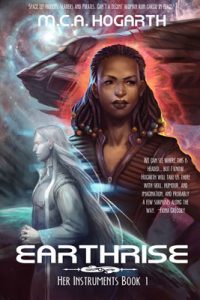 Earthrise, the first book in M.C.A. Hogarth's Her Instruments trilogy, is a comfy space opera which includes some furry critters. Based on my last visit to her work (books 1 & 2 of The Dreamhealers), the furry species are nice and familiar. The crew of the TMS Earthrise has a centaur with wings, a phoenix, a mated pair of bipedal felines, and a throw-pillow tribble with strong mental powers. Most of these are descendants of slave races that humans created centuries earlier.
The assembled characters have an almost whimsical balance, yet they still feel realistic. When we join them in the story, they're a well-meshed crew. There's a comforting alienness to each of them, a diversity that avoids stereotypes, but claims labels of diversity within diversity, if that makes sense. We mostly see them through the eyes of their captain.
Finally, after a long wait: 'Tai-Pan Universe #51'
Posted by Fred on Sun 12 Feb 2017 - 01:17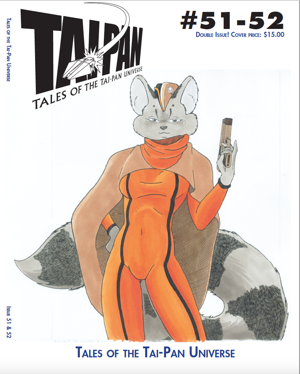 Tales of the Tai-Pan Universe #51, a furry science-fiction shared-universe fanzine that was announced in July 2015 as coming soon is finally here. It came out in July 2016, and is a double issue: #51 & #52. With a glossy cover and square binding, it feels more like a book than a fanzine.
As editor Gene Breshears describes it,
We're calling it a double issue, but at 162 pages and with 20 stories, issue 51-52 contains more than four ordinary issues' worth of tales!
It's available for $15 from Rabbit Valley, or from the Tai-Pan Literary and Arts Project. Back issues can be ordered, too - again from Rabbit Valley and also from Second Ed, at a discount. But the news isn't all good...
Review: 'The David Birkenhead Series' by Phil Guesz
Posted by Greyflank on Sat 30 Jan 2016 - 04:24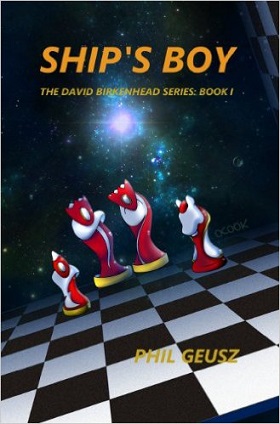 Based in a far future where humans have conquered the stars, this 7 volume space opera follows the life of David Birkenhead, slave rabbit.
The star-faring human race, finding no aboriginals to oppress on the various colonized worlds, create their own non-human slaves. Rabbits, dogs and horses are as nearly as intelligent as humans. The margin is so thin that only their limited education and indoctrination make it seem like a big difference. The House of Marcus, the creator of the rabbit line, has always endeavored to treat rabbits as free as the law allows, but all over the Empire, they see rabbits reduced to mere property status. They begin to secretly manipulate the gene pool so that rabbits might one day be seen as equals ... despite the fur. Their plan is cautious and will take several generations to bear fruit. David Birkenhead is one of two rabbits to be secretly tinkered with, but before he is even born, three houses and their worlds revolt. The Empire begins a series of battles with this new Imperial Nation. Plans to uplift the rabbits further go on the back burner. And then David turns 12 ...
So, you may ask (as many readers on Goodreads.com or Amazon have), why rabbits? Well, I really don't see cats making good slaves. And ther's heavy European influences here, so I wouldn't expect to see birds, which I might if we had more Asian influences. Rabbits are simply cute and make good foils for the violence and turmoil that unfolds. Plus, Phil Guesz is a lapine master.
Ship's Boy (The David Birkenhead Saga Vol. 1), Legion Printing and Publishing, Inc, June 4, 2012, trade paperback $5.99 (90 pages).
Midshipman (The David Birkenhead Saga Vol. 2), Legion Printing and Publishing, Inc, August 8, 2012, trade paperback $8.99 (193 pages), eBook $0.99.
Lieutenant (The David Birkenhead Saga Vol. 3), Legion Printing and Publishing, Inc, September 10, 2012, trade paperback $9.99 (167 pages), eBook $2.99.
Commander (The David Birkenhead Saga Vol. 4), Legion Printing and Publishing, Inc, October 5, 2012, eBook $2.99 (167 pages).
Captain (The David Birkenhead Saga Vol. 5), Legion Printing and Publishing, Inc, October 31, 2012, trade paperback $7.99 (133 pages), eBook $1.99.
Commodore (The David Birkenhead Saga Vol. 6), Legion Printing and Publishing, Inc, November 21, 2012, trade paperback $13.99 (302 pages), eBook $2.99.
Admiral (The David Birkenhead Saga Vol. 7), Legion Printing and Publishing, Inc, November 30, 2012, trade paperback $8.99 (119 pages), eBook $2.99.
'Tales of the Tai-Pan Universe' #51 is coming
Posted by Fred on Sat 18 Jul 2015 - 20:29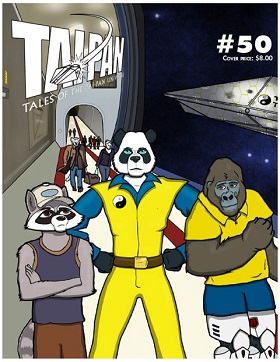 Tales of the Tai-Pan Universe, launched in January 1992 by a consortium of Seattle-area furry writers, artists, and editors, and the oldest on-paper furry fanzine still being published, released its fiftieth issue in September 2012. Despite its website’s continued online presence with its semi-annual schedule, the long delay since number fifty was published has resulted in a growing doubt that it is still in existence.
Now editor Gene Breshears has stated that issue number fifty-one is finally ready for the printer, and should be out by the end of this month, or August 2015 for sure. The delay has been partly due to the requirement that all stories in Tales of the Tai-Pan Universe must be consistent with that fictional universe’s 36th-century interstellar storyline. With over a hundred stories by different authors, making sure all details, references, and characterizations are consistent, and the need to get illustrations for those stories, all on a volunteer basis, means it is getting increasingly difficult to prepare an issue.
But Tai-Pan fans can relax with the expectation that issue number fifty-one is about to appear.
Update: Tales of the Tai-Pan #51 & #52 have been published as a double issue – its last.
Furry sci-fi series 'Delura' starts Kickstarter campaign
Posted by Higgs Raccoon on Tue 5 Mar 2013 - 00:41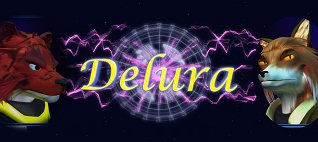 Delura is an independently-produced drama/space opera created by Ryan and Taben Roye of Tanadrine Studios. Started in 2010, the series is presented as a 3D webcomic and several animated shorts.
The titular Delura is the name of the galaxy in which the series takes place. The story includes many alien races resembling anthropomorphic animals, including vulpine and lupine beings. It centres on a felinoid mineship operator who finds himself with damaged memories in a strange medical ward, and reluctantly begins his new life whilst knowing nothing of who he was, is, or will be.
Ryan and Taben have started a Kickstarter campaign to fund Delura's 2013 season. A $6,500 goal has been set, to go towards providing more animations and webcomic content, and to upgrade hardware and software so as to improve the quality of the graphics.
Review: 'Flight of the Star Phoenix', by Bernard Doove
Posted by Fred on Sun 2 Dec 2012 - 01:09 Six of Bernard Doove’s last seven books have been set in his 24th century “Chakat Universe”. So is Flight of the Star Phoenix, but with a difference. These are the adventures of the starship Phoenix, captained by a coyote morph and crewed by just about every species in Doove’s universe. Chakats are included in the mix, although this is not really a chakat story.
This novel is really an assembly of the thirteen Phoenix stories that have appeared on Doove’s “Chakat’s Den” website. They are called chapters, but they read more like a collection of separate short stories. Although the book has an overall theme – in 2332-2337, the interstellar freighter Phoenix must prove itself financially profitable by its fifth anniversary or go out of business – it reads more like thirteen separate adventures during those five years, with individual beginnings, plots, climaxes, and conclusions. Fans of short, episodic starship adventures will enjoy this more than the fans of long novels. And the fans of Doove’s regular chakat tales will be very satisfied with it.
CreateSpace, November 2012, trade paperback $21.95 (388 pages). Illustrated.
Video review: 'DSV Nautica Vol. 1'
Posted by Isiah Jacobs on Sat 21 Jul 2012 - 17:13Isiah reviews 'DSV Nautica Volume 1' after his interview from forever ago.
Links: Web version - print edition - users on FA: Rei Vegan - Zhelle - Yoippari
Review: 'Further: Beyond the Threshold', by Chris Roberson
Posted by Fred on Sun 24 Jun 2012 - 19:35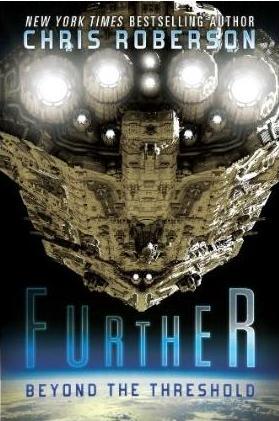 The first line in this science-fiction novel is: “When I woke up, surrounded by talking dog-people, it was clear we’d strayed pretty far from the mission parameters.” (p. v) There are a talking chimpanzee in a smoking jacket, cravat, and pin-striped trousers; a gigantic lion with a hairless human head; and a robot in the form of a silvery-mercury metallic eagle in the first scene. Furry, no. Anthropomorphic science-fiction, yes.
Captain Ramachandra Jason Stone is a 22nd century spaceman, the captain of Wayfarer One, the first interstellar spaceship launched to travel to Alpha Centauri. The crew is put into cryogenic suspension for the forty-three year voyage, but something goes wrong.
The Wayfarer One is not found and Stone revived until 12,000 years later. By then, humanity – defined as anything sentient, whether a natural life-form or an Artificial Intelligence – has spread into the Human Entelechy, a “superculture of thousands of inhabited worlds and habitats linked by the threshold network, centered roughly on Sol. There are roughly ten trillion sentients, not counting the large number of intelligences who exist as digital incarnations in virtual domains”, etc. (p. 45)
47North, May 2012, trade paperback $14.95 (vi + 343 [+ 1] pgs.), Kindle $4.99, audiobook $10.
Review: 'Death Drop' (D-Evolution, vol. 1), by Sean Allen
Posted by Fred on Sun 11 Dec 2011 - 10:39 Hoo-hah! Roscoe, does this bring back memories! Memories of all the rip-roaring space operas that I devoured during my junior-high and high-school years. Among my favorites were the Chalice of Death stories by Calvin M. Knox, in Science Fiction Adventures magazine; the last of which was the wonderfully-titled “Vengeance of the Space Armadas” (collected into Lest We Forget Thee, Earth by Ace in 1958).
A hundred thousand years ago, there had been a planet called Earth. It had been a proud world ruling a thousand vassal stars, but its stellar empire had turned upon and annihilated their conquerors, and wiped the name of Earth from the maps of space. ~~~~ But Earthmen still survived . . . a strange race of worldless men and women, by tradition advisers to rulers, but never themselves ruling. Wanderers through myriad planets, their origin was a half-forgotten legend. …
It was later revealed that “Calvin M. Knox” was a pseudonym of Robert Silverberg, who had hacked out the Knox stories in his spare time while a college student, for beer money. Silverberg said later that they made it hard for the critics to accept him as a “serious author”. [Ed Valigursky's 'racy' cover likely didn't help. Update: See Mr. Silverberg's comments.]
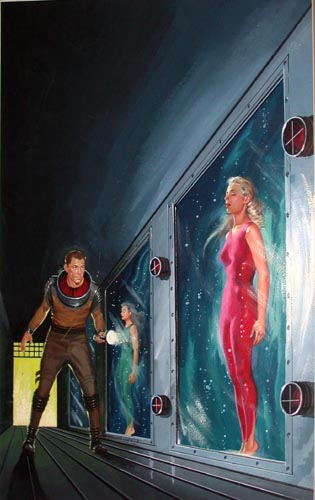
You know what? I’m damn glad that he wrote them, because uncritical teenagers need blood-&-thunder space opera just as much, if not more, as they need Serious Literature.
I suppose video games have assumed the popular-fiction role that pulp magazines such as Captain Future, Planet Stories, and Startling Stories used to fill. Kudos to Sean for bringing space opera back to print with his “D-Evolution” s-f novels, of which Death Drop is the first.
Pueblo, CO, Vintage Six Media, October 2011.
Trade paperback $19.95 (560 pages; Amazon), EPUB, Kindle, MOBI, PDF $9.95.
Review: 'Tales of the Tai-Pan Universe; Omnibus One'
Posted by Fred on Wed 28 Sep 2011 - 12:05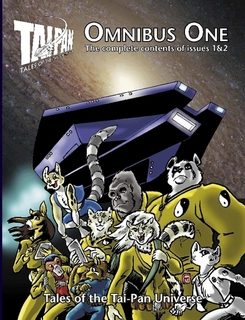 The Tai-Pan Literary & Arts Project is one of the oldest organizations in Furry fandom. According to the Editor’s Introduction, it was started by a group of seven Seattle fans having dinner at a Denny’s during Norwescon X, March 24-27, 1988. They decided to publish a shared-world Furry space-opera fanzine, set in the 36th century against an interstellar background, with a group of writers and artists featuring the same Furry characters in stories edited to be mutually consistent. (See WikiFur for the full historical story.)
Today, twenty-three years later, the Tai-Pan Project has included over fifty writers and artists. It incorporated as a not-for-profit organization in 2000. Its Editors-in-Chief have been Whitney Ware, 1988-1994, and Gene Breshears, 1994-present. It holds a social/editorial dinner Writer’s Night gathering in the Seattle area on the third Saturday of every month. Its publication, titled The Tai-Pan under Whitney Ware and Tales of the Tai-Pan Universe under Gene Breshears, is published approximately twice a year; issue #49 is scheduled for November 2011. Tales of the Tai-Pan Universe won the Ursa Major Award for Best Anthropomorphic Magazine in 2003 and 2004, and the story “In His Own Country” by Kristin Fontaine in issue #39 won the award for Best Anthropomorphic Short Fiction in 2005.
Tai-Pan Literary & Arts Project [Editor-in-Chief: Gene Breshears], September 2011.
Trade paperback $15.00 (176 pages).