
science fiction
Review: 'The Wild Robot'
Posted by 2cross2affliction on Wed 16 Oct 2024 - 08:05 Chris Sanders has only directed four animated features (plus a live action adaptation Call of the Wild), and the previous three (Lilo & Stitch, How to Train your Dragon and The Croods put him in four way tie for most nominations without a win in the Best Animated Feature category at the Oscars. It feels pretty certain that The Wild Robot will be the movie that finally wins him that Oscar, but we'll keep such speculation to a minimum.
Sanders's first feature, Lilo & Stitch, is probably the only truly great movie to come out of Walt Disney Animation Studios in the first decade of this century. (To be clear, you're allowed to like other movies from that decade, but most were flawed.) Anyway, the upshot of Lilo & Stitch becoming a beloved classic is that its directors, Sanders and his writing and directing partner, Dean Deblois, were driven out of Disney by John Lasseter a few years later (I don't like that guy).
Sanders and Deblois took their talents to DreamWorks Animation, where they delivered How to Train Your Dragon to the studio, often seen as one of the highlights of its output.
I've often seen Sanders cast as the "idea guy" in the Sanders/Deblois partnership, as well as being the guy who brings a lot of unique visual aspects to his projects, while Deblois is the more story-driven member of the partnership, bringing in the emotional aspects. I'm not so sure about that, especially after this movie, which features an emotional story just as potent as Lilo & Stitch and How to Train Your Dragon, sans Deblois. The Wild Robot also features a visual design that echoes the original illustrations of the book it's based on, by Peter Brown, showing Sanders is more than just a recognizable art style.
Furries That We Were
Posted by Mink on Mon 14 Oct 2024 - 01:55Lucy is a science-based graphic novel by Patrick Norbert, illustrated by Tanino Liberatore (Heavy Metal magazine). “At the end of the 1970s, a discovery changed the face of the world: the almost complete skeleton of a specimen of Australopithecus, the oldest common ancestor of mankind, was unearthed in the Afar Triangle in Ethiopia. But who was this woman named ‘Lucy’ after the Beatles song? In this comic book with a romantic breath, remarkable for its scientific veracity, we follow the timid footsteps of our ancestor in his awakening to consciousness. A journey made of dangers and discoveries, rocked by the starry night where all the mystery of the world is hidden.” Previously available only in French, in 2023 Heavy Metal Entertainment finally released it in English.
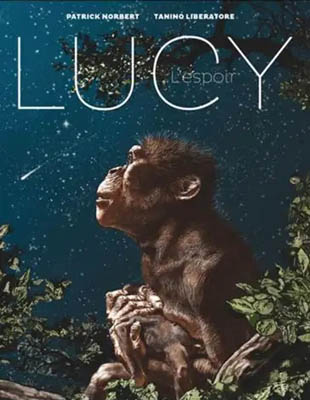
image c. 2024 Heavy Metal Entertainment
Watch Out For This Chick
Posted by Mink on Sat 5 Oct 2024 - 00:41That’s actually a rather lame gag way to introduce a comic miniseries we missed, but now it’s out as a collected trade paperback. The Sacrificers, written by Rick Remender and illustrated by Max Fiumara and Dave McCaig, is a dystopian science fiction story featuring, among many other strange things, a group of bird-like aliens. “Tomorrow is a harmonious paradise thanks to five families who make everything perfect… for the price of one child per household. Now, as that bill comes due, a son expected to give everything for a family that never loved him, and an affluent daughter determined to destroy utopia, must unite to end one generation’s unnaturally protracted reign.” Look for it from Simon & Schuster.
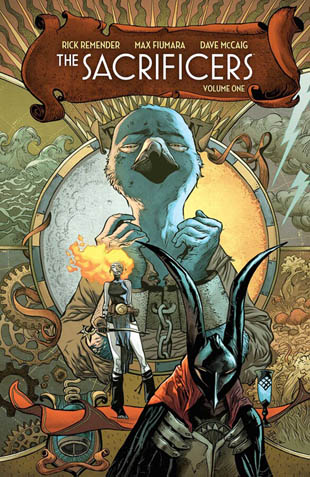
image c. 2024 Image Comics
Movie reviews: 'Princesse Dragon', 'Dragonkeeper', 'Even Mice Belong in Heaven', 'The Concierge', 'Mars Express'
Posted by dronon on Fri 13 Sep 2024 - 01:56 It's a flood of reviews! Today's trailers are for:
Dragonkeeper,
Even Mice Belong in Heaven,
The Concierge,
and Mars Express.
Those are in increasing order of recommendation. The first three are for kids, the fourth is anime, and the last one isn't furry but is worth mentioning!
Taral Wayne, early furry fandom artist, passes away
Posted by dronon on Mon 5 Aug 2024 - 17:52 Taral Wayne (born Wayne MacDonald), a Canadian artist in both science fiction and furry fandoms, passed away last week at age 72. (October 12, 1951 - July 31, 2024.)
I had the opportunity to hang out with Taral many times from about 1994-2001 until I moved away, after which I sadly let myself become more distant. If you were a friend or colleague of Taral's, even if you're not in furry fandom, please feel free to post a comment or personal memory here!
Taral Wayne was a resident of Toronto and discovered science fiction fandom in the early 1970s. Within the next ten years he was an active participant, lending his artistic talents to zine culture. He was also a member of the proto-furry APA, Vootie.
Cry Havoc
Posted by Mink on Fri 12 Jul 2024 - 01:54Somehow we overlooked this one when it was a comic — but now it’s been collected together as a single graphic novel! It’s Star Trek: Deep Space Nine — The Dog of War, written by Mike Chen and illustrated by Angel Hernandez. “An extremely rare purebred corgi from Earth makes its way aboard Deep Space 9 when Quark cuts a deal to procure it for a high buyer. After all, a Ferengi without profit is no Ferengi at all! But Latinum the corgi comes with unexpected cargo that shakes Captain Benjamin Sisko to the core: A Borg component discovered by a crew sent to uncover Cardassian technology after the station’s reoccupation.” Check it out over at Penguin Random House.
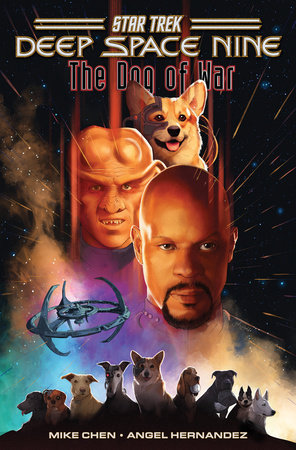
image c. 2024 IDW
Trailer: 'Star Trek: Lower Decks' Season 4
Posted by 2cross2affliction on Mon 4 Sep 2023 - 11:42Bear with us here, as if you just watch the following trailer, you may be a bit confused as to what it actually has to do with the furry fandom. You'll just have to take our word that there is actually a fairly important, fun furry character in this series, despite the fact she's in less than a second total of the trailer. (If the video below isn't visible, try this link.)
Star Trek: Lower Decks is the eighth television series (if you count streaming series as such) and the second animated series in the long running Star Trek franchise. The first three seasons of the show are available from the Paramount+ streaming service; the fourth season will begin airing September 7. In a tribute to the original animated Star Trek series's catperson alien Caitian crewmember Lt. M'Ress, Lower Decks's supporting cast includes Dr. T'Ana.
The Mouse That Whirrrrred
Posted by Mink on Thu 10 Aug 2023 - 01:52Multiple Ursa Major Award winner Rick Griffin recently self-published the novel Ani-Droids, a radical re-imagining of his popular science fiction novel Argo from 2011. “In violation of the will of the Collective, Mira McAllister set out to create a new breed of ani-droids that can think for themselves. But when she discovers a mouse-droid with unusual quirks to her programming — and darker secrets besides — she may have set in motion an accidental rebellion… The Collective must not find out. But the Collective is every other ani-droid on Earth.” Ani-Droids is available now in e-book, paperback, and Kindle editions.
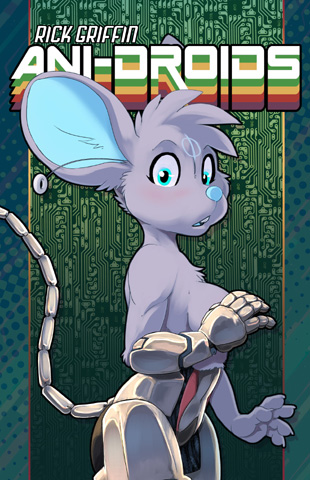
image c. 2023 by Rick Griffin
Doctor Who and the Secret of Novice Hame hints at a furry Doctor Who?
Posted by 2cross2affliction on Tue 2 Jun 2020 - 17:55To help distract quarantined Doctor Who fans, there are Doctor Who: Lockdown! simulcast watch-alongs of popular episodes of the "New" series of the show, featuring creatives behind the scenes Tweeting along, as well as short videos to go along with the watch-along.
With the May 30 watch-a-long of the loose "trilogy" of episodes "The End of the World", "New Earth" and "Gridlock" a sort of illustrated audio ""The Secret of Novice Hame", written by Russell T. Davies, was attached. The titular character and narrator of the story is Novice Hame (played by Anna Hope), who appeared in the "New Earth" and "Gridlock" episodes and is an anthropomorphic cat. She tells the story of her life among the various anthropomorphic animals of the far future planet of New Earth, and is visited by David Tennant's "Tenth" incarnation of the Doctor.
An interesting implication of the short piece is that it opens up the possibility that the Doctor themself might someday become an anthropomorphic animal; Novice Hame notes that there are stories of the Doctor in various forms, including animals.
See Also: Flayrah's 2006 coverage of the the episode "New Earth"
REVIEW: Bleak Horizons, edited by Tarl Hoch
Posted by Greyflank on Sat 18 Apr 2020 - 10:16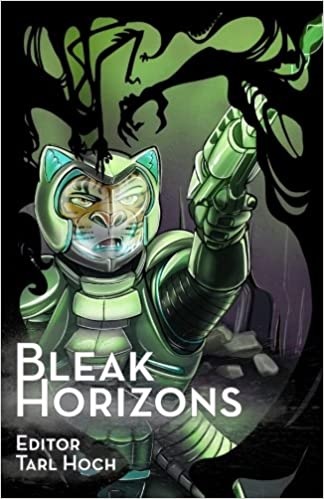 A great many people only experience science fiction by what my mother and millions of others referred to as "monster movies". From Frankenstein to Aliens and beyond, the unknown and the unexplored are often our undoing. Bleak Horizons, edited by Tarl Hoch, is a wonderful collection of 15 stories that mix SF and Horror with various levels of anthropomorphic settings and characters. And, full disclosure, one of those stories is mine. Happily, the mix includes more than just blood thirsty monsters and end of the universe scenarios.
Overall my favorite stories in this anthology are Hardwire, Pentangle, and The Ouroboros Plate. My least favorites are 4/13/2060 and Not Like Us. Below is a short review of all the pieces. I think you should snag a copy, if only to read my favorites and have a taste for this genre. However, I also really enjoyed Carmen Miranda's Ghost Is Haunting Space Station 3 so you have every right to question my taste.
Multiverse, hopes to bridge the communities of Fantasy, Sci-fi, & Horror Fans—Furries included
Posted by littlebeantiger on Sat 28 Sep 2019 - 11:55 Editors Disclosure: This article has been posted by the communications director of the convention.
-----
Multiverse, a brand-new convention for fans of science fiction, fantasy, horror, comics, furry culture, and more, will hold its debut event from October 18th to October 20th in Atlanta, GA.
The convention, located at the Hilton Atlanta Airport, will bring together fans, authors, artists, and other creators, all of whom share a common passion—genre fiction. Attendees can expect sci-fi, fantasy, and horror media, tabletop role-playing games, cosplay, and other beloved staples of “geekery” to feature heavily at Multiverse.
“Panel discussions, a fursuit festival, an art gallery, a gaming hall, and even a charity auction for the nonprofit RAICES—it’s going to be so much fun, truly,” says convention chair Allie Charlesworth. “Whether you love Game of Thrones or Black Panther, the movie Get Out or Dungeons and Dragons or even My Little Pony, this is absolutely your con.”
In memoriam: Fred Patten (1940-2018)
Posted by dronon on Sat 17 Nov 2018 - 10:05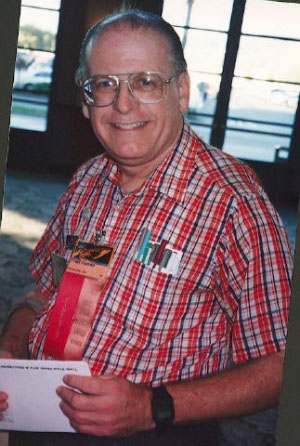 Fred Patten was born in Los Angeles, California on December 11, 1940. By the time he was ten years old, he'd become interested in science fiction and had started to collect SF books and magazines. From 1958 to 1963 he attended UCLA, where he graduated with a master's degree in Library Science. During his university years, he discovered science fiction fandom, joined the Los Angeles Science Fantasy Society (LASFS), and started to write for fanzines.
In the 1970s, Fred became a partner in a bookstore in Long Beach, and also developed an interest in manga and anime from Japan. In 1977, along with Mark Merlino and others, Fred was one of the founding members of North America's first anime fan club, the Cartoon/Fantasy Organization. Partially through the C/FO, he and Mark expanded their mutual interest in animals in cartoons and science-fiction, which was a major step in the early evolution of furry fandom. A lot people aren't aware that in North America, both anime and furry fandoms share an originating root!
Remembering Fred Patten
Posted by SylysSable on Fri 16 Nov 2018 - 22:43 There is a balding man with glasses, standing in the corner, cradling a book against his stomach, reading. You saw him a lot. At the Los Angeles Science Fantasy Society meeting hall, the APA collation room, in the library, at science fiction conventions in function rooms and room parties, at San Diego Comic Con in the Rowrbrazzle contributor parties, at furry parties.
His name is Fred Patten, and was in no way the passive participant he seemed. With a partner he opened a book shop in Long Beach, California that not only carried SF and Fantasy books, but comics from all over the world. He reviewed SF and Fantasy literature for fan and professional publications. His apartment was literally wall-to-wall books. He collected SF/F art, storing paintings in his bed frame. I don't think anyone knew where he slept... or if he did.
Book review: "Earthrise" by M.C.A. Hogarth
Posted by Greyflank on Thu 23 Nov 2017 - 23:27 Earthrise, the first book in M.C.A. Hogarth's Her Instruments trilogy, is a comfy space opera which includes some furry critters. Based on my last visit to her work (books 1 & 2 of The Dreamhealers), the furry species are nice and familiar. The crew of the TMS Earthrise has a centaur with wings, a phoenix, a mated pair of bipedal felines, and a throw-pillow tribble with strong mental powers. Most of these are descendants of slave races that humans created centuries earlier.
The assembled characters have an almost whimsical balance, yet they still feel realistic. When we join them in the story, they're a well-meshed crew. There's a comforting alienness to each of them, a diversity that avoids stereotypes, but claims labels of diversity within diversity, if that makes sense. We mostly see them through the eyes of their captain.
'Star Wars: The Last Jedi' to feature crystal foxes
Posted by 2cross2affliction on Wed 22 Nov 2017 - 22:12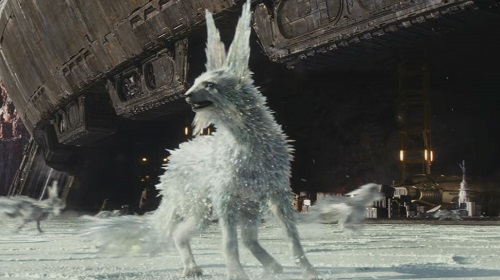
Furry fans may have noticed a seconds long clip of crystalline, possibly fox-like critters scampering around the trailer for the latest instalment of Star Wars, subtitled The Last Jedi. The upcoming movie was the subject of a cover story by the magazine Entertainment Weekly, and one of the things covered were these "crystal foxes", which are known as vulptices. The Last Jedi is scheduled to be released December 15 (which technically means it's opening Thursday, December 14 for "previews") in America, and now furry fox fans have a reason to get excited.