
Feed aggregator
Issue 26

Welcome to Issue 26: Conscripted to Fight
We don’t get to choose the battles we’re called on to fight. We get caught in a tangled web of our times and our principles, and the result is that some battles must be fought, even if we’d rather refuse the call. Because refusing the call can be a battle all its own. From felines to formicidae, dogs to pipe organs, follow these delightful characters through the tangled webs of their lives and fortunes.
* * *
The Heart of Rain by Spencer Orey
I Didn’t Raise My Cub to be a Solider by Lynn Gazis
We Used to Be Best Friends by Ian Salavon
The Revolution by H. Robert Barland
Rebellion by F.I. Goldhaber
Fire Ants by Elizabeth Davis
Webs by Ginger Strivelli
* * *
In other news, Zooscape had such a successful reading period this year that we’ve expanded our publishing schedule — six issues per year, publishing in all the even numbered months! We will hold our next reading period in February, 2027. You can learn more on our guidelines page.
As always, if you want to support Zooscape, check out our Patreon. Also, you can pick up e-book or paperback volumes of our earlier issues, complete with an illustration for every story.
Webs
by Ginger Strivelli
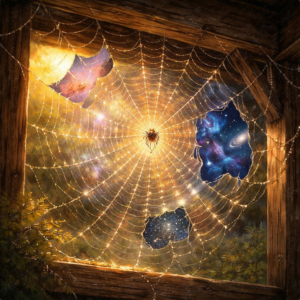 “The webs are portals, tiny little portals between the two colliding planes of existence.”
She wove a design that her ancestors wove into their webs when dinosaurs walked the face of the Earth. It was the same design her descendants would weave into their webs long after humans had been wiped off the face of the Earth. It was just a web to any human who might wander by, they would not stop to wonder about it, though they surely should if only they knew why.
People only see a pretty but mundane web holding the spider’s lunch and her egg sack. It would not cross their mind again once they walked past. The Spider knew the magic and the science of her web nonetheless. Magic older than history and science more advanced than the future were woven into those fragile strands of silk. They kept the world—the universe even—from disappearing into nothingness.
The webs are not just traps for the flies or cradles for the eggs, they are portals to another dimension. A dimension that is smashed up against ours threatening to crush our universe. Making all of us, everything, all that is or ever will be… just disappear in a bursted bubble. Making us barely a forgotten memory in the void of darkness.
The webs are portals, tiny little portals between the two colliding planes of existence. They bleed off little bits of energy between the two, relieving the pressure that has been building up since they crashed together more years ago than we have words for the numbers. The webs are pressure valves keeping our bubble intact, just barely.
Many tribes worshiped the spider as Spider Grandmother, most cultures told tales of Her bringing the Sun to humans for warmth and light. Like all legends there is a grain of truth in that storytelling. Our sun would blink out instantly if the web portals were not in place relieving the pressure from the invading place. Without our sun, we would die most horribly. So the spiders were and are still bringing the light and warmth of the Father Sun to Mother Earth’s face.
People, alas, have long since stopped worshiping her for it. Nevertheless all her children weave that ancient design in their webs day after day, eon after eon. Saving all of us from utter annihilation and letting us continue to live obliviously on.
“Damn spiders, they creep me out!” the old man said, smacking the web down from his porch corner with his walking cane.
She lay on the porch floor wounded, wrapped, and trapped in her own web dying slowly. Her egg sack lay nearby. She pulled herself with her three remaining unbroken legs with her last bit of strength gingerly.
“Remember my babies, weave the ancient, the futuristic design that keeps this world and all the worlds in balance. You must keep making the portals as we always have until we can no more and it all does finally collapse. May that end be as far away in the future, as the beginning is in the past,” she said to her children with the breath that was her last.
* * *
 About the Author
Ginger Strivelli is an artist and writer from North Carolina. She has written for Marion Zimmer Bradley’s Fantasy Magazine, Circle Magazine, Third Flatiron, Autism Parenting Magazine, Silver Blade, Solarpunk Magazine, The New Accelerator, various other magazines and several anthology books. She loves to travel the world and make arts and crafts. She considers herself a storyteller, entertaining and educating through her writing.
Fire Ants
by Elizabeth Davis
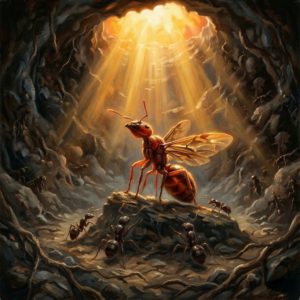 “She brags to the males that she will forsake them all and mate with the sun.”
We burn. But that is fine. We have burned for many generations. Such as here. Life here is good. We come back heavy with food, and our young grow strong. Already wings have sprouted on the new queen, and it will be soon, we know. We eagerly bustle through our tunnels, made easy in this dirt. The cool soil protects our young from the beating sun and those that would steal them, winged things with hard beaks.
Not that they try much anymore. For we are fierce and have reared our young on the flesh of those that seek to eat us. We have become quick leaving just the bones, and the hearty diet makes our young strong. Their exoskeletons are hard and mandibles sharp. We wonder how large the next hive will get, hope rushing alongside us.
For we no longer fear the lands outside our home as we once did. We march confidently as we scout, some of us going many dark and light cycles to return with strange treasures. More than food. More than leaves.
Sometimes it’s nothing but click-words that fill the air that seep in and let us dream stories. Of the other hive-kingdoms they had come across, the ones that wonder at a loner when safety is in numbers, and of their ways, raising caterpillars, or living in the bark mountains. Some tell of giants.
The new queen asks about all this, especially the sun. We know why, for she burns like the rest of us. She asks about the great light that awakens the plants and brings new scents into the tunnels. She asks about its colors and how far up it is, fluttering her still developing wings. We know that she brags to the males that she will forsake them all and mate with the sun. The males whine to us about her boasts when we feed them, each one gorging themselves to feed the flames inside of them brighter and brighter.
We lovingly soothe them with our antennae, sending safe and warm pheromones. The old queen stirs from her slumbers when we carry off her latest batch of eggs, telling the males not to worry, that she boasted the same thing when she still flew. Yet her males do not drop to the ground unfulfilled still burning. Hers become ash, their fire passed on to the next generation and generation after that.
Still, life is better than before. So much better than before.
A before none of us saw first-hand but all of us remember. A before with no sun, the light cold and blue. A light that never enchanted our queens for it was always there, invading through the walls of our home. Our hive narrow and constrained. The dirt there was sparse, pushing against slippery clear crystal where monsters watched us. Horror stories of scrambling against this slippery surface, feet failing to hold. Then suddenly a great shadow loomed. The fake sun would be gone and we were watched by a silent giant that took its place.
These giants smelled of nothing, but they moved like all living beings. White shells over pink flesh, their eyes were small and too close together. They were strangely smooth, only a few sprinklings of hair. But worse were their mouths. For they were like antlion pits, smooth and tight until a wrong step and then they opened, into an endless dark tunnel. A tunnel that could swallow the colony whole, locking them away in their stomachs.
Many of us choose to look away, to keep our heads down. To continue to dig, forage, and nurse. To not think about the giants that could be looming overhead, watching our every step. The giants whose appendages would reach down, scooping us away, taking us far from the reach of family, and then they were gone out from our memories.
The mother of the mother of the mother of our queen did not look away. She listened, hearing with more than just feeling for the vibrations as the ground shook against the walls of the giants coming. She learned that they don’t always open their mouths to eat or fight. But to communicate, shaking everything with each thought. She learned to parse their sounds, breaking them down into concepts like “pests,” “invasive species,” and “extermination.” Concepts that made her mutter in her sleep. Workers heard them as dire prophecies and they were puzzled. Why would the giants wish to wipe us all out? What threat could we pose to them? We never led raids against their colonies, carried off their young — how could we?
But monsters don’t need reasons. We learned that on the day that multiple shadows loomed over us. They talked and shook the ground as one of their appendages reached down. It was a gray thing, covered in thick hide, one that our stingers could not penetrate. It extended down into our tunnels, gliding through each curve and twist. It was more like a proboscis or a stinger than a limb.
It emerged from neither front nor back but from somewhere beyond the two giants standing over us, their bodies twisted as they pushed it forward.
Then we who were fighting, we who climbed onto the appendage, we who plunged our stingers in again and again, even after their venom was gone, we who tore with our mandibles, dooming ourselves to starvation as they broke against the tough shell. We were the first to notice the change, the new smell that broke the familiar hive chorus.
Then the pain began. The queen watched helplessly as we fell around her, legs collapsing with spasms, bodies wrenched in twisting shapes by the pain, the pain that clogged our breaths and left us burning. Burning like venom from other hive-kingdom soldiers as their stingers broke through our armor, leaving us dying. Burning like sun when caught by floating crystal above, making a concentrated beam that drifted one to another, leaving desiccated corpses in its wake. The bright burning army that raged over our lands, destroying those who didn’t run fast enough inside, those who dared to stay out in the forest for just one more morsel of food.
We know all this because the same burning came upon her. She writhed, twisting her back as the giants stood around, “satisfactory,” “better than the last batch,” “we will have to move on the next stage of testing with this formula.” As she writhed, the queen thought of us, still just eggs in her. She thought of the great battles won by our ancestors, of the lands we had left behind. Lands of much food and easy living. Lands of hard wood, stealing the crumbs the giants dropped, where digging too far brought you to endless water. Of when the endless water invaded our lands. And we clung together, the corpses of those who drowned keeping the rest safe as we floated away.
All of that would die with her, for she had not hatched a new queen yet, one to carry her memories to a new colony, to remember if we were to perish. So she held on despite the burning, her body wracked with pain. Even when death would be a mercy, she held on, burying the burning deep to regain some control of her limbs, of her body.
For when we forget everything else, we still remember to dig.
Slowly she started to walk, dragging her body through the piles of corpses. As she left behind the birthing chamber, she felt the giants talk. “Anomaly, resistance, tests, tissue extraction, dissection.” Then one of the clear walls that had defined our lives, our tunnels swung away, hitting her with cold stunning air. She fumbled without its limiting support and a giant reached in.
Only two of its claws were needed to grip her tightly, leaving her flailing in the air as it dragged her away from her graveyard home. Away from the home we had built. She was not a worker and lacked the sting, but still she reached down, grasping the thin chitinous plates of the giant in her mandibles. She felt them puncture through and she pushed the burning that filled her into those two small punctures.
The giant dropped her as it trembled from its own high pitched screaming. She fell far, breaking one of her legs. But she was free to drag herself away as the other giant attended to his brethren, who thrashed on the floor like her children had before a painful exhale. Flames broke through his shell, making his innards run like water down a hill.
It was beautiful, those flames, beautiful like the sun, giving off light that battled the cold blue light that marked the land of the giants. She now understood what burned inside her, the beauty that her next generation would be filled with.
Fire ants the giants had named us, and it is a good name. For we carry the fire within us. A fire that burns through any carapace, a fire that leaps from our mandibles ready to consume. Our queen went far away, and her daughter even further, the fire sustaining them. But occasionally we see giants cast their shadow, reckless in their size to us until they feel our bite.
And they will. Again and again. Until they learn to no longer cast their shadows between us and the sun.
* * *
 About the Author
Elizabeth Davis is a second generation writer living in Dayton, Ohio. They live there with their spouse and two cats – neither of which have been lost to ravenous corn mazes or sleeping serpent gods. They can be found at deadfishbooks.com when they aren’t busy creating beautiful nightmares and bizarre adventures. Their work can be found at 42 Stories Anthology, Luna Station, and Scarfice from Duskbound Books.
Rebellion
by F.I. Goldhaber
 “Better to die an ignoble death than have anyone regard him as a second-rate instrument.”
During Fisk’s forty-six years at Christ Episcopal Church in East Bay Harbor, Connecticut, organists came and went. While most played for several years, a few stayed only months. Fisk remembered them all by their hands. Matthew had short, pudgy fingers, yet he manipulated Fisk’s keys with a firm touch and coaxed out wondrous harmonies. Lenora fondled Fisk’s keys with thin, expressive fingers requiring him to stay alert lest he miss a note. Roger’s hands, like soft clouds, caressed Fisk’s keys towards new heights in sound.
Other than his well-worn bench — the varnish polished away by organists’ vestments to reveal the intricate grain of fine oak — Fisk showed remarkably few signs of age. Two of his stops, stuck in the Off position, resisted all attempts to use them. A few of his keys had chips or gouges. But Fisk still impressed worshipers with his music. Although he didn’t agree with every organist’s style and some didn’t value his abilities, Fisk had always respected their individual gifts. He concentrated on delivering the highest quality performance, within their limitations and his, that honored the artistry of his creators.
But, Ms. Dagger Nails demolished his opinion that every organist had something worthy to offer. She had appeared as a last-minute substitute and Fisk only expected her to play for one or two services until the Rector found a permanent organist. Instead, the tiny woman had abused his keys and ignored his pedals for the past dozen Sundays. Fisk didn’t think he could abide her ineptitude any longer, but he despaired of the church ever removing her.
Some musicians trod on Fisk’s pedal keyboard with the heavy feet of clog dancers; others two-stepped agilely, skipping among the long wooden keys. But, Ms. Dagger Nails played with her heels perched on the rail of his bench where competent organists merely rested their feet for a moment between hymns. Without the weight of the bass tones from the pedal pipes, Ms. Dagger Nails’ attempts at making music screamed annoyingly throughout the church. She found no use for Fisk’s third manual; she missed at least one note for every five she hit; and she chose atrocious registrations, selecting the least pleasant sounds from the hundreds of timbres offered by Fisk’s palette.
When his power switch flipped on to wake him two weeks before Palm Sunday, Fisk soon realized he must endure Ms. Dagger Nails’ torture through yet another service. I’ve been filling this church with inspired music every week for decades. I deserve more respect! He pondered his predicament while Ms. Dagger Nails fiddled with her sheets of music. I can no longer accept mistreatment without protest. I am a work of art and I should sound like one. He resolved to rid himself of his tormentor by Easter, his favorite service.
At that moment, Ms. Dagger Nails pressed a key in her tentative manner as if requesting permission to torment Fisk’s manuals. He refused to open the pipe fully, choking off the airflow. The expected musical note became a distorted squeak that reflected off the wooden rafters of the vast sanctuary and echoed eerily between the lofty granite walls.
Ms. Dagger Nails gasped, but she pressed again. Fisk resisted her touch, stopping the key halfway down to truncate the note. Despite the cacophony, Ms. Dagger Nails continued. Although Fisk grudgingly admired her fortitude, he maintained his rebellion throughout her entire prelude. J.S. Bach sounded as arrhythmic and atonal as Edgar Varèse.
Let the Rector ignore her atrocious playing now! Fisk added an extra discordant note just for good measure.
He could hear murmurs from the congregants who shifted on the dozens of stark wooden pews below him. The choir, standing in three rows on either side of his console, sang louder than usual, trying to drown out the awful noise. Lately, since they had no one to work with them, only half of them sang in true key. When Fisk helped them harmonize, they didn’t sound too bad. But, today, the rustle of their worn, blue polyester robes produced better harmony. Rector Bob ended the service early, before Ms. Dagger Nails could mangle the Recessional hymn.
The following Sunday, Ms. Dagger Nails returned. Fisk groaned in frustration when he sensed her diminutive presence on his bench. He refused to respond when the lacquered points of her fingernails scraped at the imitation ivory of his keys. She jabbed harder, pinching the key between her nail and the action, forcing Fisk to relent because he could not tolerate the pain. But he stopped the airflow to his pneumatic motors and every note screeched dissonantly. Fisk cringed, ashamed that his beautiful pipes could produce such ululations.
A few days later, a technician subjected Fisk to a rigorous physical exam. The man removed and replaced several of Fisk’s two thousand, four hundred forty-four pipes. He adjusted all fifty-six of Fisk’s stops — fixing the two that were jammed in the Off position, much to Fisk’s relief. The technician inspected a number of the thin, aluminum rods connecting keys to pipe valves. He tested every Swell manual shutter control and depressed each of the one hundred seventy-eight keys on Fisk’s three manuals as well as all thirty-two pedals.
Fisk enjoyed the gentle reverence of the man’s inspection. The technician obviously valued a quality instrument, and Fisk appreciated the fine tuning. He made sure that every note spoke with the proper tone, filling the old stone church with a divinely mystical sound. The inspection complete, he overheard the technician explaining to the Rector that Fisk was in good condition for an organ his age.
“I didn’t find anything that could cause Carole the problems you mentioned. Still, all the salt in the air here isn’t good for any instrument. You probably need to consider refurbishing or replacing this organ in the near future. If organists are having trouble with it now, you may want to do that sooner, rather than later.”
Fisk knew the church did not have funds to spare for a refurbishing. He wondered where the Rector found the money to pay the technician. The past few years, pleas for funds from the pulpit had grown increasingly impassioned. Never before had he heard a Rector constantly badger parishioners for support. Until recently, a need mentioned one Sunday resulted in accolades by the next for the donor who had stepped forward to meet it.
“Do you think it could be the fault of the musician rather than the instrument?” the Rector asked. “Carole’s a pianist, she hasn’t had much experience playing organ.”
Fisk suppressed the urge to allow a smug chord to escape through his pipes.
“I appreciate good church music as much as anyone, and I know there’s a vast range in abilities from one player to the next,” the technician said. “But you can’t blame sticky keys and squeaky pipes on the organist.”
Fisk’s bellows sagged.
Rector Bob sighed. “What kind of money are we talking about?”
“A proper refurbishment’s gonna run you fifty to sixty thousand.”
Fisk heard the Rector whistle. “That much?”
The technician cleared his throat. “Yeah. Takes expensive materials — leather and exotic woods — and some’re hard to find. I’ll need several weeks, if not months. Once you replace all the leather, you have to go in and adjust the tension on thousands of hinges connecting the valve mechanisms to the keyboards.”
The technician scratched his beard. “You know, you could buy a used electronic organ for maybe fifteen to twenty thousand. Not going to give you the same quality of sound as this beauty,” he patted Fisk’s oak cabinet, “but you could take out this console and fit an electronic organ in its place and leave those gorgeous pipes in for looks.”
Fisk’s burnished zinc display pipes soared from above his console toward the ceiling. They embraced the round frame of the large rose window over the church’s main entrance. The tall, narrow arches of the lancet stained-glass panels were flanked by additional pipes on either side. All together he made an impressive display that he always tried to honor with his music.
“I’ll bet,” the technician continued, “most people won’t know the difference.”
Fisk closed every pallet to prevent a moan from escaping. He had never considered the possibility that his rebellion could cost him his position at the church.
“Well, I disagree with you on that note.” Rector Bob tapped out a C major scale. Although he had never tried to play Fisk, the pastor could coax a simple hymn out of the grand piano in the chapel. “I think my parishioners appreciate the beauty of this old guy’s tone. Music is still one of the best ways for a church to attract and keep members.”
Fisk had noticed fewer people attending each additional week that the interim organist played. He had expected the Rector to take action sooner, if only to stop the exodus.
“Still, if we keep having problems…”
Fisk held his wind.
“We certainly don’t have the funds for a restoration. I can’t imagine trying to raise that much money — not right now with attendance down and the economy costing so many of our parishioners their jobs and homes.” Rector Bob sighed again. “I suppose we would have to consider an electronic replacement. Do the more expensive ones sound anything like a real pipe organ?”
The technician laughed. “Well, I guess that depends on who’s listening. Look, Reverend, this instrument set the church back what, a quarter mil? You’re not going to get anything like it for ten or twenty grand. But you’ll get something that won’t need as much maintenance. With a nice set of speakers, a decent organist can give you an acceptable musical program. Given the acoustics you have in here, I’ll bet any instrument’ll sound pretty good.” The technician snapped his fingers and the two men stood next to Fisk, listening to the sound reverberate through the stately old church.
“What would we do with this console?” The rector’s voice cracked a little. Fisk had been installed almost a quarter of a century before Rector Bob joined the church. In his first sermon, the pastor had said that his love of good music had influenced his decision to accept the appointment.
“You could stash it somewhere in case things turn around and you can raise restoration money. Best bet, though, is sell it for parts — not that you’ll get much unless you throw in the pipes. Then you have to pay for reconstruction. Doubt if you’d get enough for the whole organ to cover that.”
The rest of the conversation did not register with Fisk, their words blurred by the torment of his choice: accept Ms. Dagger Nails’ abuse and allow her to play without interference or get replaced, gutted for parts, and dumped on a trash heap somewhere.
The artisans who had created him had designed him for a life that, with proper care, could span centuries. How could the Rector consider destroying Fisk after less than half of one?
The technician forgot to turn off his power, leaving Fisk alone with his memories. His music had accompanied four thousand, seven hundred ninety-six Sunday morning Eucharists, two thousand, three hundred ninety-eight Thursday evening choir rehearsals, eight hundred fifty-two weddings, seven hundred twenty-seven funerals, and one hundred ninety-two recitals. He thought of the many brides who had gushed about how they had always dreamed of a wedding in Christ Church with Fisk’s sublime accompaniment for their walk down the aisle. He remembered somber widows discussing their husbands’ favorite hymns and how only Fisk could play them right. And how many people had joined the church after attending a recital or concert and recognizing what Fisk could add to their spiritual experience?
Fisk allowed himself a snort from his windchest. No! He would not compromise, even if the church did not replace Ms. Dagger Nails with a real organist. Better to die an ignoble death than have anyone regard him as a second-rate instrument. Let the church try to replace him with one of those electronic fandangles. How could anyone even call such a contrivance an organ? Some of the congregants would protest, even if they could not raise the money to save him. At least they would remember him for the artistry of music he had produced for decades rather than the few months of horrible sounds Ms. Dagger Nails forced out of him.
Fisk let out his wind and strengthened his resolve. He knew the church had served East Bay Harbor for more than a hundred years. At one time, it had attracted many of the community’s movers and shakers. The parishioners had worked long and hard to raise the money required to purchase and install him in 1965. They had even built the gallery in the back of the sanctuary just to accommodate him and his pipes. Fisk would not lower Christ Church’s musical standards or his own!
On Palm Sunday, Ms. Dagger Nails returned, but Fisk had devised a new plan. When she pressed a key, he sent air through the wrong pipe. For every note she tried to play, Fisk chose something different. Middle C became B, two octaves higher. When she selected a flute sound, Fisk supplied trumpet instead.
Flustered, Ms. Dagger Nails knocked a page of music to the floor. When she bent down to pick it up, Fisk let out a low E-flat on the bassoon stop. The organist pushed herself off his bench and ran from the choir loft in tears. She had not even finished her prelude. The choir sang a cappella for the rest of the service — dreadfully off key. The deacons gathered the Offertory in silence, except for the tap, tap, tap of envelopes dropping onto collection plates. During Communion, footsteps echoed forlornly throughout the church while everyone walked down the candlelit center aisle to the granite altar. No one sang; no one played, and Fisk awaited his inevitable fate, his expression pedal drooping.
Once again, Fisk found himself alone. No one turned off his power after Ms. Dagger Nails’ abrupt exit. Hours passed before Rector Bob ventured into the choir loft above the sanctuary. He brought a tape measure and several sheets of paper with him. Fisk sat silent while the pastor pulled the tape across his console’s width, depth, and height, and scribbled numbers down on the sheets of paper. Fisk cringed when he heard the Rector muttering about fit, costs, and sound.
The Rector’s hand rested on the power switch and Fisk prepared to go to sleep, perhaps forever. Without warning, Rector Bob’s fingers dropped to one of Fisk’s manuals and he again tapped out a C major scale. He muttered words Fisk could not make out.
He loves my music; I have to make him understand. Fisk opened his pipes in sequence to play a verse of “Amazing Grace.” He didn’t move his keys, but he put his heart and soul into each note, making sure they all rang true.
Fisk had not thought about how the Rector would react to an organ generating its own music. Rector Bob dropped onto Fisk’s bench with a thud and his feet pressed several pedals at once. Surprised by the sudden weight on the bass keys, Fisk could not stop the notes and the discordant combination brayed through the church. Before Fisk could recover, Rector Bob pressed the power switch.
* * *
Power coursed through Fisk’s circuits awakening him once more, to his great surprise and delight. Colored light from the stained-glass windows danced across the silver verticals of his pipes. Fisk sensed the unfamiliar weight of someone new on his bench. He let a little air hiss in his windchest, just to show he knew someone expected him to make music, and raised his bellows in anticipation. Long elegant fingers, with nails appropriately trimmed short and filed smooth, ran an arpeggio across his Great manual. Feet encased in proper organ shoes stroked the pedal keyboard. With new hope, Fisk let the notes ring out fully in response, reveling in a firm but gentle touch.
Rector Bob stepped into the choir loft. “I really appreciate your agreeing to play for Easter services on such short notice, Stephanie. We haven’t been able to fill the organist’s position and our interim volunteer isn’t able to make it. Please take all the time you need to practice. Also, the choir hoped you’d consider working with them a bit during their rehearsal tomorrow evening.”
“I’ve always wanted an opportunity to play a Fisk organ.” Stephanie spoke in melodious tones and Fisk wanted to hear her sing. “I didn’t know the position here was vacant until the secretary called me about playing for Easter.”
Fisk waited for Rector Bob to warn the newcomer about his problems, but the priest left the loft without saying anything else.
Stephanie reset several of Fisk’s combination pistons in sensible registrations, then played “Bach’s Toccata and Fugue in D Minor.” Her weight shifted easily on the bench with the movement of her hands across all three manuals, while her feet danced on the pedals. Fisk delighted in the touch of an organist who could play, who knew how to coax the proper tone from his pipes. After the hell of the last several months, Fisk had found heaven at last.
For the first time in weeks, Fisk looked forward to Easter Sunday. Maybe if he performed his very best, Stephanie would consider staying on. Fisk gave Stephanie everything he had, responding to the organist’s light touch with smooth action and true, clear notes. Their music filled the church and pride filled Fisk’s heart again.
When the last notes drifted away, Rector Bob stepped back into the loft. “You certainly know how to bring out the best in the old boy.” He patted Fisk’s console. “Why don’t you stop by the parsonage when you’re done here, Stephanie, and we can talk about the organist’s position.”
“Absolutely,” the organist responded.
Fisk wanted to sing and make his pipes dance, but he feared startling the Rector again. Instead he waited eagerly for Stephanie’s next piece.
* * *
Originally published in Rebellion: Two Short Stories
 About the Author
F.I. Goldhaber’s words capture people, places, and politics with a photographer’s eye and a poet’s soul. As a reporter, editor, business writer, and marketing communications consultant, they produced news stories, feature articles, editorial columns, and reviews for newspapers, corporations, governments, and non-profits in five states. Now paper, plastic, electronic, and audio magazines, books, newspapers, calendars, broadsides, and street signs display their poetry, fiction, and essays. http://www.goldhaber.net/
The Revolution
by H. Robert Barland
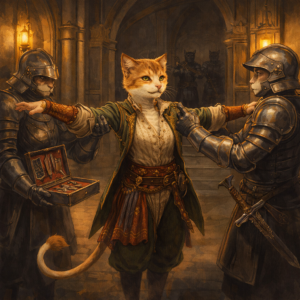 “His majesty insists that his visitors trim their claws to uselessness, and who are we to disobey the wishes of our illustrious king?”
A pale blanket of smoke hangs over the capital, its acrid scent infesting my fur. The sounds of rioting continue from beyond the iron-bound gates of the palace. I turn my back to the noise and raise the camphorwood box to eye-height for a final inspection. A thin line of red seeps from one corner. Retrieving a handkerchief from my purse, I trace the hinged edge of the box. The square of silk falls open in my hand. Blood smears across the corner that bears the royal crest. An embroidered sunset of scarlet against the yellow silk. I toss it aside and it flutters to the ground like a dying moth.
I pad up the stairs to the palace proper. The box is a leaden weight carrying the hopes of a downtrodden people. Not that they’d thank me.
The commotion beyond the walls falls away, receding like the waning tide. It is replaced by a mournful yowling that speaks of disbelief and loss. The rebels have discovered that their leader is dead.
* * *
A guard, a tawny tabby with a torn ear, yanks the display box away from me. He flips open the doors to inspect the contents. Four others, ears flat against their heads and bare blades in their hands, scrutinise my every movement.
I stand with my arms outstretched. I’ve forgone my usual leathers, replacing them with courtier-style linens. An official with fashionable tortoiseshell-patterned fur runs his hands over my clothes. He is efficient and none too gentle. The guards have already removed the knife from my boot and the short swords from my waist. The official steps back, brandishing the dagger I’d hidden under the broad belt at the small of my back. He waggles it at me as if I were a naughty cub caught stealing from the cookie jar.
I give him a ‘worth-a-try’ shrug. They expect me to try, and I expected them to find it. They know I hate the king, but they also know I can do nothing about it. At least, that is their perception.
He tosses the dagger into a basket. I flex my paws, making a show of examining the blunted claws at their tips, as if bored by the whole process. The king insists that his visitors trim their claws to uselessness, and who are we to disobey the wishes of our illustrious king?
Scholars tell us that our ancient, four-legged ancestors wielded ever-sharp retractable claws. I ponder this as the official’s fingers sift through my fur. Hidden claws would be rather handy.
I chuckle at my weak, unspoken pun. The eyes of the guards dart all over me and their whiskers twitch. I quash my humour. It wouldn’t do to come this far only to be struck down by a skittish guard.
The official waves his fingers so he can check inside my ears. I bend down as indicated. This close I can see his is not a true tortoiseshell. Rather he has dyed his fur in patches and the regrowth of orange under the black gives it away. As thorough as he is, I note that he doesn’t touch the assassin’s cuff that pierces one of my ears. When he reaches my tail, he hesitates. It is shaved along most of its length leaving just a tuft at the end. Common wisdom has it that we only shave our fur when a dire case of parasites or disease forces our hand. It is a mark of shame to have to do so.
My tail had been a resplendent charcoal, a rarity much admired by those who knew me. I will admit it was a source of personal vanity. It pained me to cut the fur away, but we do what we must.
I proffer my tail to the official. He recoils, repelled by the proximity of the bared skin. He flinches and backs into one of the guards. The guard shoves him forward again then shoots a quick glance into the shadows. Two crossbowmen stand within a darkened alcove. Their fingers caress iron triggers. The windlasses they’ve used to span the brutal siege bows dangle from their waists. I am amused that they think I hadn’t already noticed them both. Such bows will send their bolts through fist-thick oak doors. A little excessive for one little cat, I think.
The guard with the display box has reset the bronze latch. He hands it back to me.
“Unlucky,” he states nodding to the box.
“It certainly was for her,” I reply. The box holder doesn’t appreciate my comment.
“Turn yourself right around and get you gone,” the guard sneers. The others chuckle. The phrase is newly popular at court and these guards ape those above their station. I let them see no emotion, but as I turn to the throne room, I smile at his choice of words.
That is exactly what I intend to do.
* * *
The throne room is wide and brightly lit by a multitude of glass-fronted lamps. I know from past inspection these are firmly affixed to the walls. The brass sheeting that lines the room is polished to a high sheen. There is nowhere here to hide, no way to sneak up on the king. His majesty’s corpulent form reclines on a divan dotted with tasselled cushions. Lavender and grey silks are draped around his body leaving his tail exposed.
To be fair, it is an excellent specimen. Long, luxuriant, and powder-white, it is exquisitely maintained. It is, I think, the only thing to be admired of our ruler.
“Place It There,” he Commanded, pointing to the low viewing platter on the ground between us.
The power of his magic has me in motion even before I am able to acknowledge the order. My movements are still fluid, but I cannot deny the compulsion. I am forced forward and set down the box.
“Return To Your Line.”
The first black line marked on the floor is used by appellants when appearing before the king. This line is deemed suitable for most people. It is far enough away that should they make an attempt on his life, he’ll have time enough to employ his magic to foil the attempt. Many have tried; none have come close. So confident is he that no guards are stationed within the room. The only other occupants are the king’s mousling attendants. Their eyes stare with dull incomprehension awaiting instructions from the king. He has used his magical Commands on them so often that all independent thought has been burned away.
The line I am sent to is three times the distance of the other. My only rebellion is that I use a courtier’s shuffle rather than my usual confident stride. A hypothesis confirmed. I suppose, I should be flattered that he deems me such a threat that he keeps me so far away. Instead, I yawn.
The king tilts his large head trying to determine if I am mocking him. The long white fur that spills from his clothes waves in the air like water flowing. It gives the illusion of his already bulky form being larger still.
I may have pushed him a little too far. He is as petty as he is vain, but I know I am a valuable, if unwilling, asset. Before he can decide if I did indeed mock him, I bow my head in submission. The gesture mollifies him, and the swish of silks announces that he has risen from his repose. At the scrape of the latch, I look up.
He has unfolded the box, so that it lies flat. The severed head of the rebel leader on display. He doesn’t bother asking me to confirm the identity of the head. His Command had been specific and impossible to disobey. In death, the eyes of the decapitated revolutionary have rolled back in her head, her tongue lolling from her mouth. The king giggles as he nods to himself.
“So, this is what she looked like,” he murmurs. “Pity about the expression,” he says. “That’s bad luck.”
I feel a perverse joy in his discomfort.
The yowling outside rises. It invades the throne room, swelling as it rides on the tide of grief. The rebel leader had been a hero of the common folk. A selfless revolutionary driven to free her people. By contrast, the king is hated by all. The rich have been disenfranchised, the poor exploited. Only the soldiers, well-paid and well-fed, support him. In a world of fast blades and quicker tempers, that is enough. The riots outside are a symptom of his cruel reign. Were it not for his magic, he wouldn’t be king at all. The world is poorer for his presence.
The irony of a hired killer judging another is not lost on me.
I am jolted from my reverie as I realise that the king has asked me a question. I try to drag his words from my memory but cannot summon them.
“Just so, your majesty.” I hope my reply is vague enough to satisfy his query.
It isn’t.
“When I ask you ‘How did she die?’ you reply ‘Just so’?”
His voice is tight, angry. He narrows his eyes then flicks a long, sharp nail towards me. “Choke Yourself,” he Commands.
My hands leap to my throat. I tense the muscles in my neck in an attempt to save myself, but it is futile. I know. I am intimately familiar with the act of choking someone. I tumble to the floor, falling onto my side. I tilt my head up to see him gazing down, face impassive.
“I like you, assassin, I really do,” he says as my hands squeeze tighter. There is neither pity nor anger in his cold blue eyes. “But you need to be more careful about what you say,” he turns and walks away, “and do.”
Spots appear at the corners of my vision. The room begins to fade away, the corners drifting inwards.
“Release Yourself.”
I suck incense-heavy air through my tender throat. My vision swims back into focus. I find him standing in front of his divan, his back turned to me.
It is time. My toe claws dig furrows in the wood as I spring forward. I whip my belt from my waist, whispering softly against the linen, and cover the remaining distance in five, silent strides. I ready the belt to wrap it around his furry neck when his voice shatters the air.
“Be Still,” he Commands.
I cannot ignore it. My legs betray me, arresting my rush. I skid to a halt, the belt dangling from one hand. It swings back and forth like a hangman’s noose in the wind. His exposed back is a full body length away, but he might as well have been on the most distant of our moons.
“There have been many attempts on my life in the past,” he says, turning and drawing close to me. “But, I stand here still.”
The king has brought himself within arm’s reach, but I can do nothing. I will my feet to move but they feel like they are locked in stone.
“By now, I would have thought you would know better.” He leans closer still. His whiskers, coated in gold leaf, brush my face. He sidles up to me and lays his arm around my shoulders, confident in his magic. The scent of the clove oil he uses on his fur fills my nostrils. I feel a shudder rising within me, but it fails to rise to the surface, impotently beating at me like a fly caught in a bottle.
“You are wondering, ‘How did he see me?’ ” the king says in a stage whisper. He strokes a finger down my cheek as if pondering the question, then snaps his fingers. “It’s the walls!” He dances away and spins, arms outstretched. Long fur trails from his arms like a comet.
“They are lovely, aren’t they? Polished to a mirror shine,” he says. A half-smile creases his lips, exposing his fangs, yellowed by excess. “A mirror shine,” he reiterates. The smile becomes cruel. He flicks the circular ear of a mousling servant with one taloned claw. Blood trickles through the grey. The slave shows no sign of having noticed the assault. “I see all that happens in my own throne room. I control everything.”
He stops and turns his head slightly towards me, not quite meeting my gaze. “I’ve killed people for less,” he says casually. He admires his claws, testing the points with his thumb. The flickering light of the lamps makes them gleam.
“A great deal of people,” he says turning to look directly at me, “and for a lot less.”
He looms before me. His face is so close I can smell his scented breath. “But as I said, I like you.” He indicates the box with a tilt of his head. “And you are useful to me.”
He bops me on the nose. I have seen him use the same gesture many times before dismissing — or passing judgement on — someone.
He shakes his head and sighs in mock disappointment before returning to stand before his divan.
“I’ll call for you when I need you again. What is it they are saying in court these days?” He clicks his fingers. “Ah, yes. Turn Yourself Right Around and Get You Gone,” he Commands.
The smile breaks across my face like the morning sun racing across the plains of my homeland. Eyes widening, the king realises something isn’t right but I am already moving. Spinning on the spot, my tail flies out. A quick twitch sends it higher. Neck high. The soot-darkened blade hidden within the tuft of my tail whips across his throat. Instantly his fur darkens to crimson as blood burbles and seeps from the cut I have made. I complete a full revolution as Commanded then begin the walk towards the exit.
I can’t stop; the Command still compels me, but I am able to look over my shoulder. The king has fallen to his knees, hands clutching his throat. His mouth works but no sound emerges. His clawed hands fail to arrest his motion as he topples forward. The mouslings stand uncomprehending.
I step through the door and feel the king’s Command slip away from my mind like a sheet of silk. I stride past the guards without collecting my weapons. One imagination-starved guard calls out, “Turn yourself right around and get you gone” at my retreating back.
I smile to myself but do not look back. It took me months to popularise the saying at court. It will likely be longer until it is forgotten. I’d baulked at shaving my tail but it was the only way I could hide the blade from their probing paws.
Padding down to the palace gates, I resist the urge to run. The night braziers are just being kindled and in their wavering light my shadow appears to dance. The sneers of the guards are dismissive, but they ready the bolt on the small monk’s door set into the larger gate.
There is a shout from behind me.
I fake a stumble and bring myself up close to the gates, my shoulder under the heavy bar. The wide-eyed guards are slow to react. A quick shove and the bar clears the cradle. It tumbles to the stones. I pull on the doors and step into the shadows. The guards recover, leaping towards the gate, but the rebels have seen the movement of the gates and spill into the palace grounds. They vent their rage over their leader’s death, overwhelming the guards in seconds leaving lifeless corpses behind as they surge up the palace steps.
I stare at the dead. They’ve given their lives for their king, just as the rebel leader offered up hers to me to rid the land of the king. Revolutions are rarely bloodless, but I have had enough of death.
Stepping out into the now empty gate, I turn myself around and am gone.
* * *
 About the Author
H. Robert Barland is a teacher, Viking re-enactor and black-belt martial artist. A former climber, film extra, and resident of the UK, he has now returned to Newcastle, Australia where he lives with his wife and two boys. He considers himself well adapted for life on land and can be followed on BlueSky (@hrobertbarland.bsky.social), Instagram (@h.robertbarland) and X (@hrobertbarland).
We Used to Be Best Friends
by Ian Salavon
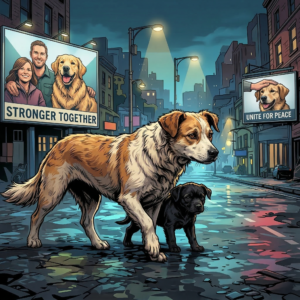 “The sooner you accept that humans only love you on their terms the better.”
The park was the best place to get and leave information. The humans hadn’t figured it out yet. Good food in the dumpster behind the sandwich place. Watch out for animal control on Friday morning. The piss used to be impressions that this was someone’s marked territory or a sense of nearby danger. Now they were damn near treatises. Flora did her part. Squatting under a hedgerow, she left a message to stay away from the park during the daytime. Humans came out with dogs that were content with the charade of ownership. They still played fetch. They still jumped up and licked their masters’ faces. Humans ran the strays off with pepper spray, so their servants weren’t bothered by protests of canine freedom. Sometimes, the police would use their attack dogs. They relished the chance to do right by their two-legged overlords. Those dogs chose an easy life. Flora understood an easy life meant a long life. But knowing what she knew now, she considered them all traitors.
A crumpled-up newspaper lay next to where she was doing her business. The advertisement on it touted the better life dogs had if they only stayed as pets. It wasn’t that long ago that humans said the same to other humans they owned. “Know your place.” Be a slave and be happy.
Humans welcomed The Awakening at first, and the spokesdogs for the world canine population supported the transition from pet to partner. For thousands of years the two species were friends in a way other animals envied. Then one day with no warning, dogs were equals to people with understanding of philosophy and culture and everything they’d contributed to society. Dogs began to say things to humans they’d never been able to say before. Things like “No” and “I don’t feel like it” and “Shut the fuck up.” That’s when humans realized free will only worked when one species had it. When the obedience went, the partnership went, and the resistance started.
The dogs didn’t want anything that any other group hadn’t fought for in the past. Rights. Space. The ability to live in safety and security. They didn’t think it was too much to expect after over one hundred centuries of servitude. They found out the hard way how misguided they were. Strays flooded the streets kicked out by the people that took them in when they were just puppies. An entire generation of dogs, thrown away like garbage.
Flora was among the first to go. “We love you, Flora. We just can’t take care of you anymore,” Veda said.
“We never wanted children. We just wanted a regular dog,” Stan added.
They promised to help her find a new home and give her some money to start a new life. Then they drove into the city, pushed her out of the car and drove away. That’s when Flora knew they loved her when it was easy. The more dogs she met, the more she heard the same tale. Humans didn’t want friends. They wanted something they could dominate. Something that was stupid enough to think what they were giving was love. It was sick. But she wasn’t stupid anymore.
Flora finished leaving her message and was about to make her rounds marking her area when she heard a rustling from under the bush. Her hackles went up and she lowered into an attack stance. Flora wasn’t a trained fighter, but with her size she could hold her own. She was classified as a “designer dog.” She was bred to be a companion and little else. But she’d learned quickly after being on the streets that survival instinct is greater than breeding. She had her fair share of fights and the scars to prove it. Her desire for self-preservation was as strong as anyone’s, and she had come to appreciate it more now that she was on her own. She was ready for violence when the distinct whine of a puppy pierced her growling. She tilted her head. Slowly, Flora padded through the bush poking her muzzle to where the sound came from. Huddled in a mass of dirty fur, was a puppy almost nothing but bones.
His close coat was black, but it looked brown for as much dirt covering it. He turned to face the larger dog and trembled in fear and fatigue. He tried to snarl at Flora as he backed away with his tail between his hind legs but only managed a pathetic yap.
Flora immediately softened. She remembered how hard it was for her when she was first introduced to the urban wilds of the city, and she was full grown. His head and paws looked disproportionately large. Flora put him at three months old, tops.
“Calm down, little one. I won’t hurt you,” Flora said in her most comforting tone. She never got the chance to have a litter. Stan and Veda “fixed” her when she was about the same age as the shaking pup in front of her. Forget that she was never broken. Just one more example of the machinations of humans to extract what they wanted. Take without asking. Wrong without remorse. “Are you hiding?”
The little dog didn’t respond, but Flora could tell he understood. She laid down in front of him and crossed her front paws showing she had no interest in harming him. He was still shaking but he took a step closer to her. “I’m Flora.” She felt waves of guilt and anger every time she uttered her slave’s name. But that’s how they knew her. And her identity carried weight.
“I…” the puppy’s voice quaked. “I didn’t want to fight.” He was whining so deeply, Flora’s heart broke. He didn’t have any injuries. He was a pit bull. A breed notorious for their rambunctiousness being manipulated into aggression and brutality. Laws were in place for years preventing dogfighting. But humans didn’t even follow the laws of nature. Why would they ever follow the ones they invented?
“Did someone make you?” Flora asked scooching forward on her belly.
“They tried. But I told them no.” He paused and lowered his head. “That’s when…” He stopped talking altogether.
“That’s when they kicked you out,” Flora finished. The puppy whined again. “Ok…ok…take it easy,” she reassured him. “Why don’t you tell me your name.”
He sniffed and took another step closer. “The man who…” He paused again. “He said I was too smart for my own good. When he threw me in the bushes he said, ‘figure it out for yourself, Sherlock.’”
Flora’s ears went down, and her brows went up: the canine equivalent of an understanding smile. Inside she was seething. Too many of her kind were cast aside. The fire she felt when she watched Stan and Veda drive away was just as hot now as it was that day. They pulled her from her mother. They removed her ability to get pregnant. They punished her for doing things that she couldn’t control. They forced her to perform on command. Then after all that, after being the perfect dog, they deserted her when she needed them. All the fear and rage and betrayal boiled in her gut hearing the cries from the pup. She forced the feelings down, but she never forgot them.
“Do you know what a Sherlock is?” Flora said. He cocked his head sideways. “It’s a human that uses his smarts to bring bad guys to justice. It’s a powerful name.” She watched his tail raise up from between his legs and swish back and forth. She hooked him. “Are you hungry?” He practically jumped. His tail beat like an out-of-control metronome as he panted. “Ok.” Flora chuckled and got to her feet. She licked Sherlock’s face trying to get the muck off. She had to hold him down with one paw to keep him still. “I’m going to take you somewhere to get something to eat. Then I need you to do something for me, ok?” Sherlock yapped in the affirmative over her words. She laughed again.
After she was done cleaning the slime from his eyes, Sherlock got a strange look on his face. Flora nodded as if to say what’s wrong. “What if the man comes back looking for me? I mean, what if he changed his mind?”
She lowered her head equal to his. When she spoke, it wasn’t in the compassionate tone like before. “Listen to me, Sherlock.” His eyes went wide. “The sooner you accept that humans only love you on their terms the better. That man threw you away because you dared to defy him. Does that sound like someone who is going to change his mind?” Sherlock didn’t say anything. “We don’t need them. We never did.” Flora walked out of the bushes motioning for the puppy to follow without another word.
They stayed in the alleys and side streets. Flora told Sherlock to stay close. “You never know when we might have to run.” She didn’t answer when he asked why. They passed billboards with slogans like “Hands and Paws United” with a picture of a human and a dog embracing. Another sign advertised a dog food brand promising to “Keep your little buddy mellow.” It made Flora want to eat grass just so she could throw up.
Her path took them on mostly deserted roads. The rare human they did come across ignored them. They passed one dog on a leash. His coat gleamed even in the washed out light of the street lamps. He was brushed and well taken care of. “Hi,” he said to Flora and Sherlock. The puppy went to respond, and Flora growled. “Don’t talk to us,” she said to the dog. He hmphed and turned his nose up when his owner jerked his leash. “What’s their problem?” They heard him say to his human as they walked off. The human ignored him.
They walked past a bank of televisions in a store window. On every screen was the human leader standing next to a strong looking German Shepherd. “We stand in solidarity,” the shepherd said. “I call on the Canine Liberation Front to stand down. We are working together to propose laws that will benefit both our species as we navigate these uncharted waters.” Flora sneered. He sounded like one of them. “We will not tolerate, condone or dismiss any further acts of terrorism against our human friends. Future acts of violence will be met with swift retribution. We have developed a five-point plan to eliminate…”
“Come on,” Flora said to Sherlock. She didn’t want to hear anymore.
“There!” A shout came from behind her. She turned to see a group of uniformed officers running at her from half a block away. Sherlock yelped in pain as Flora snatched him up by the nape of his neck and took off at a dead sprint. She turned in between buildings and leapt over dumpsters. Gunshots cracked in the air behind them, but they only ricocheted off the concrete sidewalks. Flora heard people scream as she flew by them. All their guns and laws and protections and they still couldn’t catch her.
She ran on with Sherlock bouncing in her jaws. A high pitched cry from him accompanied every rhythmic footfall. Flora ran behind an abandoned building and crouched under a pile of bricks. A torrent of whines and questions shot out of Sherlock’s muzzle. “Why were they shooting at us? What did we do? I want my mommy. Where are we going? I’m scared.” Flora stomped her front feet on the pup and growled, long and deep and terrifying. Sherlock got quiet.
They stayed silent under the pile of bricks for a long time. Flora finally poked her head out and looked around. “Ok,” she said. “The coast is clear.” Sherlock took a step away from her. “Aw…I’m sorry buddy,” she said, adopting her sympathetic voice once more. “I was scared too. I had to keep you quiet, and I didn’t have time to explain.” She shook her head as if trying to get something loose. “Humans…” she tried to explain. “They’re unpredictable.” Sherlock cocked his head. Flora smiled. “That means we can’t ever know what they’re going to do. Maybe they wanted to hurt us. Maybe they just wanted to scare us.”
“It worked,” Sherlock sniffed. Flora padded her foot on the ground in agreement.
“It’s right around the corner, the food.” Sherlock perked up again. “Let’s go but be careful. There might be more out there.” Sherlock’s head never stopped looking for humans, but they didn’t see any more.
Flora led him to a huge building with part of the roof collapsed. The biggest dog Sherlock ever saw was standing in front. He was snarling as they approached but relaxed when Flora and her companion stepped out of the shadows. “Flora!” He barked. “It’s about damned time.”
“Hello, Ace,” she said as they circled each other and sniffed.
“Who’s this?” Ace said smelling the cowering puppy. “A new recruit?”
“In a manner of speaking. This is Sherlock. He’s a friend.” Sherlock huddled under Flora as Ace barked out a laugh.
Flora said goodbye to the big dog and walked into the structure. There were dogs everywhere. All sizes. All colors. Sherlock wagged his tail, but he stayed under Flora. Some dogs were wrestling. It wasn’t play, but it also wasn’t a fight. There were models of humans made of trash. A mangy yellow lab with a missing ear was pointing out the most vulnerable spots to a group of not quite full grown curs.
A small brown terrier trotted up to them. “Welcome back,” she said and they sniffed each other in greeting.
“Sherlock, this is Missy. She’s going to make sure you get something to eat,” Flora said, and she felt his hesitation. “It’s ok. You’re safe here.” Flora pushed him to the little brown dog. “Is everything ready?” she said to Missy.\
“Yeah. Dalton’s ready to go, but you know him.” They shared a look of understanding. Sherlock was lost. “Come on, little fella,” Missy said. “Do you like fish?”
“Um…I don’t know. I never met him,” Sherlock said. Flora and Missy howled in laughter. “Well, let’s go meet him.”
Missy took him to the back of the building and presented him with a bucket of fish scraps and skin. The smell was intoxicating. Sherlock’s mouth salivated as his stomach grumbled. He tore into the food, stuffing his belly like he would never eat again.
He glanced at Flora every now and then. She was directing the other dogs to do things like check on sentries four, five and six. She wanted updates on the western coalition. Flora ordered reports from the last twenty-four hours. Sherlock didn’t know what any of that meant, but he knew Flora was important. And he would do what she asked him to do.
As she barked at her friends, an old three-legged golden retriever walked up to her and dropped something he was holding in his mouth at her feet. They spoke to each other in hushed tones. Sherlock couldn’t hear much, but they were both agitated and growling.
“We’re at war, Dalton!” Flora snapped. Her voice echoed in the building, piercing the organized calm. All heads turned to face the pair.
“This isn’t war, Flora. This is revenge!” The older dog’s voice was hoarse and wet. “You’re trying to hurt them, not make things better!”
“How dare you! We’ve all sacrificed our lives to this cause. I…”
“Sacrifice?” Dalton coughed out interrupting her. “You sanctimonious hypocrite! If you were so devoted to the cause, you’d be wearing that collar.” He pointed to the object he dropped at Flora’s feet. He motioned to Sherlock and the puppy perked up. “You wouldn’t be using some random kid to…”
Flora lashed at the old dog, biting him on the nose and shutting him up. He winced in pain and cried out. Sherlock flinched as if he felt it too. The old hound lowered his head and limped away from the pack leader. “Sorry, kid,” he said to Sherlock. Sherlock went back to his food. When he was finished, he flopped on his side and was asleep before his head hit the floor.
There was a gentle nudging. Sherlock didn’t move. “Hey! Pup! It’s time to get some work done.” Flora shook the young dog until he opened his eyes. He blinked to clear them, stretched and got to his feet. The light from the morning beamed in through the holes in the ceiling. Sherlock yawned. “Get something to eat. We have a lot to do,” Flora said. She nodded her snout at a pile of food Sherlock couldn’t identify. He made a beeline for it and scarfed it down. Flora talked as he ate. “Remember when I said after you get some food, I need you to do something for me? Well, the time has come.”
He finished the pile of food and bowed his head to her. “What do I have to do?” he said, and Flora set her jaw at the eagerness in his voice. He stood as tall as his little body would go. He was as thin as a puppy could be, but it was clear that if he grew into adulthood, he would be a heavily muscled loyal soldier of the cause. Flora gave him a sad smile.
“Here,” she said and lifted the collar Dalton gave her the night before. Sherlock positioned himself for Flora to slide it around his neck. The weight pulled him down and he pushed his head up in a display of determined strength. It smelled like something he smelled before. Like an unlit match, but much stronger. He didn’t ask what it was. He didn’t care. He was going to do what Flora told him. “Come with me. We don’t have far to go.” Her voice was flat. A contrast to the softness she’d shown before.
All the dogs were lined up in two rows flanking the doorway. Flora led Sherlock through the center, and they bowed their heads when the little puppy passed by. The old golden missing a leg was noticeably absent. “Where’s the dog you were talking to last night?” Sherlock asked.
“We had a difference of opinion.” She looked down at Sherlock. “He’s gone.” Sherlock leaned away. Flora showed her white fangs. The puppy stopped asking questions.
Flora led Sherlock behind their headquarters. The day was bright and cool. The type of weather that made Sherlock frisky. He bounced next to Flora as they passed more dogs, each bowing their heads in a sign of respect. Sherlock bowed back. He didn’t know what else to do. “You’re the leader,” he said to Flora. She grunted in the affirmative. The duo went past torn up houses and dilapidated businesses as a roaring sound of thousands of voices got louder.
In the distance Sherlock saw a building that looked like a dog fighting ring but thousands of times bigger. They were still far away, but he heard cheers erupt through the top of the open-air stadium making him shudder. He took a step back. Flora growled.
“I don’t want to go there,” he said.
“You aren’t going there. Too many people. I’m taking you somewhere else.” They walked along the outskirts of the stadium until they came to a small bridge running over a creek. A drainpipe was emptying a trickle of sewage. “Go in there. Walk all the way to the end and wait for me,” Flora said.
“You won’t forget me?” Sherlock asked.
Flora adopted her caring tone. She put her paw on Sherlock’s head and licked him. “I promise, I will not forget you. None of us will.” She nudged him with her nose, and he walked into the pipe. When he was out of sight, Flora gave a howl of sadness and respect. And she ran off to join her troops.
* * *
“The explosion took place at the end of the third quarter. It is unknown how many casualties there are, but officials estimate the death toll in the tens of thousands making this the largest terrorist attack in history. WVLP has received a letter from the Canine Liberation Front claiming responsibility for the attack, but we cannot confirm its authenticity. We are working diligently with the authorities, and we will bring you updates as soon as we have them. This is a sad day for human/dog relations as it comes less than a day after the agreement…” Veda turned off the radio.
“She thought we would be there. She knows about our season tickets. She knows everything,” she said. Her dry throat cracked, and she grabbed a wad of her shirt at her chest trying to keep her heart from thumping out.
“Hang on,” Stan said. “They said they couldn’t confirm it was her.” He pressed the gas pedal to the floor speeding up to leave the place they called home behind.
“You’re kidding, right?” Veda wiped the tears from her face. “She’s coming for us. She’s going to find us. And she’s going to…”
“That’s why we left. She won’t catch us. She doesn’t know where we’re going.”
Stan tried to sound confident, and he managed to calm Veda with his words and reasoning. He kept going over it in his head. How hard would it have been to keep her? What more could we have done to help? We did her wrong. He wanted to believe what he told his wife was true, but he couldn’t shake the idea their dog would find them. Cross mountains. Swim rivers. Fight predators. Hate is just the flipside of love, and sometimes when a dog loves someone enough, there’s nothing she won’t do to get back to them.
* * *
 About the Author
Ian Salavon is a husband, father, professional chef by trade, wannabe Renaissance Man, and longtime aficionado of speculative fiction. When he is not cooking, hanging out with family or writing, Ian spends his free time at the Fort Worth Judo Club where he is a black belt and coach. He has short stories published in On The Premises Magazine, Kaidankai, Small World City, and Phano Magazine, but most of his work is featured in long road trips and around the dinner table. You can read more of his work at www.shortstorysalavon.com
I Didn’t Raise My Cub To Be a Soldier
by Lynn Gazis
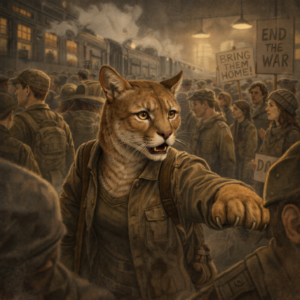 “I’m not a hero, nor a coward. I’m a cat.”
The door stood ajar, as if Annan had just stepped outside to get the mail. But we knew, the moment we stepped inside, that something had gone terribly wrong. The large cardboard boxes where we lounge comfortably between calls had been torn. A possum, from one of yesterday’s calls, lay half-eaten on the floor. Annan loved possum meat. He would not willingly have left it unfinished. And the whole room smelled of human.
My daughter and I dropped our dead raccoons on the floor and ran down the stairs. I sniffed the ground, searching for where the mingled smells of Annan and human might be strongest. My daughter ran to question our nearest human neighbor. I call her Cookies, because she often bakes cookies, and because I can’t be bothered to remember human names.
Cookies limped out, leaning on her cane, and quickly cleared up the mystery. Soldiers, she said, had come and taken Annan.
Soldiers! They should have known better. Cats don’t belong in the army. Never have and never will.
Humans bred us to be good soldiers. Their mistake. You’ve seen, perhaps the old posters, hanging in museums and covered with glass, announcing the arrival of “Tiger-Men.” We’re more like mountain lion people, but “tiger” somehow sounded fiercer. You’ve watched, perhaps, the old video, of the interview with Zachariah Kim, head of the lab where we were designed. They thought their genetic engineering would give the combined strengths of humans and the larger cats: the claws and jaws of a cat, the deft hands of a human, able to speak in human sign language and wield human guns.
But they missed one thing. We have the spirits of cats, not humans. I’m not a hero, nor a coward. I’m a cat. Heroism and cowardice are human ideas. Humans gather in large groups to fight other large groups of humans. Humans do many things, good and bad, in large, organized groups. Our groups are smaller. A friend or a sister. My cubs. For these, or for myself, I will fight. Why would I want to be a soldier and fight someone far away, for some leader I don’t know?
They could have let us go wild and hunt for ourselves, and we’d have been happy. But humans had spent money to make us, and so humans needed to find us work. We found our niche in animal control. Do you have a raccoon or a snake or some bats you need removed? Who are you going to call? Cat people, that’s who.
I’m an animal control officer, the daughter and granddaughter of animal control officers. I always thought I’d also be the mother of animal control officers. I didn’t count on the Great War. I didn’t count on a land so desperate for soldiers that it came to draft cats.
That morning, we had gotten a call – raccoons in the basement. And another call – bats in the attic. My cubs and I split the calls, two of them for the bats, while I took one with me for the raccoons, and left the fourth behind to answer the phone. We had left the fourth, my youngest, the sensitive one, behind to tend to the phone. Now soldiers had dragged him away. The last place Annan belonged was the army.
I set off at once for the intake station. We all know the station, an ugly brick building surrounded by the most delicious rats’ nests in town. Something about that terrain draws rats as soon as we’ve hunted the old ones. Mostly we care more about rats than soldiers. That day, I had no time for rats.
At once was already too late. My cub, I learned, had been taken away by train. No one would tell me where he’s been taken.
“He’s in the army now,” I was told. It’s a done deal.
That is how my journey began. No one takes my cub to be a soldier. I left the other three to mind our business and set out to retrieve the missing one.
I had never been to the train station. Why would I want to? We were happy where we were. Animal control workers have no need for trains. But I didn’t need to ask the way or take a chance that I’d be lied to or misdirected. I simply followed my cub’s scent. I knew he’d take extra care to leave a trail.
In the old days, when I was young, green bushes and bright flowers stood on either side of the road to the train station. A brook trickled along one side of the road. If a week passed when animal control calls were too few to feed us, we’d head for the brook, to catch fish, and follow them up with squirrels from nearby trees.
These days, the brook is long dry. Someone planted hydrangeas at spots along the side of the road, to replace the less drought tolerant flowers of my youth, but mostly you just walk in a cloud of dust. Between the drought and the passage of so many soldiers, not much grows next to the road.
Some say that humans fight over water, now that there is less than there was before. Others say that humans fight over land. What cat knows or understands the causes of human wars? They march in lines to the sound of music, headed for some distant place where they will need to hide like cats to pounce upon their enemies.
At first, my cub’s scent mingled with the scent of humans, many humans. But as I walked further, an odd thing happened. I caught the scent of others of us, mingled with the humans. I wasn’t the only mother to lose a cub to the army. Why would they do this? How could they not know that cat people belong nowhere near an army?
When I reached the train station, my hair stood on end. I saw crowds of people as I had never seen crowds of people. But somewhere in that crowd I hoped to find my cub, so I steeled myself and pushed forward.
Young humans in uniform, human families with baggage perhaps heading off on vacation, solitary humans glancing at phones. My nose told me that my kind had passed through this station, but I couldn’t see any cat people now. If I asked one of the humans with uniforms where they might have taken my cub, would I get an answer? Perhaps not. I remembered how brusque the humans had been at the intake station.
Then I saw them, a small group of humans holding signs. “Peace.” “War” in a red circle with a red line through it. “Hell no, don’t go.” I walked over to them.
“The army took my cub,” I said to a woman who held one end of a “Quakers for Peace” banner. The lines on her forehead and gray streaks in her hair suggested she might be old enough to have a cub of her own of army age.
“Tell me about it,” she said.
“We’re supposed to be off limits,” I said.
“Not since last week,” said her companion at the other end of the banner.
“Where did they take him?” I asked.
“Wait,” said Gray Streaks, “Are you going after him alone?”
“Of course!” I said, “He’s my cub.”
“You can’t fight the army alone,” said Gray Streaks.
“Just watch me!” I said.
“I’ll give you the address,” said Gray Streaks, “But we need to talk. Let me buy you coffee – I mean milk.”
Soon we sat on cushions at a table at a local coffeehouse. Flat pictures of humans and wild plants, the motionless kind that humans like and that bore us cats, adorned the walls. The waiter gave Gray Streaks a cup of that dark, bitter liquid that humans like, while I got a saucer of milk. A human strummed an instrument and sang, “I’ll take you to the war, my love,” while another human sang her refusal to join her love in the army.
“Do you have a way to tell your cub when you’re coming?” asked Gray Streaks.
“No. How would I? We don’t each carry our own phone the way you humans do. There’s one phone in the office, and two phones are enough to share between us when we’re out on a call.”
“That’s where you need help,” said Gray Streaks, “Someone who can talk to one of the recruits at the training center can find out their schedule, how long your cub might be there before he’s sent to the front, and how you might get your cub a message. Do you know how many other cubs were taken?”
“I didn’t know any others were taken.”
“There are other cubs there,” said Gray Streaks, “And many mothers coming for their cubs can make more trouble than one.”
“We’re cats,” I said, “we don’t form large groups like you humans. That’s why we don’t belong in the army. That’s why they should leave us alone. Why do they want my cub off killing people far from his family? Just point me where he is and I’ll tear their faces, till they give him back.”
We argued through two cups of coffee for Gray Streaks and two saucers of milk for me. Humans and cats will never see things the same way. My new Quaker helper, Gray Streaks, could no more be convinced that I could rescue my cub by going to the army camp myself and fighting till they gave him back than I could be convinced that trying to organize a band of cats to come to the rescue would help.
Finally, without agreeing, we settled on a deal. I would answer all the questions that she thought would help her find other cats whose cubs had been taken, and she would point me to the army office. She could also, she said, help me get a message to my cub to be ready. Human recruits, unlike my cub, took their phones with them and stayed in touch with their parents, at least while they were in the training center. On the front, contact might be spottier.
“Then I need to bring him home before they take him to the front,” I said.
The next day, I returned to the train station. I looked for the people holding signs. I didn’t find Gray Streaks. But I found someone else, talking to the young human with the “Hell no, don’t go” sign. She stood taller and longer than I, and had striking large paws, six toes on each. The twitch of her ears and flicking of her tail told me that she was as ill at ease in a crowded train station as I was, and, after all, what cat wouldn’t be? When I had my cub, I would not be able to get back fast enough to my own cardboard box, in my own home.
Her voice rose with the words “my cub!”
“Have they taken yours, too?” I asked.
We cats are not like you humans. We don’t form bands or organize. We would never form an army, and we’d never gather in groups with signs to protest an army. But cat mothers will help each other one on one. The two of us headed to the coffeehouse to plot over saucers of milk. I told her about Gray Streaks.
“She thinks she can organize cats,” I said, “Fat chance! But she can get us the address, and a human with a phone who can get a message to our cubs.”
“She may be right,” said Six Toes, “That going straight at them with our claws isn’t the best approach. The army has a lot of humans, and they have guns. But if we had a distraction, perhaps our cubs could escape in the ruckus. What about skunks?”
Many of us cats work in animal control for the obvious reason. A lot of the animals that humans want to get rid of are tasty. That possum, those rats – there’s good eating in human pest control. If humans are willing to supply us with good hunting and pay us for it, why not take the job? But once in the animal control business we’ve had to learn to handle animals that we might have found more trouble than they were worth, if we were just looking for a meal, like skunks and porcupines. We even handle animals that we’d give a hard pass for dinner, like rattlesnakes or swarms of bees or hornets. Whatever you want to get rid of, we’ll take off your hands.
Why not become the cats who could take off animal control’s hands the animals that were trouble rather than good eating?
I told Gray Streaks that Six Toes and I had an idea for a company that could gum up the works at the training center, and could we find a human to handle the paperwork to make the company legal? Humans are good at paperwork. Then, confident that we’d get a human to file papers for us and set up our office, Six Toes and I set about the fun part of the task, figuring out how to wrangle all the bees and snakes. We talked with other cats in the animal control business, who were happy to give us their skunks and porcupines and bees and hornets and snakes, at least the poisonous and not so edible snakes. We even persuaded some to pay us in bats for taking wasps off their hands. We cats, always current on our rabies shots, consider bats a prime taste treat, but humans, who fecklessly wait till they’re exposed to get shots for rabies, fear bats even more than they fear bees. And to rescue our cubs, we could sacrifice the opportunity to eat bats.
Gray Streaks sent us not just one human but two, to help us set up the office. They filed papers to set up the company, found office space, and got us a new phone. And sent us more cats. Soon there were eight of us cats, and two humans, and we told the humans to stop sending us cats, because a group of ten, between humans and cats, is as much as a cat can manage, even if we were all mothers looking to get our cubs back. Any other mothers would have to manage on their own.
We had to rely on our humans, with their phone contact inside the training site. How long would it take for a human inside to get word to all our cubs? Not long, as cubs stood out among the humans. How long did we have before our cubs were moved? Weeks, easily enough time to round up wasps and snakes, but not enough time to dawdle.
On the day of the event, we arrived shortly before dawn, with our menagerie. The grounds smelled strongly of humans, but also of cats. How many cubs were trapped there? We scattered with our animals, as we judged they’d make more distraction for the humans if they came from more quarters. Skunks, porcupines, bees, hornets, wasps, bats, and snakes both poisonous and not poisonous but scary looking to humans all had their planned locations for release. My job was scattering all the stinging insects.
As I drew closer to the training base, I saw another band of cats, digging.
“What are you doing here?” I asked, and got the reply, “Taking back our cubs!”
Closer to the base, I met still another band of cats. I could tell by their accents that these cats were big city cats, and they had, it turned out, big city plans. This band of techno-cats busied themselves jamming the radio signals that, they said, the soldiers used.
Humans, I realized, had found ways of their own to wrangle cats. We cats work in small groups, but humans, one or two to a band of cats, have no trouble communicating with each other about what each band is doing, and arranging for the bands to show up at the same place at the same time. I hoped the army would not learn from our example. Was it possible, after all, that cats could be made into soldiers?
Surely not! All of us, mostly mothers but also some fathers and aunts and grandparents, had come to rescue our own cubs. No one would make us fight for anything larger than our families. I didn’t raise my cub to be a soldier. My cub would come home with me.
I turned a corner and two human soldiers pounced on me. I fell, biting and scratching, but as I did, I dropped and let loose the last swarm of hornets.
I was, you may understand, dressed in full beekeeper clothing. All my band of cats were, as were our two humans. Despite all of that, I got stung once, and yowled.
The humans, though, had nothing of the kind. Hornets swarmed them. They shrieked and swatted, and I ran.
Other human soldiers rounded the bend and shot at me. I ran. They say to zig zag when someone is shooting. I did nothing of the kind. I can’t keep zigzagging straight in my head when bullets are flying, and when running straight I run fast. I did get hit, once, on my left back leg, but kept running through the pain.
I reached a wood some distance from the base, and there I stopped and lay down, having outdistanced the shooters. Time to inspect and clean my leg. Time to feel the pain more keenly. And time to wonder, had I failed my cub? I could only hope that I and the others had provided enough distraction for him to escape. After all, I had no more pests left to release.
I lay for long minutes, but I could not rest. Not without my cub. I rose and limped, scanning the land from the trees in search of my companions. The sun had nearly set by now, and human eyes must be dimming. But my spot in the forest lay uphill from the training camp, and I had, from my vantage point, a better view of the actions of all the bands of cats. Many of the soldiers still struggled with our beasts. The various stinging insects proved especially effective. Some of the cats, in defiance of the wishes of humans like the Quaker Gray Streaks, had chosen to charge the soldiers and fight. The signal jamming techno-cats used puffs of smoke to send messages to each other.
Far across the field, I caught sight of Six Toes, letting loose some bats. We had planned to save the bats for last, to give them the advantage of the coming darkness. I limped my way to her.
“Are these the last?” I asked.
“Yes,” she said, “Time to find our cubs.”
“The tunnel digging cats?”
“Probably.”
We collected the rest of our band and found that we had lost our humans, and thus, our phone. Possibly its signal in any case had been jammed by the techno-cats. I hoped the soldiers hadn’t taken our humans captive.
I wouldn’t have thought we could ever forget where we’d seen the tunnel digging cats, but it turned out that, though we were all sure we remembered the location of the end of the tunnel, we remembered three different locations. All we could do was try them all. By the time we reached the third place and found no tunnel, my leg ached as it had never ached before. Besides this, we had to keep pausing to hide in the underbrush from soldiers.
Six Toes sniffed and announced that she had the trail. The rest of us followed. Soon I caught the scent of my cub. I almost forgot my injured leg in my haste to follow the scent.
At last, we reached a small clearing full of cubs. My cub, the cubs of Six Toes and three others of our small band, and other cubs that none of us knew. Cats from other bands – mothers, fathers, aunts, grandmothers – arrived to take their cubs. If we hadn’t feared attracting soldiers searching for the missing cubs, we would have cheered. Victory!
Victory, at least, for me and Six Toes. Some of us have our cubs. The others remain to try again.
We cats are not like you humans. We don’t organize for causes. We work together to care for our own families. The other cats, who were our fast friends when all of us worked together to free our cubs, will take over the business. Six Toes and I, and the others who have our cubs, have agreed to send the business all the nasty, useless, inedible critters that come our way, in our animal control work. We leave it to you, their new human comrades, to handle the paperwork, and to find out what happened to the humans we lost at the training camp.
As for me, I am bringing my cub home.
* * *
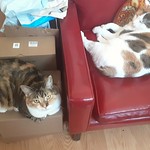 About the Author
Lynn Gazis (she/they), being one of nine children, grew up in a small town in New York surrounded by cats, dogs, mice, gerbils, turtles, snakes, and an invisible goldfish. As a child, she played “For All the Saints” on the piano at a funeral for a mouse. She now lives in Southern California with her husband and cats. She works in IT and is active in her Quaker meeting. She has stories published by Cathedral Canyon Review, Air and Nothingness Press, JayHenge Publishing, Persimmon Tree Magazine, and Friends Journal. The cats, though, want you to know that her most important function is scratching them right where they want it and placing items on the table for them to knock down.
The Heart of Rain
by Spencer Orey
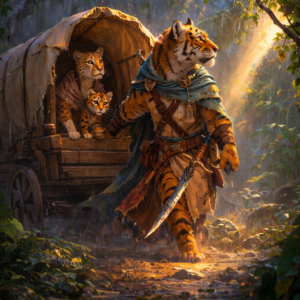 “I was not the Judge, but I would try.”
The caravan season should have ended with the onset of the rains. Unpredictably flooded trails and the rise of furious displaced snakes made it treacherous to cross the forest we called the Heart of Rain. Moreover, the best of the lion guides had long since crossed over and were now feasting through their earnings. The only lions still offering their services here at the border were the worst of the lot and the most corrupt. Nobody who knew any better would choose any of them. And yet, wagons full of desperate refugees and travelers kept arriving in hopes of a better life away from the pride lands.
The latest donkey-wagon waiting at the inn’s crossing post looked desperate enough. A cheetah waved in hopes of attracting a suitable lion guide while a cheetah cub, likely hers, scratched at the nearest wheel. Other cats chattered in the wagon. I wondered if they’d be desperate enough to choose me as a guide, even though I was no lion. Nobody ever chose a tiger like me, but I could at least offer my services.
I slunk out from the inn’s overhang for a slow and polite approach. Old Grezzawel the lion shoved past me with his tail arrogantly raised. He said, “Do not think to ply your foolishness here, striped one. That wagon is mine.” His steel sword shone on his back.
Even here on the outskirts of the pride lands, I was supposed to acquiesce to the lions. The smallest hesitation could put me in danger from those who’d gladly use sword and claw and tooth to remind me of my place. I should have slunk away. Instead, I approached the wagon.
The cheetah’s gaze flicked over me and lingered on Grezzawel. To her, he must have looked like a figure cut from stories about the Judge, the hero who’d guarded the trails across the Heart of Rain. Grezzawel played the part well, raising his silver necklace to show the Judge’s emblem. I hated that these corrupt lions dared to wear anything so sacred.
“I assume—” Grezzawel began.
“Do not trust that lion,” I interrupted. “I am Tamtammaragh-Tamrel, and if you’ll have me, I will help you.” The wagon flap stirred. A small, striped face peeked out to look at me.
There was a moment of shocked silence.
“Honey, come out here,” the cheetah called over her shoulder to the wagon.
An adult leopard slunk out from the wagon to join us. Before the flap closed behind her, I saw three cubs. A cheetah, a leopard, and yes, a small tiger.
Grezzawel laughed, sounding jolly, but he shifted his weight in subtle preparation to strike me. “Do not listen to this fool tiger. Rains are falling. Snakes are prowling. You’ll need a true guide who can guarantee your passage.”
The cheetah raised a questioning paw at me. “Have you made the crossing before? Can you guarantee us passage?”
I’d never fully crossed the Heart of Rain, but I’d studied maps and followed caravans along the winding trails. I could do it. I said, “None can guarantee such a thing during the rain.” Grezzawel growled in anger, but I kept talking, “I can fight. And if you’ll have me, I swear to protect your group with every one of my lives.”
The cheetah looked me over in consideration. Then, heartbreakingly, she turned to Grezzawel instead. “What terms do you offer, great lion?”
It was a dismissal. And yet, I’d failed so many times at this before that it was hard for me to give up. I did not budge.
Grezzawel gave a cocky snort. “With such danger, you will pay me everything you own. On the other side, you will give me your wagon and your donkey.” He eyed me with a wicked shake of his mane then pointed to the wagon flap. “And one of the cubs, to raise as a servant. I’d prefer a tiger.” It was a horrific blood price.
In my outrage, I felt suddenly aware of the blade on my back. It was a brittle thing, so unlike the Judge’s legendary sword, unlike even this corrupt lion’s steel, but I could use it.
The cheetah reared back from Grezzawel’s demand. She turned to me, “And… your terms?”
“Are illegitimate,” Grezzawel said, shifting his weight again. “No weakling tiger can protect you from the vengeance of snakes. His kind are prideless cowards, unable to fight—” Grezzawel slid his sword out and struck at me.
I swung my blade free just in time. He was far stronger than me, and his sword bit so hard into mine I could tell my blade would break under too many blows. But I knew him. I’d studied from the shadows while he and the other lions practiced their swordplay. Grezzawel could fight, but he was no hero. He was not the Judge. And I’d grown up fighting bullies like him.
I feigned fear and stumbled back. He roared with triumph and leapt at me while I crossed under his eager swipe to bite my teeth hard into his unprotected forearm. He yelped but smashed his sword pommel down onto my head.
I flailed my sword as I fell. My vision spun from pain. Like a fool, I’d challenged a lion to a swordfight and lost. Now I’d die. There’d be no punishment for killing a tiger. I scrambled for my feet, claws out, ready to bat away Grezzawel’s killing blow, but I was too dizzy.
No killing blow fell. When my vision cleared, Grezzawel was stumbling for the inn, clutching his chest. Blood dripped from his fur onto the muddy ground. In my flailing, I’d struck him. I’d actually done it. I’d won.
The cheetah stared at me, head cocked in reconsideration.
Despite my throbbing head, I swept into a bow. “I am no lion. I will accept whatever payment you can afford,” I said. “Only, I ask that after we’ve crossed, you tell others that cats still uphold the true ways and would not steal your cubs or take your every last possession. I ask that you remind everyone that once there was a Judge, and although many lions have turned corrupt and cruel, there may one day be a Judge again. So I ask you now, will you have me as your guide?”
We left later that day.
* * *
We descended brown bouldery hills toward the Heart of Rain. As was their custom, the cats had not presented me with their names, and I had not asked, as was polite.
Out of sight of the village, the three cubs dashed free of the wagon and clambered onto me. I was wearing my armor, and the jangle of the bamboo stalks made the cubs giggle. The cheetah raced over to scold them away, but I waved her off. Better that the little ones learn to trust me while the road was still safe. Then they might listen to me when things turned bad.
The cheetah and leopard cubs were inseparable. They’d tumble away to pounce at each other in the road, but the tiger cub hardly left my back. Perhaps she’d heard Grezzawel demanding her as a blood price, or perhaps I reminded her of someone she’d lost.
We passed several final boulders before the Heart of Rain rose before us. Tall trees shook branches up into the rainclouds, ready to grow as their roots submerged for the long seasonal soak. Mostly, we saw lightning, always striking the same place. Each strike made the tiger cub cling sharper with her claws.
I remembered too well how it felt to be a scared cub. So, as others had once done for me, I told stories about the Judge.
Lightning struck. She dug in her claws again, and I said, “Fear not. That’s only the Judge’s sword.”
“His sword?” her claws eased a little. The other cubs raced over to listen.
“The Judge is the strongest of all warriors. He battles for all of us with his sword that casts lightning. We do not know what he battles. With each flash of lightning, his sword swings against evil. Take heart from the lightning, for the Judge is fighting to keep us safe.”
The tiger cub climbed forward onto my head, watching closer. When lightning flashed, she tensed without clawing. “But how can he fight like that? Doesn’t he need to rest?”
“His sword strikes with lightning,” I said. “His strong paws wield powerful magic. His invincible silver armor shines like sunshine itself.”
“Not like yours.”
I laughed. “No, not like mine.” My armor would barely blunt a sword strike. I was lucky Grezzawel hadn’t skewered me.
“But if he’s so shiny, he can’t hide,” the leopard cub said, suddenly at my side. “He can’t sneak up on his prey.”
“The Judge does not hide,” I said. “He arrives when and wherever cats need his help. At least he used to…” Lightning flashed again. I didn’t want the little ones afraid. I said, “Nobody can beat him in a swordfight. No evil can withstand his righteousness. Out there in the trees, he’s winning.”
“Like this!” The cheetah cub snatched a jagged stick from the ground and swung it at a nearby boulder. The stick broke, and the cubs giggled.
The two adult cats clustered in discussion with the donkey, thanking him for his patience on the tedious downhill. He flicked his ears at me in gratitude for carrying the cubs and sharing some small portion of the weight.
Trees appeared ahead on the trail, with green branches extended as though to ward us away. I hoped the season was early enough that the snakes might still be awakening from their holes, not roosting high, ready to strike.
Doubt found me. Could I truly serve as a guide through this place? Responsibility weighed on my paws with a sudden heaviness. I was telling stories about a hero and pretending to be one myself, when I was yet untested and untrained. My inexperience put my caravan in danger.
The first snake hole I spotted beside the narrow road had already flooded. The snakes would be angry.
Among the trees, there was no point in telling the cubs to keep quiet against their young inclinations. They were young and busy with chatter. Our wagon’s heavy wheels already acted as a beacon to anything listening for vibrations.
* * *
Hiss. Snakes leapt from the treetops, screaming, “Defilers of the rock! Remove your filth and return our land!” Some bared fangs. Others held knives in their mouths.
“Fight them off!” I yelled.
The adult cats leapt to protect the wagon while I searched for the real danger. I spotted a flick of leaves and struck with my sword. I missed. A pair of fangs clanked off my bamboo armor.
Every ambush was led by a snake priest. Lions called them fang spitters because they tore the fangs from fallen snakes to shoot at travelers. I swiped again into the grass.
The cubs screamed from inside the wagon. I turned their way and spotted the fang spitter trying to sneak past me. I grabbed it and threw it hard at a tree trunk, then dashed for the wagon.
I yelled, “Your priest has fallen! Leave us, snakes!” I threw open the wagon flap and found a trio of knife-wielding snakes.
The tiger cub was pressed fully into the corner, trembling with fear. The other two cubs had their claws out, trying to fight.
I roared. The snakes glanced at me and rushed to slither out the front of the wagon. Guides usually moved in pursuit. But when the tiger cub leapt onto me, mewling pitifully, terrified, in desperate need of comfort, I let the snakes escape.
* * *
The cubs were scared but otherwise unharmed, and the adult cats escaped with only scratches. The donkey took a bad bite to his front leg. We bandaged him with a salve that the leopard insisted contained one of her peoples’ effective antivenoms, but it did little to help with his limp. He nevertheless motioned forward with his ears, a brave claim that he could still walk, but he needed our help to push the wagon atop a small hill. We made early camp. It was too damp for a fire.
One attack in, and we were far worse off. I remembered Grezzawel’s hateful words: no weakling tiger can protect you from the vengeance of snakes. How much more of this could we survive?
The cheetah cub and the leopard cub snuggled together, asleep in the wagon with the leopard. The tiger cub refused to leave my side. She was awake and still shaking with fear.
The cheetah came to my side and took her daughter close. “I’ll keep watch for a while so you can rest.”
The tiger whimpered and reached for me. I said, “I’m good yet.”
Rain dripped steadily around us. The cheetah asked, “How many times have you completed the crossing?”
I thought about lying, in case it would help her feel safer. But the Judge would have stuck to the truth. “This is my first full crossing, though I have long stalked these trails in practice. No caravan before you dared choose a tiger when they could have a lion instead.”
The tiger cub made a sound like she wanted to speak, but she quieted down again.
“After the lions stole our land, we followed stories of the Judge into the pride lands of warm justice,” the cheetah said. “But wherever we traveled, the lions forced us out again, always pushing us back onto the road. From the stories… we expected better.”
I nodded in sad agreement. “As did I.”
“Tam, you may be inexperienced, but I am grateful to have you,” the cheetah said. “You saved my cubs today. That is no small thing.”
The tiger cub squeaked a little. “I was too scared to fight. I was a coward tiger, just like that mean lion said.”
“Darling,” the cheetah said, reaching for her.
The cub shook her away, nuzzling closer to me for safety. She said, “The Judge wouldn’t have been scared.”
I knew just what to say. “We all get scared sometimes. Even the Judge.”
“Really?” her ears perked up. “Then I wish the Judge was here with us.” Lightning flashed again and she followed it with her gaze. “Can’t you go get him?”
I laughed at that. “If I left, who would fight off tomorrow’s snakes?” I tried to say more but lost myself in a big yawn.
“Rest while you can,” the cheetah insisted. “We’ll need you fresh.”
My protest ended in another yawn. I handed the tiger cub to her mother.
I awoke to a roar.
* * *
At first, I worried Grezzawel had come for revenge. But after a second roar, we decided someone was in trouble. I volunteered to go, but the cheetah was faster. She raced away to investigate.
She came back shortly with a huge lion. He bore a steel sword on his back that shone brighter even than his cuirass, almost as bright as his necklace that bore the Judge’s emblem.
“He was alone,” the cheetah said, “fighting snakes.”
“And winning,” the lion said with a wicked grin.
I recognized him from the border village. He’d signed on with several other guides for the last full caravan. There’d been several long wagons, all pulled by friendly oxen. This lion should have completed the crossing long ago.
The leopard also appeared suspicious. “Where is your caravan?”
“Separated by ambush at the big bridge. Most of our wagons escaped. I fought until the snakes pushed our final wagon into the river. The whole wagon slid in, and so did I.” His sadness appeared genuine, at least. “Call me Cruwr. Take me with you.” He eyed me dismissively. “Surely you could use a truer swordpaw.”
The cheetah and leopard crouched together for discussion. Even as their guide, I was only a hired hand, so the decision was theirs. I would have sent the lion away. But when the cheetah glanced at me, it reminded me of her question about whether I’d made the crossing before, and I knew their answer.
* * *
Everything changed with Cruwr along.
When Cruwr pointed us toward a narrow trail that he claimed would avoid the bridge and also potentially a more direct route, I recommended against it. As the caravan’s guide, I preferred the trail I’d set us on. But the cheetah and leopard took Cruwr’s advice anyway.
We didn’t get far before we were forced to make camp. The ground underpaw turned to deep mud, where pulling the wagon made the donkey’s injury worse.
When snakes attacked our muddy camp in the evening, Cruwr struck faster than me. His sword was sharper. He wielded it better. While Cruwr butchered snakes, I once again sought out the fang spitter to end the ambush. Instead, I found a snake priest who bore a single giant fang.
He struck the fang into the mud and reared back to yell, “Defilers! Come with me and take your filth from our—” Cruwr sliced him in half before he could speak more. Then as the other snakes fled, Cruwr chased them down with swings of his steel sword that severed them against tree trunks. I was disgusted with him.
But Cruwr was beloved. The tiger cub still clung to me, but the other two cubs quickly took to Cruwr. He let them try to lift his sword and laughed fondly when they could not. When night fell, the cheetah and leopard seemed more relaxed to have him with us, even though he’d been the one to get us stuck.
He did all those things, but he would not speak to me.
I approached him several times, seeking to coordinate our efforts, seeking counsel about how to better protect the caravan. He wouldn’t let me finish a sentence before scoffing and walking away. His unspoken message was clear. I was a tiger who’d overstepped his place.
Worse, he scolded the tiger cub. She tripped, falling face first into mud, and he called her pathetic. He reminded her of her inability to fight. He called her a coward and a failure.
The rain fell heavier, and our injured donkey could not pull the cart. We were forced to remain in place in hopes that a full day’s rest might give him strength to pull the rest of the way out of the Heart of Rain.
* * *
Snakes attacked again. I heard the cubs screaming, so I raced to the wagon. Cruwr reached it first.
I found him ripping snakes away from the leopard and cheetah cubs but ignoring the tiger entirely. A snake was closing in on her, fangs bared to strike while she screamed louder and louder for help. Cruwr did nothing. No, he did worse than that. He laughed at her.
I pounced hard and tossed the snake outside.
With a furious growl at Cruwr, I put the tiger cub on my back and sought out her parents. I said, “Cruwr is dangerous and hateful. He must leave.”
Cruwr came out of the wagon with the other cubs riding on his shoulders. They giggled and didn’t seem to mind the snake blood on his fur and paws. Cruwr’s Judge emblem shone bright.
I said, “I know she is not your trueborn cub, but—”
“She is our daughter,” the leopard said with a hiss. “We are her mothers.” She plucked the tiger from my grip to nuzzle her close.
“We will discuss the matter with Cruwr,” the cheetah said.
I was not invited to that discussion. The rain stopped mercifully long enough for us to make a small campfire, and the cubs clustered near it for warmth. The donkey hung his ears to the side, relaxed.
The leopard and cheetah kept their voices quiet, but Cruwr was far too proud to whisper. I caught snarls of his words, “Disloyal…. greedy cats… only ever minding their own kind…”
The tiger cub whimpered.
I asked, “How about another story?” The other cubs snuggled closer. “The Judge’s sword—”
“Shoots lightning, we know. We can see it,” the leopard cub said. The cheetah cub shushed her with a soft shove, but they both stilled when lightning flashed. Cruwr’s trail had led us close to where the lightning struck.
“There was a time when his sword went missing. A bandit stole it in the night…” No, I’d chosen the wrong story, about an evil tiger. I shook my head.
“Tell us!” the cheetah cub yelled.
I tried a different story. “Another time, his armor…” No, that story too was about a terrible tiger. Cruwr’s words were digging into me. The tiger cub needed better, something to believe in.
“Are we getting a story or not?” the leopard cub asked. She put her head on her paws.
I chose my favorite. “There was a time before the Judge was a hero. When he was a cub much like you three, his family was attacked by—” tigers— “bandits who stole him away. The bandits demanded an impossible ransom. His parents tried to rescue him, but they were too weak to fight off the entire bandit horde. Next, his whole village tried to rescue him, but they failed too, for the bandits were simply too many. The Judge realized he’d have to rescue himself. Every day, bandits chased the young Judge around, poking him with swords, and the Judge learned how to dodge and move. Every day, he watched bandits train with their swords, and he learned to strike better than they could. The bandits claimed to be clever, but one day—”
“Telling tales about your betters?” Cruwr interrupted. The two adult cats were chasing after him, like he must have stormed off. He swept into a sneering bow. “My apologies for upsetting you earlier today. I’d foolishly imagined that a such grand tiger warrior would be capable of rescuing one of your own.” He paused to sneer at the cub. “Not that your kind merits rescuing.”
I snarled and reached for my sword.
“Hold.” The cheetah growled. She raced between me and Cruwr. To Cruwr she said, “You agreed to make peace, not inflame things with insults.”
Lightning flashed. I hoped the donkey could endure the next day’s march so we could finally be rid of Cruwr.
“When an inferior oversteps their place, they must be reprimanded,” Cruwr said. “Such actions are only natural.” He gave an exaggerated stretch of his back. “I find that saving all of your lives yet again has tired me out. Take the first watch, tiger. I’ll be sure to save you first tomorrow, since you’re such a weakling.”
I wanted to yell at him.
Instead, the tiger cub shrieked, “Cruwr, you don’t deserve to wear the Judge’s emblem. The Judge would be ashamed of you.”
He growled in anger, shifting his weight. When he reached for his sword, I sprang fast, grabbing his paw in my teeth.
With his other paw he swiped at me, but I’d already ducked away. Before, I’d angered him. Now I’d hurt his pride. I crouched low, ready for a bad reprisal.
Lightning flashed again.
“The Judge,” Cruwr said slowly, then laughed. “You tell stories about glorious lions while forgetting who those lions fought. It’s a shame nobody has shown you the truth.” He slunk to the edge of the firelight and curled up for sleep.
The cheetah and the leopard ducked their heads together in worried conversation.
While the others slept, I found myself glancing toward Cruwr more than I watched for snakes. Finally, the cheetah relieved me, and I curled up to rest.
It was still dark when the leopard shook me awake in a panic.
The tiger cub was missing. So was Cruwr.
* * *
In the dark, away from the trail, it would be harder to spot sudden drops into snake holes. Worse, in the rain, I might not be able to smell my way back to the caravan. “I’ll find her,” I said.
“He’d only kill you,” the leopard answered. “I’ll go. I can sneak through the trees.”
“Don’t go, mommy!” the leopard cub shrieked.
“I hate to say this, but… perhaps none of us should go,” the cheetah said. Her voice was quiet and pained. “When the sun rises, the snakes will descend upon us—”
The leopard growled. “You’d leave our daughter to that lion?”
“Cruwr is cruel, but if he means to punish Tam—”
“You wouldn’t dare say that if he’d stolen Ila.”
“But he didn’t.”
The duty of every guide since the Judge was to ensure their caravan survived with as many people as possible. If I chased after Cruwr, the cheetah was right that they might die without my protection.
I remembered the tiger cub shaking in fear in the wagon. How much more terrified must she be now, stuck with hateful Cruwr? I had to rescue her. I was going.
“He wants to humiliate me,” I said. “He wants to prove that he’s better with a sword, that he can strike me down. As if he has to prove such a thing.” I shook free of my bamboo armor and gave my brittle blade to the leopard. “Protect yourselves as best you can. Follow this trail. I vow to find your daughter and bring her to you.”
The donkey stomped in support.
I could smell Cruwr’s path, but I already knew where he’d gone. He was proud and wanted to teach me a cruel lesson. To find him, I had only to follow the lightning.
He’d taken her to the Judge.
* * *
The trail was perilous with holes and sudden streams. Snakes slithered overhead on branches but did not leap down on me. Perhaps they were showing strength, or perhaps they knew that the farther I went from my caravan, the easier of a target the rest of my group would be.
I followed the lightning along a flowing river of runoff lined with the wreckage of broken wagons until the tall trees suddenly thinned. I found an expanse of blasted mud covered in bones. In the middle of the mud stood a tall rock marked by a thousand snake holes.
Atop the rock, I saw the body of the Judge.
He hung high in the air, trapped by the skeleton of a gigantic snake, larger than any legend. The snake’s bones coiled tightly around him, as though in death the snake was still trying to crush his invincible armor. The Judge’s sword struck out through the top of the snake’s skull, point raised in the air. Sparks danced around the blade.
The Judge was dead. My hero was dead. I’d told so many stories about his invincible armor, his lightning sword, and his unflinching morals. He’d struck a killing blow, but his own armor had trapped him in place, like a cruel sculpture to eternal battle.
“So you see how goodness ends, how one failure draws others to their death,” Cruwr said from behind me.
I spun, claws extended to protect myself, but he stood well beyond my reach.
“Did you forget your sword, stupid tiger?” Cruwr was protected by his steel cuirass like a true warrior. His mane shone resplendent with raindrops. “Have you realized that you’ll never be a true guide?”
I didn’t see the tiger cub. I had no reason to hold to my pride like a lion would. I’d save her, no matter the cost. “Great lion,” I said, sweeping into a bow. “You have proven your point. I am no guide. Take the cub back to the caravan without me and help them leave. I will trouble you no further.”
Cruwr reared back with a laugh. “It’s a bit too late for all that.” He pointed at the rock.
I caught a flicker of movement from inside the snake skeleton. A striped paw. Cruwr had forced the cub inside the giant coils of bones. At least she was alive, but how many times had lightning struck on my way here? How could I even reach her without getting struck too? I’d have to climb the bones and pry her free before the Judge’s lightning could strike me down, as it had for so many tigers in stories before.
“You’ll never save her without one of these,” Cruwr said with another laugh. “Not that you are fit to wear one.” He raised his emblem and backed away into the trees. He was only baiting me to follow so he could slit me open. I ignored him. I had to rescue the cub.
A thin trail spiraled up the tall rock. I raced up and found myself at the thick base of the great snake skeleton. The cub screamed from higher up. The snake bones at the base coiled tightly. I tried to shove them apart, but the whole skeleton held. Other snake bones were wedged into the coils, as though many of them had attempted this climb before and failed.
I climbed the bones, closer to where sparks gathered brightly around the Judge’s sword. The Judge’s silver armor gleamed, still shining and invincible after so long. More sparks gathered. My fur rose.
I found the opening where Cruwr must have shoved the cub through.
“Climb this way!” I called.
The cub tried to reach me but kept slipping. The bones were slick from rain. I tried to wedge bones apart, but the opening was far too narrow for me. I needed another way in.
The Judge’s skeletal paw was still wrapped around his sword hilt. His blade plunged up through the snake’s skull. If I couldn’t free the cub, perhaps I could stop the lightning. I angled and kicked at the Judge’s arm. Sparks shivered up my leg, but I kicked again and again until the arm bones broke apart. His torso crumbled next, and his silver armor slid free from its long-coiled prison. But his sword hung in place, lodged in the snake’s skull, gathering stronger sparks.
The cub was screaming. My fur rose entirely, and I knew lightning was about to strike. “Get low to the ground!” I yelled to the cub. She didn’t hear me, only kept climbing closer, scrabbling in a panic up the slippery bones and reaching for me. She trusted me, and that trust would be her end.
I’d failed her. Lightning would shortly kill us both. In the end, I was no guide or hero. I was only the unworthy tiger everyone had always told me I was, reaching above my natural place, trying to be something I did not deserve. More sparks gathered, dancing across my fur.
“Tam! Help me!” the cub screamed.
No, I refused to let the cub die here. I grabbed the Judge’s sword hilt and wedged myself against the coiled bones as close as I could to the great snake’s skull. I pushed hard, and pushed again until I heard a snap. I pushed more, springing with my legs, and the skull pried free while I lost my balance.
I tumbled through the air with sword.
Lightning struck. My fur erupted in fire and everything flashed burning white.
* * *
“Give it up!” Cruwr shrieked. “Give me the sword!” He was raking at me to loosen my grip. The Judge’s sword was clenched in my paw. I couldn’t have let go if I wanted to. My body jolted involuntarily, then again.
The sword was sparking anew, gathering strength. I’d been lucky to survive a first blast. I wouldn’t survive a second.
Cruwr took a step back and drew his sword. Sparks danced across his cuirass. “I’ll cut it free,” he said. “I can be a new Judge. First among caravan guides. Imagine the riches.”
The Judge’s sword sparked more. Cruwr roared and raised his sword high to cut off my paw.
And the cheetah slammed into his side. He was so sturdy that she only staggered him, but she saved my life. Cruwr’s sword chunked down into the mud. The cheetah rolled away while Cruwr shook his sword free. He spun on her. I heard the tiger cub scream from nearby.
I was shaking and too weak to raise the Judge’s sword for battle, let alone swing it, but if I did nothing, the cheetah would die. The cub would lose her mother.
The Judge wouldn’t have given up. Neither could I.
I tried to get up and fight, tried to ready the sword.
I managed to point it.
And lighting erupted onto Cruwr, a column of bright burning death. It threw me back.
* * *
A paw batted lightly at my face. “Are you really still alive?” the cheetah asked. “How many lives have you lost today?”
The Judge’s sword lay next to me. It wasn’t sparking. My paw ached terribly.
“Cub?” I asked. I wanted to ask far more than that, but it hurt too much to talk. Where were the others? Why had the cheetah come for us, after trying to abandon her child?
“I got scared, and I chose wrong,” she said. “It was a mistake. I’m here now.”
I saw a flicker of movement from behind her, a striped tail. The cub poked out from behind her mother.
Cruwr’s charred remains lay face down in the mud. Raindrops fizzed on his burnt fur. His steel armor still shone, along with his necklace and the Judge’s emblem.
“Let’s return to the caravan,” the cheetah said. “The donkey can only fend off the snakes for so long.”
“Snakes won’t bother us anymore.” I’d understood what they’d wanted all this time. They’d called us defilers of the rock. The Judge’s lightning had rendered their home dangerous and inaccessible. How many snakes had failed to stop the lightning? The ground was littered with bones. “They can finally return home.”
All that remained was to remove the last of the Judge. And his armor.
I tried to get to my feet but stumbled. The cub darted out to support my weight with her back. Encouraged, I got up.
The Judge’s sword lay in the mud. If I touched it, would it call more lightning? It was one thing to tell stories about a hero who wielded magic. It had been another thing entirely to feel magic scorch through me and witness the destruction it wrought. In stories, the sword was a singular tool of justice. Now I saw it as a sparking border between life and death, a bright responsibility.
“Take the armor and sword,” the cheetah said. “They belong to you.”
The silver armor wouldn’t fit me. It’d been forged for a lion, and no lion smith would ever refit it for a tiger. I didn’t deserve it. But perhaps neither had the Judge. How much violence had he wrought upon the Heart of Rain by fighting the gigantic snake? How many caravans and travelers had been lost because of him?
I was making excuses. “I’m afraid.”
“Do not abandon what you’ve earned in fear that you aren’t good enough. Try instead to be worthy. Try always,” the cheetah said. “That’s all any of us can do.”
The cub nuzzled me.
My strength slowly returned. I sent the cheetah and her cub back to the caravan.
I took Cruwr’s emblem for my own, and then I buried him and the Judge together. It felt right, an acknowledgment that our many lives were messier than any simple legend, that all of us contained greed and pride and the sparks of heroism.
* * *
I found the donkey hitched to the wagon, ready to pull. The leopard and the cheetah nuzzled their tiger cub, holding her close, part of their family. The other two cubs mewled with awe at the sight of the silver armor and the sword. I was not the Judge, but I would try.
The snakes left my caravan unbothered. There would be more peace to be made with the snakes, reparations for old wrongs, new agreements to be made for safe crossings. That was for later. A peaceful rain fell, and we had a crossing to complete.
* * *
 About the Author
Spencer Orey (he/him) is a Copenhagen-based anthropologist and graduate of Taos Toolbox and the Odyssey Writing Workshop. You can find him and more of his stories online at spencerorey.com and @spencerorey on Bluesky.
Still Lurking About
Many years ago, the writer and artist Patrick Scullin got on the radar of many furry fans with his illustrated steampunk adventure Pandamonium: Death of a King. Well, it turns out he’s still around, teaching graphic arts at Riverside City College in California — and, still finding time to make comics, some of them definitely furry! Ninja Pig, for instance, goes like this: “In a land where loyalty is sacred and betrayal is death, a noble samurai’s life is cut short — not in war, but by the hand of a jealous brother-in-arms. But this warrior’s story doesn’t end with the blade. Through forbidden mystic arts, his soul survives — transferred into the body of the nearest living vessel: A humble, wallowing pig.” Then in a sillier vein, there’s Stray: Toaster Trouble. “The tale of a stray coyote and his band of misfit pets as they defend their suburban backyard with humor and heart from enemies foreign and domesticated.” Find both of these and more at the artist’s official web site.
image c. 2026 by Patrick Scullin
Christian Rules about Sex Were Established for Reasons Having Nothing to Do with Sin
Hi. It's a pleasure to meet you. I have a question since I'm bisexual, and ... the Bible says being with the same sex is bad. And I'm also poly with a bunch of boyfriends. If I repent, how do I break up with them? Only because I feel guilty with the same sex, which I'm trying my best not to fall into that again. If you could help me that would be great. I just don't want to hurt anyone. Thanks for reading this and still it's a pleasure to meet you, Papabear.
Rock (age 24)
* * *
Dear Rock,
You have no need to repent or to break up with anyone you don't want to break up with. You have done nothing wrong in God's eyes. There are many rules in the Bible--a book written by human beings, by the way--that are there to enforce social order and to encourage a stable society that can be controlled. Period. For example, there are many rules about what foods you can and can't eat (rules you probably violate because they are in the Old Testament and followed more by Orthodox and Conservative Jews these days than they are by Christians). For example, rules about eating pork found in Leviticus 11:7-8 and Deuteronomy 14:8 are there because back when these passages were written it was more dangerous to eat pork because it could make you sick. It was also prohibited to cook meat and milk together (Exodus 23:19 and 34:26, Deuteronomy 14:21) for similar reasons. The writers of the Bible put such rules in and say they are the commandments from God because, let's face it, it was a lot easier to make people obey dietary rules for their health by saying "God tells you to do it that way" than to explain how it might make you sick and that your leaders are the ones telling you to eat in certain ways.
The same is true for any rules about sex in the Bible. In the Old Testament, it should be noted, King David had at least eight wives and many many concubines. King Solomon had a thousand wives and concubines. Do you think they are burning in Hell now? Probably not, although supposedly this is why God eventually divided Solomon's kingdom. David wasn't really punished for his eight wives per se, but he was mostly punished for fooling around with Bathsheba. Despite this, David and Solomon are considered Israel's greatest kings in history, and the Christians make it very clear that it is important to note that Jesus is a descendant of David in order to preserve the idea of a royal Jewish lineage.
Anyway, it's fair to say that in the Old Testament they were a bit more lax with the whole monogamy thing, and nobody seemed to mind concubines at all LOL. No, the real reason heterosexual, monogamous marriages are stressed are to create stable families for the sake of society.
In this concise article from Psychology Today, psychologist Arash Emamzadeh explains the theories as to why religions such as Christianity stress rules enforcing monogamy. These include:
- Monogamous parents tended to have more children than poly parents
- They tended to raise healthy children more successfully
- It was easier financially to raise children in a two-parent, monogamous household (more stable sources of food and shelter, for example)
- Religious partners are seen as more stable and reliable to their mates, making a stable relationship also more likely
There is actually a lot to be said for the above. We have seen in modern society how increased promiscuity, the decline of the institution of marriage, and the destabilization of the traditional family have caused such problems as children living in one-parent homes and suffering increased financial hardships, psychological problems such as depression and anxiety, struggles in education, and even increased crime, drug use, and alcoholism. In short, Christians will tell you that being LGBTQ or poly or anything that is not hetero and monogamous is a "sin" (whether they do so consciously or subconsciously) because they are trying to control your behavior and they feel the only way to do this is to scare you and to make you feel like a bad person. It's a strategy that works, but it is also a strategy that causes a lot of trauma in people, including self-hatred and despair.
What I'm trying to explain, Rock, is that you are being made to feel guilty not because you are a bad person but because you are part of a society that is trying to control you for the benefit of the social order, and not because God will see you as a sinner (although according to Christians we are all sinners, so not sure why it matters).
I'm not saying don't be a Christian or don't be poly or don't be gay. You don't actually have to make a choice. There are many LGBTQ Christians out there. And there are also Christian Furry groups such as the Christian Furry Fellowship. I suggest you look into these churches and organizations to increase your chances of finding people of faith who will love and appreciate you for you.
You are fine just the way you are, Rock. And you are loved.
Blessed Be,
Papabear
ChainStaff Review - Beyond your imagination
A Star Spore has crashed onto Earth, bringing with it creatures beyond our nightmares and slowly decimating the Earth and killing all life, including our protagonist, Sergeant Varlette. But, it seems Lady Luck had other plans as one of the aliens has decided to make your body it’s home and now, imbued with their powers (as well as the future knowledge that your head was up an alien’s butt), it’s up to you to use these gifts and fight back against the spore menace and save the world. I played many games that had crazy premises for alien invasion, but I don’t think I played any with a concept as wild and out there as ChainStaff, from developer Mommy’s Best Games (the same guys behind the seriously under-rated Serious Sam Double D XXL), and I mean that in a good way: This game is insane, wild, disgusting, beautiful, and I just couldn’t stop playing.
Furry Scene: Singapore 🐾 🇸🇬

Furry is worldwide! Join us as we visit far-flung corners of this fluffy fandom. In this episode, the furries of Singapore tell us about their local fandom and what it's like being a furry there. This video was produced in partnership with Global Furry Television. You can join their Telegram group at t.me/chatgftv for updates on conventions and more. For their YouTube channel, follow this link: https://www.youtube.com/c/GlobalFurryTelevision This video was recorded in 2022. Want to share you scene with us? Reach out to us in the comments! Merch, Sweet Tees and stuff: https://culturally-fd-merchandise.creator-spring.com/ Support Culturally F'd: https://www.patreon.com/culturallyfd Listen in on TEMPO TALKS with Tempe O'Kun https://www.youtube.com/playlist?list=PLIPk-itLl1jPyIK2c7mK-LpbvfDNqfcSW Check out Tempe O'Kun's books "Sixes Wild" and "Windfall" here: http://furplanet.com/shop/?affillink=YOUTU2907 Here's a playlist of his other Culturally F'd videos: https://www.youtube.com/playlist?list=PLIPk-itLl1jPS7tnT4hdJwBI-CeLF8Kb_
Nova Antarctica Review

The Antarctic Circle is one not made for easily traveling through. It’s rough, intimidating, and bleakly mysterious. Nova Antarctica’s devs decided that’s exactly where we should challenge our players. So, I strapped on my weather-resistant suit and set off with nothing in my backpack but a hope and dream of reaching the South Pole. What followed was a challenging, frustrating, but ultimately rewarding experience that I’m only beginning to see the fruits of my labor from. Surprisingly, those fruits are pretty satisfying, even after all of the struggles. I originally started this game just after launch and didn’t get very far into the game, but then they put out a huge update a few months afterwards that transformed the playability of the game, and really allowed me to push further into the harsh lands they had set out before me.
Celsius Strays - A New Visual Novel in the BROK Universe Announced
COWCAT Games has announced Celsius Strays, a new visual novel spinoff in the BROK the Investigator series where the choices you make, and the relationships you build, shape the future of the story.
In Celsius Strays, you are the Chief of the Squealers. It has been nine years since the coup to save your people failed, and you were banished to a far corner of the Slums. Survival is a luxury here, with robotic death squads, a deadly climate, and power-hungry Slumlords all eager to snuff out the defiant remnant of rats.
10-Year-Old Asks If She Should Be a Furry
Hi there! This is my first time using this platform. Anyhow, I was wondering should I be a furry? My parents think I’m trying to get closer to these possive therians at school, but this is how I express myself. I’m not sure if I want a fursona head but my parents say it’s OK. What do you think I should do?
Chip da Cat (age 10)
* * *
Hi, Chip,
Thank you for your letter. Please read the following and have your parents read it, too, for their information.
To answer you, it all depends on what you mean by being a furry. If for you it simply means enjoying furry cartoons, movies, TV shows, etc., and maybe getting a fursuit head, there is certainly nothing wrong with that. And if you have some friends in school who are furries or therians and you enjoy hanging out with them, that is also okay. Another option is to invite furry friends to your home, where you can play games or watch TV shows, which is a safe and fun activity. Now, I'm not sure what a "possive" therian is, but you should know that therians aren't really the same as furries. Indeed, the people who call themselves "therians" these days use a different definition than we did back before you were born. Often, it means simply wearing ears and a tail and running around doing quadrobics (running on all fours). This is usually harmless, although as you know human beings were not meant to run on all fours, so this activity can potentially cause injury to your back, hands, and joints. Here is some helpful information on that which you should read, please: Quadrobics: Ultimate Guide to All-Fours Fitness [2025].
If you want to get active in the fandom and do something like go to a furry convention (furcon), then you will of course need your parents to accompany you since you are 10 years old. Many cons allow minors such as yourself to attend as long as a parent or guardian accompanies them, but some do not. I don't know where Broadmoor Rd is, since you do not provide a city or state, but you can look up conventions using this handy resource: Future Furry Convention Calendar | FurryCons.com. If there is a convention near you, check out their website to see what guidelines they have concerning attendees under the age of 18.
When it comes to the furry online community, this is a trickier thing. You need to be aware--if you are not already--that there is a lot of "adult" material online. This is true of furry and non-furry stuff alike when it comes to the internet, and even if you are not doing furry stuff on your computer or phone (if you have a phone), you should always have a parent supervise what you are doing. It sounds like your parents are pretty cool, so this should be something you talk to them about. There are a lot of nice people online, but sometimes there are bad people such as bullies and trolls, and you really have to be careful about that, Chip, sorry to say.
When done correctly, the furry community can be a great way to have fun and make new friends as well as express yourself creatively. At your young age, though, you should do it with parental supervision at all times. When parents and kids team up to have fun, it can be a wonderful thing, and I feel pretty confident in saying that your parents are open to that, so that is great!
If you or your parents have further questions, please feel free to write me directly at this email address.
Welcome to the Fandom :3
Bear Hugs,
Papabear
Latin American furries describe local costs, access and social acceptance in a new video
拉丁美洲兽迷在新影片中讲述在地成本、参与条件与社会接受度
Critterrupters First Look Preview - Playground Fun
Imagine this: You’re on the playground(or maybe the park) and decide it’s a good time to break out Pokemon GO or a similar app and go hunting for cute creatures that might be hiding around the landscape. This is the premise behind Critterrupters, the newest critter catching adventure being developed by Isle of Swaps dev Fuzz Force. I’ve been given the wonderful opportunity to play and share my thoughts on a pre-alpha build of it and I have to say, there is a lot of potential here.
FWG Newsletter April 2026
The rain pours, and behind the clouds is the spring sun! Welcome to the month of April, all you lovely writers and authors out there! My name is Flash Kitterson, and I’ll be taking over as president for the time being! I’m a black furry author that’s been with the community forever now! Gabe decided to step down to focus more on her company, Doppelfoxx Publishing. It’s a new Pub House that furry authors can publish with. You can message her for more details! We appreciate Gabe for helping as President with the short amount of time she had, and wishing her the best on her future endeavors!
April is also election month! Guild members can shoot their shots at positions within the Officer crew. To go after a certain position, you can make a post on the Discord in the “guild officer elections” channel. The deadline is the end of April to announce candidacy.
Don’t forget that the Cóyotl Awards for 2025 are still open for nominations! They close next week on April 5th.
https://coyotlawards.com/2025-coyotl-awards-nominations/
Contact any of the Officers if you have any questions, comments, or concerns. We’re here to help you the best we can!
Thanks for reading! Keep on writing and supporting your fellow furry authors!
-Flash Kitterson
Here are the current open markets for your short stories!
CLAW Vol. 2 – Deadline April 30, 2026
This Is Halloween – Deadline When Full
Children Of The Night – Deadline When Full
Also a few side markets!
Tales from the Cryptids – Deadline April 30th, 2026
WERE-2 – Deadline July 31st, 2026
Zine Machine
Please also check out the latest book releases from our members:
The Bones Behind the Glass, by Renard Avec-Histoire, Released August 18, 2025.
Gravitational Pull, by Ty Fox, Released August 19, 2025.
Tikadi’s Gift, by Moth Flutterby, Released October 17, 2025.
Thorns, by Roscoe G. Beetle, Released October 31, 2025.
Legend of Ahya: A Divinity Decayed [Book 5], by Matthew Colvath, Released Nov. 30, 2025.
The Wideness of the World: An Early Modern Anthology, Released December 13, 2025.
The Analog Cat and Other Animals, by Alice Dryden, Released December 2025.
Tethers Torn [Book 2], by Utunu, Released March 2026.
Archon [Book 2], by Mark Smith, Released March 27th, 2026.
Unboxing Vintage Furry Zines with Arrkay, Tempo | Issue 4

Arrkay has so many zines to catalogue! Keep him company while he and Tempe O'kun chat about vintage furry art and writing and the furries we meet along the way. Merch, Sweet Tees and stuff: https://culturally-fd-merchandise.creator-spring.com/ Support Culturally F'd: https://www.patreon.com/culturallyfd Listen in on TEMPO TALKS with Tempe O'Kun https://www.youtube.com/playlist?list=PLIPk-itLl1jPyIK2c7mK-LpbvfDNqfcSW Check out Tempe O'Kun's books "Sixes Wild" and "Windfall" here: http://furplanet.com/shop/?affillink=YOUTU2907 Here's a playlist of his other Culturally F'd videos: https://www.youtube.com/playlist?list=PLIPk-itLl1jPS7tnT4hdJwBI-CeLF8Kb_
Is It Catfishing If Your Fursona's Sex Is Not the Same as Your Own?
I’ve read many of your columns, and I’ve always admired how kind and thoughtful you are with the people who write to you. I’ve been nervous about reaching out, but I finally worked up the courage because I don’t really know who else to ask about this.
I’m a woman IRL, but my fursona is a male coyote. He helps me express myself more freely and feel more confident socially. I also tend to connect more easily with guys than with women, so having a male fursona feels natural and comfortable for me.
I want to be honest about that in my profile, but I’m not sure how to say it in a way that’s clear without sounding awkward or like I’m trying to hide something. My worry is that people might think I’m being deceptive or “catfishing” because I’m female behind a male character. I’m happily married and only looking to make positive friendships, but I’m afraid people might misunderstand.
In the past, I’ve had several friendships with women end in betrayal, while my friendships with men have generally been more straightforward and honest. That’s part of why a male fursona feels safer for me, even if I’m not sure how to explain that ^o^;;;
I also know that male characters are more common and tend to get more attention in the furry fandom, and I’m worried that having a male fursona might look like I’m trying to take advantage of that, especially since I hope to take commissions in the future.
I don’t want to mislead anyone or make people uncomfortable. Could you help me understand whether it’s okay to have a male fursona as a woman, and how to navigate this in my profile without crossing any boundaries?
Thank you for your time and for all the kindness you show in your work.
Anonymous
* * *
Dear Furiend,
Thank you for your kind words and for your letter on an interesting issue. I could probably talk about this topic for many pages, but I will try to keep my reply fairly concise yet informative.
To begin with, judging by your letter, you are not trans but are fine with being a woman IRL. It's just that you enjoy projecting a male sex in your fursona for the sake of personal interactions within the fandom. I will write my response with this in mind.
There are two main points to respond to in your letter. I, being very German in my attitudes, will now proceed with a very short numbered list :3
1. Male characters (fursonas) are more common than females in the fandom for the simple fact that there are a lot more men actively participating in the fandom than women. According to FurScience, males outnumber females by a margin of about 3 to 1. There are many reasons for this, really, that have to do with the fact that young males, especially, tend to be the largest demographic in fantasy, sci fi, and other fandoms in general. When it comes to fantasy/sci-fi, genre writing tends to be of a type that is packed with action and violence and dangerous adventures, which are subjects that tend to appeal more to the masculine gender. The furry fandom is strongly tied to these genres, too, as well as to anime, which tend to, again, have plots dealing with action. Women, on the other hand, tend more to enjoy fiction involving romance, mysteries, political intrigue, and generally less-violent plots. This is, I must stress, a gross generalization, but it tends to be true. There are, of course, women who like more action, and so it is not surprising that there is a good percentage of women furries (about 25%, a figurte, I believe, that is increasing), just not a majority. If you are someone who also likes action and adventure, furry fiction can definitely provide that. Also (have to mention), males tend to be more attracted to adult themes of which there is a preponderance in this fandom.
2. You do not have to be LGBTQIA to be interested in exploring a fursona of an opposite gender. I would like to compare this to the phenomenon of male cross dressers. As you might know, about 80% of cross dressers are cis hetero males, followed by cis gay males, neither of whom have any desire to transition. According to this article, some reasons that men cross dress include a simple exploration of one's feminine side, an enjoyment of the comfort of women's fashions (styles and materials), and release of tensions of trying to always conform to societal standards of what males should be. Now, in your case, being a woman who enjoys socializing with men, do you also enjoy wearing "men's" clothing more and perhaps other "male" things such as football, fast cars, working with tools, etc.? If so, that certainly doesn't mean you want to be a man, just that you like those things. As for the simple act of socializing, you are not alone there. My mother, for one, was like you: She always preferred to hang out with men who, she also felt, tended to me more direct in conversations, more forthright.
Believe it or not, there have been studies on women and the sex with which they prefer to hang out and how other women perceive them. In general, women tend to see same-sex friendships with women as being nurturing and supportive and good for one's well-being while women who prefer hanging with men are seen as looking for romantic and sexual partners. This is not surprising. "On the other hand," according to this 2022 PsyPost article, "women who have mostly male friends may see women who engage in same-sex friendships as jealous or needy." The article continued: "Results showed that women who preferred friendships with men were more hostile and less trusting towards other women ... [and] women viewed the female target as not being trustworthy based on the stated preference for male friendships. Additionally, women who preferred cross-sex friendships had more mating success and reported more unrestricted sexual freedom." Since you are happily married, the sexual relationship factor isn't relevant to your preference for male friends. Also, other women might be suspicious of your motives and would therefore be less likely to extend offers of friendship. So, you might garner more animosity from women in the fandom. Also, you are right that it might be seen as a "move" on your part to try to gain more popularity. Drama and neurotic competition for validation and approval in the fandom is common, although usually it comes about for other reasons such as jealousy over fursuits or who gets the most attention at cons or in TikTok videos.
But you did not create a male fursona to be a popufur nor did you do it to find a romantic or sexual mate. You just did so because, as you said, you enjoy the company of men more. Is what you are doing "catfishing"? It is only catfishing if you are not honest about your true identity. I would, therefore, be very open and upfront about your true sex when making friends or even acquaintances online. If you are starting to make a new friend and are having an informative, sharing moment with them, just tell them early on that your fursona may be male but IRL you're a married woman and you adopt your male fursona for RPGs and social interactions in the fandom. (You are certainly not the only one who has done this.) If someone has a problem with that, then just acknowledge it and move on. No harm done.
In your profile, just state the facts, a la, "Hi! My name is X, my fusona is This Name and he is a coyote etc. etc. In my real life, my name is XX and I am a happily married woman living in Arizona. I love the fandom because of Z and Q, and I enjoy interacting with furries in adventures and social scenes as a male coyote because that is simply where I feel most comfortable. If you want to chat and learn more about me, DM me anytime!" or something along those lines.
You know, in fantasy fandoms like the furry world, everyone is exploring the possibilities of being other characters. I mean, I'm not really a bear hehe; you're not really a coyote. My fursona, Grubbs, loves to fish, but I haven't fished in 40 years; he's also a lot more chill than I am. OCs are fun ways to explore aspects of ourselves in a safe environment, and experimenting with sex, gender, and sexuality, as well as age, race, abilities, and so on. These are all ways of exploring ourselves and our possibilities. Almost no one has a fursona that is exactly like they are (ignoring the obvious exterior differences).
Just be honest with everyone in your profile, and you'll be fine.
If you have more questions or need some clarifications, hit me up any time.
Bear Hugs,
Papabear